|
|
|
|
|
|
Bucket wheel excavators (BWE)
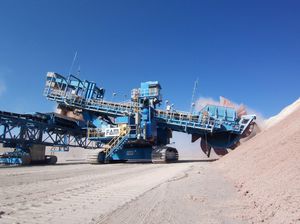
The Joint Stock Company UNEX has been manufacturing bucket wheel excavators for more than 50 years. So you can consider UNEX to be an experienced specialist in manufacturing of large-scale machinery for use in open pit-mines. The UNEX team of well-trained specialists is able and ready to react to all its customers’ individual requirements. More than 130 custom-built excavators and reclaimers can be found in e.g. Czech Republic, Russia and the Ukraine, in Bosnia and Herzegovina, Macedonia, Bulgaria, Poland and Slovakia.
There are two types of bucket wheel excavator: Compact and Classical. The division depends on the possibility of repeated assembly and disassembly.
1. It is not possible to assemble and disassemble the Classical BWE. The excavator moves on either a caterpillar or walking undercarriage. Their capacity ranges from 1 200 to 6 500 m3/h and the specific cutting force from 90 to 168 kN/m. According to the adjustable distance between the wheel and the axis of the machine, classical BWEs are divided into two groups: excavators with a telescopic bucket wheel boom (KU 300 and KU 800) and without a telescopic bucket wheel boom (K 2000).
2. The Compact BWE can be repeatedly assembled and disassembled. Their capacity ranges from 400 to 2 800 m3/h and the specific cutting force from 25 to 145 kN/m.
|
|
Opencast Mining Systems
Opencast mine
Germany
1x bucket wheel excavator SR1301/1532
refurbishing, bucket wheel head with drive unit
driving power of bucket wheel 500 kW
cutting height 26 m
excavation depth 5 m
number of buckets 14
year of construction 1986
coal 3500 m³/h
|
|
Sandvik bucket-wheel excavators are designed to strip overburden and mine coal, lignite and various soft minerals continuously. With capacities from 150-10000 m3/h (loose), they are capable of mining formations with compressive strengths of up to 20 MPa. Controlled by state-of-the art PLC systems with extensive automation possibilities, they have ergonomic, user-friendly interfaces for operator comfort, quick familiarization and sustained high productivity. Since they are of modular construction, Sandvik bucket wheel excavators are easy to optimize for different applications. All units are custom-built and made to order.
Our standard range of compact bucket wheel excavators is designed for small to medium-size opencast mines. All models are of rugged, rational construction, highly productive for their size and weight and very reliable. Models with higher capacities are of the C-frame design. Basic data for the most popular models is given in the table below.
|
|
Bucket wheel and bucket chain excavators are important products designed for mining the overburden. The first bucket chain excavator of our own construction called D 800 was manufactured in 1952, with an output of 1 050 m3/h and moved on rails. The most effective bucket chain excavator is marked RK 5000 and it achieves an output of 5 000 m3/h of excavated overburden.
Our production range covers also the biggest digging wheel excavator of the Czech Republic, the K 10000, which has been working with an output of 10 000 m3/h of excavated overburden in Bílina mine since 1978.
Bucket-chain and bucket-wheel excavators are designed according to specific requests of customers, always with respect to the actual mining conditions in which they will operate.
|
|
|
|
|
|
Bucket Wheel Excavators (BWE) are continuous cutting machines for soft to semi hard materials like clay, sand, gravel, marl and their blendings as well as lignite and hard coal. Tenova TAKRAF Bucket Wheel Excavators excavate a wide range of capacities between 200 and 16000 m³/h and at working bench heights from less than 5 m to maximal 51 m.
The Bucket Wheel Excavator is favorable connected to a belt conveyor system with or without a Mobile Transfer Conveyor intermediately installed or a cross pit spreader transferring the material to the waste dump or the raw material stockpile.
According to local mine conditions Compact and Large Bucket Wheel Excavators are offered - whereas the selection mostly is determined by required cutting height and width (working block).
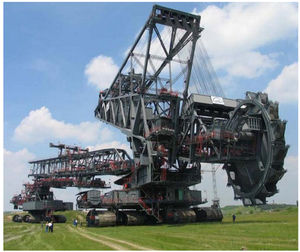
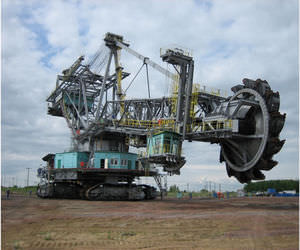
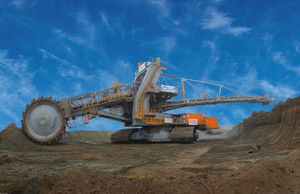
The characteristic parts of a Bucket Wheel Excavator are the cutting wheel with buckets, the wheel boom, the superstructure with counterweight boom, the substructure, the undercarriage with crawler tracks and a transfer boom to the bench conveyor (or a connecting bridge to the loading unit). All main parts are designed to meet the demands of the project regarding optimization, standardization and maintenance. Therefore, Tenova TAKRAF stands with more than 100 years of Bucket Wheel Excavator-experience.
Bucket Wheel Excavators are among the largest terrestrial vehicles ever constructed - the biggest machine built, the Tenova TAKRAF SRs 8000, has a weight of 14.200 t and moves 240,000 m³ of overburden per day.
|
|
|
|
|
|
Bucket wheel excavators (BWE)
The Joint Stock Company UNEX has been manufacturing bucket wheel excavators for more than 50 years. So you can consider UNEX to be an experienced specialist in manufacturing of large-scale machinery for use in open pit-mines. The UNEX team of well-trained specialists is able and ready to react to all its customers’ individual requirements. More than 130 custom-built excavators and reclaimers can be found in e.g. Czech Republic, Russia and the Ukraine, in Bosnia and Herzegovina, Macedonia, Bulgaria, Poland and Slovakia.
There are two types of bucket wheel excavator: Compact and Classical. The division depends on the possibility of repeated assembly and disassembly.
1. It is not possible to assemble and disassemble the Classical BWE. The excavator moves on either a caterpillar or walking undercarriage. Their capacity ranges from 1 200 to 6 500 m3/h and the specific cutting force from 90 to 168 kN/m. According to the adjustable distance between the wheel and the axis of the machine, classical BWEs are divided into two groups: excavators with a telescopic bucket wheel boom (KU 300 and KU 800) and without a telescopic bucket wheel boom (K 2000).
2. The Compact BWE can be repeatedly assembled and disassembled. Their capacity ranges from 400 to 2 800 m3/h and the specific cutting force from 25 to 145 kN/m.
|
|
Opencast Mining Systems
Opencast mine
Germany
1x bucket wheel excavator SR1301/1532
refurbishing, bucket wheel head with drive unit
driving power of bucket wheel 500 kW
cutting height 26 m
excavation depth 5 m
number of buckets 14
year of construction 1986
coal 3500 m³/h
|
|
Sandvik bucket-wheel excavators are designed to strip overburden and mine coal, lignite and various soft minerals continuously. With capacities from 150-10000 m3/h (loose), they are capable of mining formations with compressive strengths of up to 20 MPa. Controlled by state-of-the art PLC systems with extensive automation possibilities, they have ergonomic, user-friendly interfaces for operator comfort, quick familiarization and sustained high productivity. Since they are of modular construction, Sandvik bucket wheel excavators are easy to optimize for different applications. All units are custom-built and made to order.
Our standard range of compact bucket wheel excavators is designed for small to medium-size opencast mines. All models are of rugged, rational construction, highly productive for their size and weight and very reliable. Models with higher capacities are of the C-frame design. Basic data for the most popular models is given in the table below.
|
|
Bucket wheel and bucket chain excavators are important products designed for mining the overburden. The first bucket chain excavator of our own construction called D 800 was manufactured in 1952, with an output of 1 050 m3/h and moved on rails. The most effective bucket chain excavator is marked RK 5000 and it achieves an output of 5 000 m3/h of excavated overburden.
Our production range covers also the biggest digging wheel excavator of the Czech Republic, the K 10000, which has been working with an output of 10 000 m3/h of excavated overburden in Bílina mine since 1978.
Bucket-chain and bucket-wheel excavators are designed according to specific requests of customers, always with respect to the actual mining conditions in which they will operate.
|
|
|
|
|
|
Bucket Wheel Excavators (BWE) are continuous cutting machines for soft to semi hard materials like clay, sand, gravel, marl and their blendings as well as lignite and hard coal. Tenova TAKRAF Bucket Wheel Excavators excavate a wide range of capacities between 200 and 16000 m³/h and at working bench heights from less than 5 m to maximal 51 m.
The Bucket Wheel Excavator is favorable connected to a belt conveyor system with or without a Mobile Transfer Conveyor intermediately installed or a cross pit spreader transferring the material to the waste dump or the raw material stockpile.
According to local mine conditions Compact and Large Bucket Wheel Excavators are offered - whereas the selection mostly is determined by required cutting height and width (working block).
The characteristic parts of a Bucket Wheel Excavator are the cutting wheel with buckets, the wheel boom, the superstructure with counterweight boom, the substructure, the undercarriage with crawler tracks and a transfer boom to the bench conveyor (or a connecting bridge to the loading unit). All main parts are designed to meet the demands of the project regarding optimization, standardization and maintenance. Therefore, Tenova TAKRAF stands with more than 100 years of Bucket Wheel Excavator-experience.
Bucket Wheel Excavators are among the largest terrestrial vehicles ever constructed - the biggest machine built, the Tenova TAKRAF SRs 8000, has a weight of 14.200 t and moves 240,000 m³ of overburden per day.
|
|
... see all the products in the category
Excavators
|
|
|