|
|
|
|
|
|
SmartBlue Digital Cameras
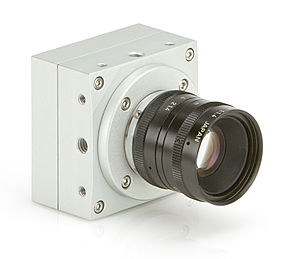
The New SmartBlue digital linescan cameras incorporate the latest in photodiode array technology based on the industry standard Reticon devices with state of the art electronics and a robust industrial camera housing. The linescan photodiode array is a Pinned Photodiode Charge Couple Device which allows for high sensitivity, fast readout, while maintaining high dynamic range, and low image lag. The New SmartBlue cameras are cost effective high performance digital linescan cameras, and feature a CameraLink digital interface. These cameras feature geometrically precise photodiode CCD image sensor with 14 um square pixels with a resolution of 2048 pixels. This “next generation” array can achieve data rates up to 80 MHz with superior noise immunity, precise linearity, and high CTE. The SmartBlue digital cameras are designed for high line rate applications with low to moderate light conditions and where small size, and low cost are required. The two-point Flat Field pixel correction circuits give the user the flexibility of correcting video data to compensate for non-uniformities in lighting, lens, or CCD sensor variations. Adjustable gain and offset controls allow users to compensate for variations in illumination found in the “real-world” applications.
The robust design in conjunction with PerkinElmer’s ultra modern manufacturing techniques allows the SmartBlue™ camera to deliver consistent, reliable performance while the rugged industrial design metal housing provides the maximum protection in a variety of harsh environments and factory floor conditions.
|
|
|
|
|
|
Now we like to present the new HPV-2 high-speed video camera extending capabilities through new technologies and additional features.
The HPV-2 is a PC-controlled camera. Up to four HPV-2's can be synchronised to obtain three-dimensional images or simultaneous images from four different perspectives.
Shimadzu HPV-2 offers ultra-high speed video recording up to one million frames per second (fps) and maintains the excellent spatial resolution at any recording speed. It comprises a new developed single-chip CCD image sensor (IS-CCD). This sensor allows capturing high-speed images even under (a relatively) weak illumination.
Features
* Up to 1 million frames per second frame rate
* Constant resolution regardless of the frame rate
* Capture up to 100 single frames
* Excellent performance under low illumination
The HPV-2 is suitable for wide-range applications in various fields of science and technology, for example, studies on hydrodynamics, destruction processes, shock wave development, visualizing machining processes as well as fast chemical reactions. In the field of life science, medical research and sport science, HPV-2 will be an important tool too.
Often, conventional high-speed video camera resolution drops down as recording speed is increased. The spatial resolution of the HPV-2 does not deteriorate, even at the highest frame rate. The camera maintains excellent 312 x 260-pixel resolution at all recording speeds permitting detailed analysis of high-speed phenomena.
Easy-to-use, multifunction software
|
|
|
|
|
|
Cognex In-Sight® vision systems are unmatched in their ability to inspect, identify and guide parts. These self-contained, industrial grade vision systems combine a library of advanced vision tools with high-speed image acquisition and processing. Best of all, configuring and deploying an In-Sight vision system has never been easier.
Simple-to-follow EasyBuilder® configuration software helps users of all experience levels to quickly setup their entire
In-Sight application-no programming or spreadsheet knowledge required.
The Cognex Connect™ suite of communications capabilities ensures that In-Sight vision systems easily integrate with any factory network or automation control system.
The VisionView® operator display panel provides a "plug-and-go" solution for monitoring the runtime operation of any In-Sight vision system on the network.
Available in a wide range of models to meet any price and performance requirement, In-Sight vision systems set the standard for automated inspection and product quality assurance across a wide range of industries.
|
|
The MultiBlue™ Biotech CCD Camera System offers a broad set of technical features designed to meet the diverse needs of biotech engineers, eliminating the cost and hassle of specialized cameras for different applications.
The MultiBlue™ Biotech CCD Camera offers a IEEE-1394b FireWire interface. This high resolution output is accomplished without cooling of the imager. By designing the MultiBlue™ camera with special attention to thermal handling, PerkinElmer has eliminated the need for an expensive, power-consuming cooling mechanism.
Applications for MultiBlue™ include: Gene research and therapy, genomic/proteomic sequencing and expression, gel documentation and drug discovery.
|
|
|
Complementing PerkinElmer Optoelectronics long history of linear cameras are todays newest and most advanced models: the LC3000 analog, the LD3500 CameraLink and LVDS cameras, and the YD5000 color cameras. Available in a variety of pixel sizes, resolutions, speeds, and outputs, PerkinElmer''s full line of linear cameras find their homes in leading edge applications such as currency inspection, print inspection, postal sorting, small parts sorting, motion picture digitization, glass inspection, and web inspection.
|
|
The SmartBlue digital cameras are designed for high line rate applications with low to moderate light conditions and where small size, and low cost are required.
The New SmartBlue digital linescan cameras incorporate the latest in photodiode array technology based on the industry standard Reticon® devices with state of the art electronics and a robust industrial camera housing. The linescan photodiode array is a Pinned Photodiode Charge Couple Device which allows for high sensitivity, fast readout, while maintaining high dynamic range, and low image lag.
The New SmartBlue cameras are cost effective high performance digital linescan cameras, and feature a CameraLink digital interface. These cameras feature geometrically precise photodiode CCD image sensor with 14 um square pixels with a resolution of 2048 pixels. This "next generation" array can achieve data rates up to 80 MHz with superior noise immunity, precise linearity, and high CTE.
|
|
|
|
|
|
Get the complete information on your target or sample with full resolution images at any wavelength that will change your view of spectral analysis.
Thanks to a unique and patented design based on volume Bragg gratings, Photon etc's Hyperspectral Imager delivers a series of monochromatic images at user-specified wavelengths. This optimized hyperspectral cube allows for spectral analysis of each and every pixel of a full resolution image. No more fastidious x-y scanning of the samples, or limited exposure time of remote sensing acquisition. More than a simple increase in efficiency, getting both the spectral and spatial content will allow you to perform completely new analyses, and push the limit of your most demanding applications.
With narrow resolutions and an operating range of 400 nm to 2.3 µm, our Hyperspectral Imager will boost your Raman imaging, vegeteble cover monitoring, or faint galaxy observation.
First developed for faint object observation in astronomy, this hyperspectral imaging technology has been carried over to a large number of applications, where it has brought new measurement and analysis possibilities.
|
|
|
|
|
|
Kappa introduces a new vision camera based on our modular high-performance platform with 14-bit digitization. The first model, the Zelos-02150 has a GigE Vision interface and offers a resolution of 1920 x 1080p and a frame rate of up to 30 fps. It fulfills all typical Kappa quality characteristics regarding hardiness and longevity.
The camera features several technical highlights. One of them is the 2/3” Kodak sensor KAI-02150, which supports 1080p and excels with an excellent dynamic range and the best image performance. A further plus is the high-performance GigE Vision interface. This creates a perfect combination of a high transfer rate (1 Gbit/s), a low-priced interface on the PC, inexpensive cabling with thin CAT5e cables up to 100 m (300 feet) and a standardized user-friendly communication protocol. The brilliant visualization of the smallest details with the lowest-contrast is the result of the numerous real-time signal processing functions based on a 14-bit digitization. Among the functions are adjustments of different exposure modes, read-out modes (e.g., binning, partial scan), frame rates, gain and exposure settings, measuring window functions, contrast and edge enhancement functions (e.g., histogram equalization), line and circular line generators and dynamic look-up tables. The color processing offers adjustments for the Bayer filter interpolation, color space transformation and color saturation. The modular camera platform can serve different sensors and signal interfaces and thus can fulfill the requirements for machine vision applications as well as applications in defense, aviation and medical imaging.
|
|
|
The i-SPEED camera system can be operated by almost anyone - just power on and it is immediately ready to start capturing your high speed events. No longer do users have to wait for the PC to power up - connection to the RCP (Remote Control Pad) or Olympus CDU (Camera Display Unit) allows full control of all camera functions. Immediate data analysis is possible to allow decision making at the source, making measurements on images that are synchronized to other data events with a live graphical display.
|
|
|
|
|
|
The World's Smallest Video Cameras.
Medigus offers the world's smallest micro cameras. The current offering includes a new revolutionary disposable CMOS camera, which has an outer diameter of only 1.2mm x 5mm long and is by far the smallest camera in the world. In addition the company offers reusable CCD cameras in two sizes: 3.0mm x 3.0mm and 1.8mm x 1.8mm.
The outer diameter size of the recently announced revolutionary disposable camera is only 1.2mm x 5mm long and it by far the smallest video camera in the world. The camera, which is based on an advanced CMOS image sensor, offers high performance at a low cost and combines superb sensitivity, resolution and dynamic sensitivity. The camera is completely disposable eliminating the need for the very costly sterilization process commonly associated with endoscopic procedures. As such, the camera is designed to be incorporated into disposable endoscopes or used in various diagnostic and surgical medical procedures.
The camera is also suitable for industrial applications and can be integrated into borescope, devices for Remote Visual Inspection (RVI), Non-destructive Testing (NDT), Machine Vision systems etc.
In addition, Medigus' CCD cameras (3.0mm x 3.0mm and 1.8mm x 1.8mm) offer excellent image quanlity and are suitable for both medical and industrial applications.
|
|
Shad-o-Box™ X-Ray Cameras
The Shad-o-Box x-ray camera is a stand-alone, high-resolution radiation imaging device complete with 12-bit digital interface. The large active area consists of one or more 512 by 1024 pixel photodiode array sensors with 48 µm pixel spacing. An integral phosphor screen shields the sensor from ambient light and converts incident x-rays or energetic particles to visible light that is sensed by the silicon photodiodes. The Shad-o-Box can be used in a wide range of applications including medical diagnostics, industrial inspection (NDT) and scientific imaging.
|
|
|
|
|
|
Shad-o-Snap™ X-Ray Cameras
The Shad-o-Snap x-ray cameras make up Rad-icon's newest product line of easy-to-use, "smart" USB cameras. These microprocessor-based cameras offer simple timing control combined with new readout modes and easy image transfers as TIFF or raw integer image files. The Shad-o-Snap 1K and 4K cameras also feature our new 10 cm by 10 cm CMOS photodiode image sensor with 96 µm or 48 µm pixel spacing. These sensors feature an integrated direct-contact scintillator that is optimized for high resolution and sensitivity, ideal for applications ranging from biomedical imaging to industrial inspection.
The Shad-o-Snap cameras have been developed with ease-of-use in mind. The USB connection installs in seconds, and built-in Windows drivers are automatically loaded to communicate with the camera. We provide a simple software interface to control the camera and acquire images. Together with a laptop computer and optional battery pack, a truly portable x-ray imaging system can be created.
|
|
|
|
|
|
SkiaGraph X-Ray Camera
The SkiaGraph product line builds on a tiled configuration of RadEye100 image sensors to achieve a total active sensing area of 8" x 8" (20 x 20 cm) and larger. The SkiaGraph cameras feature low power consumption, excellent DQE, and the same flexible readout modes as its predecessors, the Shad-o-Box and Shad-o-Snap camera product lines.
The SkiaGraph8 camera is capable of real-time imaging at up to 1.3 fps, 12-bit digital contrast resolution, 5 lp/mm spatial resolution and features a choice of scintillators providing impressive sensitivity as high as 250 ADU/mR. A GdOS (Gadox) integrated direct-contact scintillator converts x-ray photons into visible light that is sensed by the CMOS photodiodes. Analog signals from the photodiode sensors are subsequently digitized in eight parallel A/D channels and then interleaved for maximum transmission across a high-speed parallel digital interface.
The SkiaGraph8 is optimized for the standard 10-50 kV energy range. An EV model for use with higher x-ray energies or dose rates will be available in early 2009. Several scintillator options are available. The SkiaGraph8 camera ships with a desk-top power supply and our ShadoCam software. A frame grabber and data cable must be purchased separately.
|
|
BOREHOLE CAMERA PASI TC-30
An easy to use instruments to obtain high quality images even in extremely poor light condition. With its semi-rigid fiberglass cable with sliding contacts, our TC-30 TV camera can be easily pushed inside vertical or horizontal holes with small diameter, representing a valid alternative to expensive video-endoscopes.
Available lenghts 30 and 50m.
Each camera is delivered complete of:
• cable reel with sliding contacts
• lighting head with LEDs
• 5,6” LCD TFT external monitor
• centering device
• connecting cables
• USB2 video data acquisition board
• 12V power supply with battery charger
• carrying soft bag
|
|
* Hemispheric camera with 360° allround view for complete room monitoring
* Without mechanically moving parts, robust and maintenance free, for indoor and outdoor (IP65)
* Digital, continuous 8x zoom and panning
* Event-controlled 360° recording, directly in the camera with SD card support
* Alarm functions, speaker and microphone installed
* Perfect design with low installation height for in-ceiling mounting
* Compatible with all D22 accessories
* Internal DVR (16GB), recording without network load
|
|
|
|
|
|
Camera Link is a manufacturer spanning standardized interface for the digital data transfer between camera and frame grabber. Due to high transmission bandwidth Camera Link is predestined for image processing tasks. Further advantages of Camera Link are easy integration and low priced cable concepts. The Kappa 12 Bit digital cameras with CameraLink interface are equipped with Camera Link interface and work according to the base configuration. The camera series is based on variable camera electronics, low power consumption, advanced circuitry, and an extremely rugged design with an excellent signal quality at the same time. The user can choose between color or black-and-white systems, high-quality CCD sensors by Sony and Kodak with megapixel resolution and various interfaces (FireWire/IIDC compatible, CameraLink, GigE).
Kappa CameraLink cameras offer bit rates from 1.5 GBit/s up to 2.7 GBit/s. Camera Link is a registered trademark of the Automated Imaging Association (AIA). New for version 1.2: „Power over CameraLink“. Image information is transmitted parallel to power. A CL frame grabber is always required. For each CameraLink camera a specific configuration file is required. CameraLink also provides RS232 data.
Cable lengths of up to 10 m are possible. Progressive scan CCD, true color quality, megapixel resolution, excellent image quality, 12 bit digitization depth and user-friendly software environment characterize the CameraLink cameras. The customer can choose between 2/3, 1/1.8 and 1/2” CCD sensors, color or monochrome. The brilliant high fidelity color reproduction is achieved by the camera-internal Kappa color processing in real-time.
|
|
|
Camera Link is a high speed communications interface for vision applications. It provides a standard method of communication between digital cameras and frame grabbers.
|
|
|
|
|
|
The World's Smallest Video Cameras.
Medigus offers the world's smallest micro cameras. The current offering includes a new revolutionary disposable CMOS camera, which has an outer diameter of only 1.2mm x 5mm long and is by far the smallest camera in the world. In addition the company offers reusable CCD cameras in two sizes: 3.0mm x 3.0mm and 1.8mm x 1.8mm.
The outer diameter size of the recently announced revolutionary disposable camera is only 1.2mm x 5mm long and it by far the smallest video camera in the world. The camera, which is based on an advanced CMOS image sensor, offers high performance at a low cost and combines superb sensitivity, resolution and dynamic sensitivity. The camera is completely disposable eliminating the need for the very costly sterilization process commonly associated with endoscopic procedures. As such, the camera is designed to be incorporated into disposable endoscopes or used in various diagnostic and surgical medical procedures.
The camera is also suitable for industrial applications and can be integrated into borescope, devices for Remote Visual Inspection (RVI), Non-destructive Testing (NDT), Machine Vision systems etc.
In addition, Medigus' CCD cameras (3.0mm x 3.0mm and 1.8mm x 1.8mm) offer excellent image quanlity and are suitable for both medical and industrial applications.
|
|
IMPACT T-Series Intelligent Cameras (T38)
Pixel resolution: 1600 x 1200
Imager Type: CCD
Imager Size: 1/1.8 inch
Frames/Second: 12
Color: Yes
|
|
IMPACT T-Series Intelligent Cameras (T30)
The broadest range of intelligent camera products, each uniquely positioned to provide the essential features of a full-scale vision system.
- Processor – 1320 MIPS
- Memory – 512 MB RAM, 512 MB Flash
- Size – 137 x 63 x 45 mm
- Weight – 0.37 kg
- Power – 24 VDC / 1.1 A (min)
- Ambient Operating Temperature – 0° to 50° C
|
|
Imaging Module - digital camera for integration
An Imaging Module for digital image acquisition by JENOPTIK is reliable and provide an excellent price-performance ratio. It combines many years of experience in the development, design and production of high-quality image acquisition systems for various branches of industry or science.
If you look for a camera for integration into your system solution, we offer a broad range of products. The OEM camera module can be based on CCD or CMOS Technoloy, can be monochrome or color, can provide cooling or not.
|
|
The World's Smallest Video Cameras for endoscopy.
Medigus offers the world's smallest micro cameras. The current offering includes a new revolutionary disposable CMOS camera, which has an outer diamter of only 1.2mm x 5mm long and is by far the smallest camera in the world. In addition the company offers reusable CCD cameras in two sizes: 3.0mm x 3.0mm and 1.8mm x 1.8mm.
The cameras are a ready for integration into various visulaization and inspection devices, such as endoscopes for medical and industrial applications.
In addition, Medigus offers endoscope design and manufacturing services, using its cameras as well as other proprietary technologies.
|
|
This iShot Imaging rugged, outdoor iBlock camera system integrates the Sony FCB-IX11A NTSC block camera into a water proof, submersible machined aluminum housing with 17 white light LED illumination, durable for a variety of punishing environments.
The illumination ring enhances the performance of the camera and increases the range of applications the camera can be used in by allowing the user to light up the target. Illumination is controlled through the required pendant (sold separately) which provides different stepped levels of light output.
A Turck water proof connector on the rear panel of the housing allows for the single, water proof cable to carry all of the required video signals and power to and from the camera and the pendant, recorder or display of choice.
The standard 1/4-20 mount bracket is located in the center on top of the housing allowing the camera to be positioned on a tripod or other positioning mechanisms.
|
|
|
|
|
|
The World's Smallest Video Cameras.
Medigus offers the world's smallest micro cameras. The current offering includes a new revolutionary disposable CMOS camera, which has an outer diameter of only 1.2mm x 5mm long and is by far the smallest camera in the world. In addition the company offers reusable CCD cameras in two sizes: 3.0mm x 3.0mm and 1.8mm x 1.8mm.
The outer diameter size of the recently announced revolutionary disposable camera is only 1.2mm x 5mm long and it by far the smallest video camera in the world. The camera, which is based on an advanced CMOS image sensor, offers high performance at a low cost and combines superb sensitivity, resolution and dynamic sensitivity. The camera is completely disposable eliminating the need for the very costly sterilization process commonly associated with endoscopic procedures. As such, the camera is designed to be incorporated into disposable endoscopes or used in various diagnostic and surgical medical procedures.
The camera is also suitable for industrial applications and can be integrated into borescope, devices for Remote Visual Inspection (RVI), Non-destructive Testing (NDT), Machine Vision systems etc.
In addition, Medigus' CCD cameras (3.0mm x 3.0mm and 1.8mm x 1.8mm) offer excellent image quanlity and are suitable for both medical and industrial applications.
|
|
|
|
|
|
eyeMAX chip-on-the-tip technology sets new standards in laparoscopy with the latest generation CCD endoscopes. The image sensor, directly fitted within the distal tip of the endoscope, ensures clear and needle-sharp images.
The spirit of vision - Chip-on the tip endoscope. The 10 mm and 5mm laparoscopes are available with an angle of view of
0° and 30°.
Advantages
The 30° version has been provided with a mechanica l image correction system.
The direction of view can be turned through 360° b y rotating
this wheel.
The perfect depth of sharpness adapted for laparoscopy ensures relaxed simple handling during the entire duration of the operation.
Focussing is never required.
A high-contrast image is produced as only one group of optical lenses is located in front of the CCD sensor.
The camera cable and the light guide cable can be removed, which facilitates the hygienic reprocessing.
Two individually programmable buttons remotely control the functions
The unit can be autoclaved and is suitable for machine reprocessing.
|
|
|
DALSA offers the widest range of high-performance CCD and CMOS cameras in the world. What sets our products apart are their unmatched combinations of speed, responsivity, and dynamic range, giving them unrivaled image quality in industrial applications such as semiconductor and wafer inspection, electronics and robotics inspection, and postal and parcel inspection. With features such as 8-, 10-, and 12-bit output, Camera Link ® and GigE interfaces, programmability, built-in configurable flat-field correction and on-board camera diagnostics, DALSA cameras set the performance standard.
|
|
|
|
|
|
The World's Smallest Video Cameras.
Medigus offers the world's smallest micro cameras. The current offering includes a new revolutionary disposable CMOS camera, which has an outer diameter of only 1.2mm x 5mm long and is by far the smallest camera in the world. In addition the company offers reusable CCD cameras in two sizes: 3.0mm x 3.0mm and 1.8mm x 1.8mm.
The outer diameter size of the recently announced revolutionary disposable camera is only 1.2mm x 5mm long and it by far the smallest video camera in the world. The camera, which is based on an advanced CMOS image sensor, offers high performance at a low cost and combines superb sensitivity, resolution and dynamic sensitivity. The camera is completely disposable eliminating the need for the very costly sterilization process commonly associated with endoscopic procedures. As such, the camera is designed to be incorporated into disposable endoscopes or used in various diagnostic and surgical medical procedures.
The camera is also suitable for industrial applications and can be integrated into borescope, devices for Remote Visual Inspection (RVI), Non-destructive Testing (NDT), Machine Vision systems etc.
In addition, Medigus' CCD cameras (3.0mm x 3.0mm and 1.8mm x 1.8mm) offer excellent image quanlity and are suitable for both medical and industrial applications.
|
|
|
|
|
|
|
The sensitivity of the new 12 Bit b/w-camera CF 8 HS is extremely high. A high sensitive sensor in combination with intelligent low-noise circuits raise the sensitivity by 400 %. The Low Light Level Camera is predestined for the observation of objects, rooms and scenes with very low or no illumination such as: Sophisticated CCTV setups, long-range observation tasks and low light applications with short exposures. An automatic iris control allows 24 h operation at any lighting condition in daytime and at night. The CF 8 HS of Kappa avoids blurring of moving objects and noise even in typical low-light level applications. Because of its low weight, small size and rugged design it fits inconspicuously into a variety of systems. Additional features are: variable operation voltage, low power consumption, remote control of parameters by RS 232 (e.g. configurable back light compensation, AIT, AGC, Gamma, horizontal image flip and selectable display windows). Kappa develops and manufactures rugged cameras. Based on a platform strategy Kappa offers rugged cameras with maximum design environment for customer-specific requirements. The modular electronic design with highly linear, low-noise signal processing provides optimum conditions for customized solutions! The customer can select the technical equipment of the rugged cameras: sensor type, signal processing functions, interfaces, communication protocol, electronic design of the camera, cable length, power supply and connectors. The rugged cameras stand out by their rugged quality, on request complying with MIL standards. Due to their rugged construction the rugged cameras resist fluctuations of temperature, shock and vibration.
|
|
|
|
|
|
The GigE uEye® HE industrial camera extends the broad range of USB industrial cameras by powerful models for sophisticated, complex machine vision and image processing applications. The bandwidth is 2.5 times higher than with USB and cable lengths up to 100 m are possible.
The GigE camera is a completely newly developed product whose rich set of features is based on customers needs and introduces a new performance class. The models are equipped with a C-mount lens connector with adjustable mounting dimensions. A symmetrical housing permits mounting at 90/180 degrees without having to create new holders.
Strong communicative skills are another strong point of the GigE camera. Besides a trigger input and a flash output, which are both optically decoupled, the newcomers have a RS232 interface and two GPIO ports that can be used either as digital inputs or digital outputs.
Inside the industrial camera two processor cores provide superior performance. The Plug and Play Camera Manager, self-developed by IDS, makes installation and integration just as easy as with the USB versions. The software development kit is identical, which means that upgrading to the GigE does not require any changes to the application and takes only a few minutes.
GigE uEye UI-6210HE industrial camera models, VGA (640x480)
- 1/2" CCD sensor, global shutter, progressive scan
- max. 75 fps; 122 fps in AOI-mode with 320x240 pixels
- Exposure: 40 µs - 630 ms (freerun mode)
- Binning horizontal and vertical
- AOI horizontal and vertical
- Multi-I/O-Interface
|
|
|
Shoot 1000 frames-per-second with the Phantom HD at 1920 x 1080 and 14-bits-per-pixel and you will need 3.6 GB of memory for each second of recording! A 4-second recording could take up to 15 minutes to save using standard Gb Ethernet. Equip the Phantom HD with a CineMag, and save the shot to non-volatile memory in about 10 seconds.
|
|
|
|