


{{product.productLabel}} {{product.model}}
{{#if product.featureValues}}{{product.productPrice.formattedPrice}} {{#if product.productPrice.priceType === "PRICE_RANGE" }} - {{product.productPrice.formattedPriceMax}} {{/if}}
{{#each product.specData:i}}
{{name}}: {{value}}
{{#i!=(product.specData.length-1)}}
{{/end}}
{{/each}}
{{{product.idpText}}}
{{product.productLabel}} {{product.model}}
{{#if product.featureValues}}{{product.productPrice.formattedPrice}} {{#if product.productPrice.priceType === "PRICE_RANGE" }} - {{product.productPrice.formattedPriceMax}} {{/if}}
{{#each product.specData:i}}
{{name}}: {{value}}
{{#i!=(product.specData.length-1)}}
{{/end}}
{{/each}}
{{{product.idpText}}}


Owing to the anodized coating of the fork head, the bearing is virtually non-wearing.


Clevises DIN 71752 / DIN ISO 8140 / CETOP RP102P are some of the most frequently used linking elements in industry. These parts can be found everywhere where simple movements are required, e.g. linear pulling, pushing or even axle offset ...
mbo Oßwald GmbH & Co KG

MBO Clevises are U-shaped or forked metal connectors to which another part can be fastened by means of a bolt or pin passing through the ends of the connector. Clevises are used commonly in the industry for carrying out pulling, pushing, ...
mbo Oßwald GmbH & Co KG

... required in the area of the cross hole. This tool comes with the corresponding mating pieces and can be easily combined with a clevis instead of a rod end if connections are needed.
mbo Oßwald GmbH & Co KG


The NEFF screw jack accessory range offers an extensive range of accessories for all common accessory parts of a screw jack, from precise pivot bearings to the appropriate grease dispenser. If desired we manufacture tailor-made solutions ...

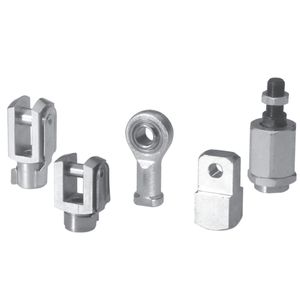

Piston rod attachments, produced according to standards that regulate cylinders manufacturing, allow the cylinder piston rod to couple with the corresponding system that has to be enlivened.


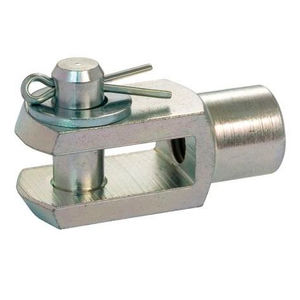


DIN 71752, UNI 1676 thread clevises Technical details DIN - 71752 UNI - 1676


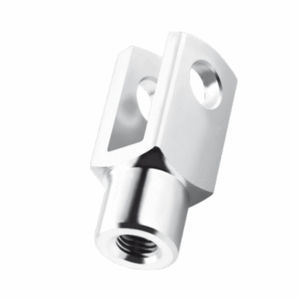

Serie G SIMILAR DIN 71752 and DIN 71752 Manufacturer - Chiavette Unificate S.p.A. Part Number - G4X8
Chiavette Unificate S.p.A.


End Fittings and Mounting Brackets The safe and correct fixing is vitally important for the perfect functioning and a long operational life of the DICTATOR gas springs. An inappropriate fixing means great danger to man and material! Depending ...


CABLECRAFT offers a wide range of performance hardware and end fittings suitable for a great number of operations. It includes products from female threaded eye ends, slip clevises, end rod thread adapters, wire stops or pivots, VLD/LD ...
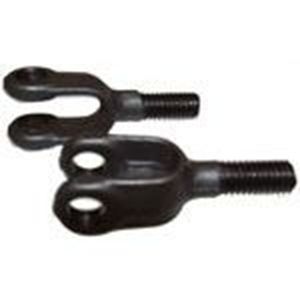

Material: C-1021 Forge Finish: Black Oxide Thread: 2A-UNC Available in FixtureProTM Design Software and PartSpec CD
Jergens, Inc.


This clevis is developed by Chinabase Machinery. It is can be used in numerous kinds of applications with its corrosion resistance feature. This female thread clevis is made of steel materials and is ...
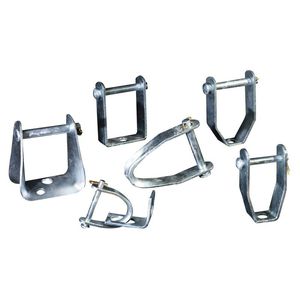

Insulator Clevis used on Electric transmission Material: Carbon steel Surface treatment: Hot Dip Galvanization


Finish: Plated Zinc Clear Description: Patent Pending Articulated Clevis Design.Enables misalignment capabilities with clevis design.
Midwest Control Products
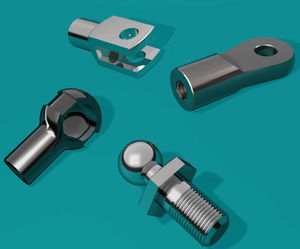

Our end fittings are designed to meet the most common environments and applications. Some of our models are specially designed to fit into our consoles or anchors.
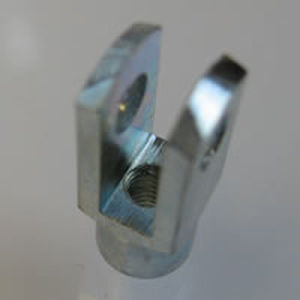

Metal clevis to fit M4 threads. A=16mm Crosshole=4.0mm Material: Zinc plated, yellow or clear passivated mild steel
Industrial Gas Springs


DIN 71752 form G steel version order example: clevis DIN 71752 G 8 x 16 - M 8 Our clevises are also in accordance with DIN ISO 8140 except the chamfer point.
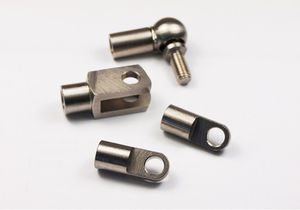

SFC offer a wide range of stainless steel end connectors that will enhance your application. End fittings or end connectors can be both the same or you can choose different sizes and type for each end.


FEMALE FORK STANDARD DIN 71752 MATERIAL 11SMnPb30 (Steel) SURFACE TREATMENT White galvanized
Berardi Bullonerie srl
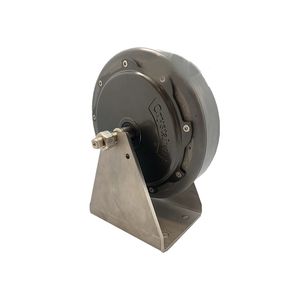

Clevis for 135mm wheel with the possibility to add a torque arm for rolling base, pallet truck, trolleys...
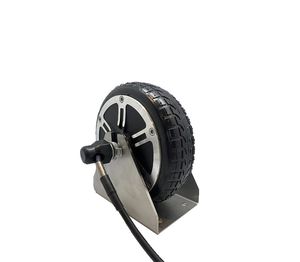
Clevis for135mm wheel with the possibility to add a torque arm for rolling base, pallet truck, trolleys...
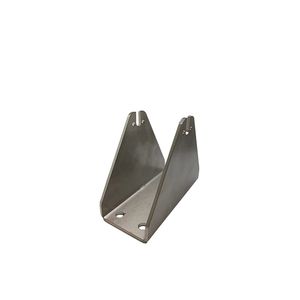
Clevis for 125mm wheel with the possibility to add a torque arm for rolling base, pallet truck, trolleys...
Please specify:
Help us improve:
remaining