|
|
|
|
|
|
SmartBlue Digital Cameras
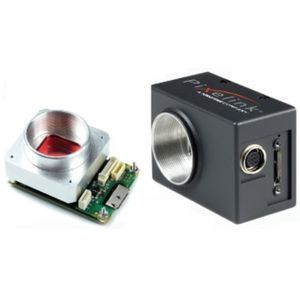
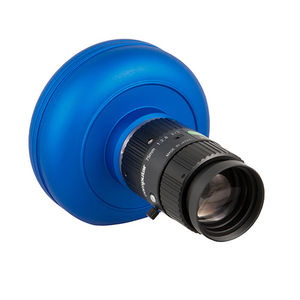
The New SmartBlue digital linescan cameras incorporate the latest in photodiode array technology based on the industry standard Reticon devices with state of the art electronics and a robust industrial camera housing. The linescan photodiode array is a Pinned Photodiode Charge Couple Device which allows for high sensitivity, fast readout, while maintaining high dynamic range, and low image lag. The New SmartBlue cameras are cost effective high performance digital linescan cameras, and feature a CameraLink digital interface. These cameras feature geometrically precise photodiode CCD image sensor with 14 um square pixels with a resolution of 2048 pixels. This “next generation” array can achieve data rates up to 80 MHz with superior noise immunity, precise linearity, and high CTE. The SmartBlue digital cameras are designed for high line rate applications with low to moderate light conditions and where small size, and low cost are required. The two-point Flat Field pixel correction circuits give the user the flexibility of correcting video data to compensate for non-uniformities in lighting, lens, or CCD sensor variations. Adjustable gain and offset controls allow users to compensate for variations in illumination found in the “real-world” applications.
The robust design in conjunction with PerkinElmer’s ultra modern manufacturing techniques allows the SmartBlue™ camera to deliver consistent, reliable performance while the rugged industrial design metal housing provides the maximum protection in a variety of harsh environments and factory floor conditions.
|
|
The SmartBlue digital cameras are designed for high line rate applications with low to moderate light conditions and where small size, and low cost are required.
The New SmartBlue digital linescan cameras incorporate the latest in photodiode array technology based on the industry standard Reticon® devices with state of the art electronics and a robust industrial camera housing. The linescan photodiode array is a Pinned Photodiode Charge Couple Device which allows for high sensitivity, fast readout, while maintaining high dynamic range, and low image lag.
The New SmartBlue cameras are cost effective high performance digital linescan cameras, and feature a CameraLink digital interface. These cameras feature geometrically precise photodiode CCD image sensor with 14 um square pixels with a resolution of 2048 pixels. This "next generation" array can achieve data rates up to 80 MHz with superior noise immunity, precise linearity, and high CTE.
|
|
|
|
|
|
Get the complete information on your target or sample with full resolution images at any wavelength that will change your view of spectral analysis.
Thanks to a unique and patented design based on volume Bragg gratings, Photon etc's Hyperspectral Imager delivers a series of monochromatic images at user-specified wavelengths. This optimized hyperspectral cube allows for spectral analysis of each and every pixel of a full resolution image. No more fastidious x-y scanning of the samples, or limited exposure time of remote sensing acquisition. More than a simple increase in efficiency, getting both the spectral and spatial content will allow you to perform completely new analyses, and push the limit of your most demanding applications.
With narrow resolutions and an operating range of 400 nm to 2.3 µm, our Hyperspectral Imager will boost your Raman imaging, vegeteble cover monitoring, or faint galaxy observation.
First developed for faint object observation in astronomy, this hyperspectral imaging technology has been carried over to a large number of applications, where it has brought new measurement and analysis possibilities.
|
|
|
DALSA offers the widest range of high-performance CCD and CMOS cameras in the world. What sets our products apart are their unmatched combinations of speed, responsivity, and dynamic range, giving them unrivaled image quality in industrial applications such as semiconductor and wafer inspection, electronics and robotics inspection, and postal and parcel inspection. With features such as 8-, 10-, and 12-bit output, Camera Link ® and GigE interfaces, programmability, built-in configurable flat-field correction and on-board camera diagnostics, DALSA cameras set the performance standard.
|
|
Guppy – small, easy, ingeneous
The AVT Guppy family consists of eleven very small IEEE 1394 C-mount cameras, which are equipped with highly sensitive high-quality sensors (CCD, CMOS). Each of these cameras is available in black/white with clear glas filter as well as in color with IR cut filter.
The cameras, operating in 8-bit mode, impress in almost any situation by their ability to produce highly sophisticated images. Due to it's very compact housing, it fits into almost all space requirements in your system. A fine stepped selection of different resolutions below 1 Mpixel (VGA, WideVGA, SVGA, XGA) leaves no wish unfulfilled and provides the right camera for all individual applications. Two additional ultra sensitive interlaced versions (EIA, CCIR) make it even more attractive to switch from analog to digital image processing.
|
|
Carl Zeiss offers a whole camera family in monochrome and color:
The AxioCam HR has a resolution bordering the optical limits with up to 12 Megapixel via Microscanning for your routine and research tasks.
The MR allround-camera is a very economical solution with an adequate resolution for all applications in material analysis.
The AxioCam MRc5 color camera with 5 Megapixel resolution and FireWire-data interface offers quickly generated, high resolution and absolutely color fast images at an excellent price-performance ratio.
|
|
ProgRes® Microscope camera
ProgRes® microscope camera family offers suitable models for all contrast methods in light microscopy. A ProgRes® microscope camera can easily be integrated into each laboratory via C-Mount and Firewire interfaces.
Exact reproduction of colors and finest details in a digital image are basis for demanding analysis and reliable documentation.
In routine, research or fluorescence: the ProgRes® microscope camera family offers the right camera for each application in light microscopy.
|
|
|
The Piranha3 camera family takes imaging to a new level with eight outputs running at 40 MHz and either 8k or 12k resolutions. The camera's 12k resolution surpasses the resolution of any other line scan camera, delivering more detail with fewer cameras in a multi-camera system for measurable cost savings. Additional system cost-savings stem from the Piranha3's superior sensor alignment accuracy, high responsivity and optimized pixel pitch, 5 µm (12k) and 7 µm (8k).
|
|
|
|
|
|
The USB uEye ME - the "Machine Edition" of the already successful uEye family of USB cameras - features a completely new housing concept. With its right angle design, the uEye ME is ideal for vision applications where there are space constraints. In addition, its lockable connectors and the industrial grade metal housing make the uEye ME suitable for vision applications where reliable performance is required under the most strenuous conditions encountered in many industrial environments.
High-quality CCD and CMOS sensors with resolutions from VGA to 5 Megapixels make way for a wide range of applications. Many models are available with colour or monochrome sensors at the same price.
The comprehensive uEye Software Development Kit (SDK) for Windows and Linux is included for free and driver-compatible with all uEye cameras.
USB uEye UI-2230ME industrial camera models, XGA (1024x768)
- 1/3" CCD sensor, global shutter, progressive scan
- max. 30 fps, 78 fps in AOI-mode with 320x240 pixels
- Exposure: 0,066 - 1040 ms (freerun mode)
- Binning vertical
- AOI horizontal and vertical
- Asynchronous, universal trigger
- Digital out
|
|
CCD Controller for Counting Photons (CCCP)
Photon etc's CCD controller counts photons at low intensity by decreasing considerably noises from EMCCD camera. The world's most sensitive astronomical camera has been developed based on this optimized controller for EMCCD camera! The high precision of its electrical signals decreases the noise from Clock-Induced Charges (CIC) while keeping fast readout. Even at high gain, better EMCCD signal-to-noise ratio (SNR) is obtained which allows precision and is less time-consuming for many applications such as astronomy and some medical imaging.
|
|
The AVT Pike family consists of five fast and robust IEEE 1394b (S800) C-Mount cameras, which are equipped with highly sensitive high-quality CCD sensors. Each of these cameras is available in black/white with clear glas filter as well as in color with IR cut filter.
The cameras, operating in 14-bit mode, impress in almost any situation by their ability to produce highly sophisticated images. A wide selection of different resolutions between VGA and 5 MPixel (VGA, 1 MPixel, 1.45 MPixel, 2 MPixel, 4 MPixel and 5MPixel) leaves no wish unfulfilled and provides the right camera for all individual applications.
Due to its IEEE 1394b interface, it provides up to 62.5 MB/s and runs perfectly together with IEEE 1394a products in the same bus system.
|
|
|
|
|
|
|
The camera series of high-resolution digital cameras is based on variable camera electronics, low power consumption, advanced circuitry, and an extremely rugged design with an excellent signal quality at the same time. The integrator can choose between color or black-and-white systems, high-quality CCD sensors by Sony and Kodak with megapixel resolution and various interfaces (FireWire/ IIDC compatible, CameraLink, GigE). The digital PS cameras have been designed especially for software integrations. The matching Kappa sdk3 offers state-of-the-art software environment based on .net and C-API. Together with the sdk or the detailed interface description the PS cameras convince as high-performance components in all measuring and testing machines.Kappa provides machine vision cameras with top-quality Sony sensors or with Kodak sensors with high refresh rate and square pixel matrix. The machine vision cameras offer highly linear, low-noise signal processing in real time. There is a wide choice of interfaces: RS 422, FireWire, CameraLink, Gigabit Ethernet, USB, HD-SDI, LVDS, video etc... The machine vision cameras from Kappa offer high frame rates and megapixel resolution. With 12 bit digitization depth, raw data and a parametrizable signal processing the machine vision cameras provide numerous measurement advantages. The machine vision cameras are compatible with common image processing software solutions. Machine vision cameras are designed for integration into machines and systems.
|
|
|
The Pantera TF 11M4 is an advanced, full frame camera that offers a unique combination of megapixel resolution, fast frame rate, large bit-depth, and a Camera Link interface. The camera's data rate of up to 2 x 36 MHz provides incredible throughput while its 4008 x 2672 pixel resolution enables you to reduce the number of cameras required for large-area surface scanning. With up to 14 bits of output, this camera is capable of discerning the tiniest differences between gray scales. The DALSA-made sensor used in the Pantera TF 11M4 has extremely low noise eliminating the need for voluminous and costly cooling mechanisms.
|
|
DVL Series
LORD's high-sensitivity DVL Series of linescan cameras offer superior imaging performance.
Our linescan cameras feature C or F or Mamiya lens mounts. The standard Camera Link interface makes integration easy into existing systems and increases flexibility when it comes to connecting to various grabbers or changing cameras. Other interfaces are available on request.
|
|
|
|
|
|
Lumenera's Lu160 CCD USB 2.0 Camera
Lumenera’s Lu160 series of megapixel cameras are designed to be used in a wide variety of applications,particularly in low-light conditions and where high dynamic range is required. Both color and monochrome, enclosed and board level product models are available.
This ultra high-performance USB 2.0 camera provides 15 fps at 1392x1040 pixels. Based on a high-quality 2/3" CCD sensor with fast global shutter - ideal for capturing objects in motion. 1.4 megapixel ExView HAD CCD provides capture in the lowest of light conditions with, 8 or 12 bit digital output. I/O control for synchronization with strobe and peripheral devices. Advanced camera functions are available through a comprehensive Software Developers Kit, with sample code and full technical support to quickly integrate camera functions into your application.
CAMERA SENSOR
Image Sensor 2/3" format, color or mono, 10.2mm x 8.3mm array
Effective Pixels 1392 x 1040, 6.45µm square pixels
Frame Rate 15 fps at 1392x1040, 30 fps at 640x480 (binned)
Sensitivity High
Dynamic Range 72dB
Exposure Manual
White Balance Auto / Manual
Dimensions (W x H x D) 2.00 x 2.50 x 1.63 inches
Mass ~150g
Power Requirement External 6VDC, 800mA (included)
Power Consumption ~6.0 Watts
Operating Temperature 0° C to +50° C
Operating Humidity 20%-80%, Non-condensing
Interface Connector Standard USB 2.0
Lens Mount C-Mount
Frame Buffer 1 frame buffer (optional expansion to 12 frames)
|
|
Alta Features
The Alta Design Team worked hard over a two year period to bring this advanced degree of integration and performance to our valued customers. Alta set new standards for imaging performance, connectivity, cooling, compactness, cost effectiveness, and the elimination of external support electronics.
Like the AP and KX series, Alta is a platform, not a CCD or specific interface type. It is designed for a variety of CCDs, ranging from the smallest to those measuring 36mm on a side with 4096 x 4096 arrays.
The Alta platform comes in 3 optical apertures. The D1 systems contain the small-mid size CCDs and maintain C-mount back focal distance. The D2 systems contain larger CCDs up to 28mm on a side. Our D7 systems accommodate very large CCDs such as the Kodak KAF-16801E, KAF-16803, and KAF-09000 sensors. Our newest addition, the D9s, provide the same aperture for these very large CCDs, but provide deeper cooling.
|
|
pixelfly qe
This high performance digital 12bit CCD camera system features state of the art in CCD and electronics technology. The pixelfly qe has an extraordinary quantum efficiency with up to 65%. The system consists of an ultra compact camera head, which either connects to a standard PCI or a compact PCI board via a high speed serial data link. The available exposure times range from 5µs to 65s. A digital temperature compensation is integrated instead of a space consuming thermo-electrical cooling unit. All camera functions can be remotely accessed and controlled via digital interface. This compact digital CCD camera system is perfectly suited for many scientific and industrial imaging applications, like microscopy, spectroscopy and quality control.
|
|
|
|
|
|
Lumenera’s new Lm085 mini CMOS USB 2.0 camera is designed for industrial environments with high contrast-light scenes, tight space constraints, and rugged environmental conditions.
An ultra-wide dynamic range makes the Lm085 an ideal choice for applications with variable lighting conditions, as this camera can provide a dynamic range of 100dB.
The Lm085’s small form factor of 44x44x56mm and robust mechanicals are well suited for conditions where the camera is under sustained vibration, fatigue, and stress from conveyor lines, mechanical arms, mobile vehicles, or gantries that introduce shock and vibration. An electronic global shutter eliminates the smear effect generated by moving objects, while the locking mini USB and RJ45 GPI/O connectors keep cables reliably attached to the camera back plate even in challenging conditions.
When high throughput is essential, the Lm085 provides 60 fps at full 752x480 resolution, and over 100 fps at 376x240 binning mode.
Uncompressed images in live streaming video and still image capture are provided across a mini USB 2.0 digital interface. No framegrabber is required. Advanced camera control is available through a complete Software Developer’s Kit (SDK), with sample code available to quickly integrate camera functions into OEM applications.
Hardware and software based synchronization trigger is provided standard. 32 MB on-board memory is available for frame buffering.
|
|
pco.2000
This high resolution 14bit CCD cooled camera system comprises advanced CCD and electronics technology. With the new approach to integrate the image memory (camRAM) into the camera itself, it enables unmatched fast image recording with 160MB/s. The system features thermo-electrical cooling (delta vs. ambient -50°C), a superior high resolution (2048 x 2048pixel) and low noise (down to 10e- rms). It consists of a compact camera with an external intelligent power supply. The image data are transferred via customer selectable standard data interfaces to a computer (IEEE 1394 (“firewire”), camera link). The available exposure times range from 5µs to 49days (500ns opt.).This digital CCD camera system is perfectly suited for low light camera and piv camera applications.
|
|
|
|
|
|
Lumenera’s INFINITY3-1 Cooled CCD camera is designed to be used in a wide variety of scientific applications. Cooled models are ideal in low-light conditions and where high dynamic range is required. Both color and monochrome product models are available.With 1392x1040 resolution and on-board processing, these cameras deliver outstanding image quality and value for industrial and scientific imaging applications.
Uncompressed images in live streaming video and still-image capture are provided across a USB 2.0 digital interface. No framegrabber is required. Hardware and software based synchronization trigger is available as an option provided. On-board memory is available for frame buffering. INFINITY3-1 model cameras are offered in both enclosed and board-level forms and are fully supported by Lumenera’s INFINITY CAPTURE and INFINITY ANALYZE software. Custom form factor (sizes) can be provided.
All Lumenera products are supported by an experienced team of software developers and application engineers. We understand your imaging needs and are here to help you with your integration and development.
CAMERA SENSOR Image Sensor Sony ICX285 2/3” format, 1.4 megapixel color or monochrome progressive scan CCD sensor
Effective Pixels 1392 X 1040, 1.4 million pixels
Frame Rate 15 fps at 1392x1040, increased through binning and ROI
Digital Output 8 and 12-bit
Dark Current (e-/s) 0.15 electrons / pixel / s when cooled
Pixel Size 6.45µm x 6.45µm
Full well capacity >18,000 electrons
Readout Noise 8 e- rms
Cooling type Hermetically sealed and dry gas filled Peltier cooling to 25 degrees Celsius below ambient
Readout Frequency 28.6 MHZ
|
|
Alta U Series
So many improvements in such a small package: No more external controllers, plug-in cards, or frame grabbers. Dual digitization for high precision plus high speed focus. On-board camera memory for fast local sequences and no worries about transfer interruptions. Time delayed integration for imaging far beyond the size of the sensor. A single 12V power input for optional battery-powered operation.
|
|
Leica DFC300 FX
Digital color camera (c-mount) for fluorescent applications, very high sensitivity, 1.4 MPixel resolution, firewire interface
The Leica DFC300 FX Digital Color Camera specializes in high sensitivity imaging in fluorescence for genetic research, biotechnology and medicine. The Leica DFC300 FX digital camera records live cells, sequences of motion and fluorescence specimens or particles that are susceptible to photobleaching, even at the lowest light intensities. High sensitivity in the visible spectrum ensures reliable results in fluorescence microscopy, especially for GFP and other low illumination applications. The stylish camera housing is lightweight and compact, and easily attaches to your particular microscope (c-mount). The Leica DFC300 FX camera also provides quick transfer for PC and Macs with standard FireWire interface.
|
|
|
|
|
|
pco.1300 oem
This versatile high performance 12 bit CCD camera system is specifically designed for OEM applications. The pco.1300 oem has an extraordinary quantum efficiency of up to 65 %. At the heart of the camera is an FPGA processor allowing for sophisticated control and accurate timing of the CCD and associated electronics. In addition, a proprietary offset control algorithm has been developed which provides very high offset stability, regardless of ambient temperature or signal changes ensuring accurate and repeatable quantitative data over long periods of time. The pco.1300 oem’s most unique feature is its flexibility for customization to fit any OEM user application. ROI, binning, cooling, as well as other features of the camera can be selected and optimized to accommodate the user's application. Camera features excellent resolution (1392 x 1040 pixel), 12 bit dynamic range, exposure time 5 µs to 1 hour, internal frame buffer for continuous image capture (64 MB min), excellent low noise of 8 e¯ rms @ 10 MHz, selectable regulated cooling to -30 ºC vs. ambient, standard interface IEEE1394a, optimal offset stability and control (< 1 count). This low light camera system is perfectly suited for many sensitive and low noise imaging applications, such as biochip reading, fluorescence imaging, confocal & light microscopy etc..
|
|
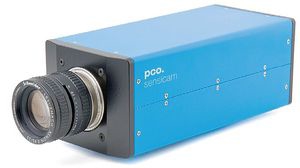
sensicam em
The new generation of electron multiplication (emCCD) CCD sensors is integrated into the proven sensicam camera system. With this on-chip multiplication of the light signal the readout noise of the camera can be neglected ( 50). With its excellent resolution of 1004x1002pixel this high performance cooled digital 12 bit CCD camera system is best suited for extremely low light camera applications. The system features thermo-electrical cooling of the image sensor (delta of -45°C vs. ambient temperature) and an outstanding quantum efficiency (up to 65%) achieving a high spectral sensitivity in general and especially in the NIR. Exposure time modes (software selectable) range from 75 µs - 1h. A high speed serial data link connects the system to the PC (fiber optic link available). This low light emCCD camera system is perfectly suited for scientific imaging (e.g. microscopy, bio marker and label imaging) and for night vision applications.
|
|
Lumenera offers a wide range of cameras based on high performance sensors, providing a variety of unique capabilities to satisfy your imaging applications.
|
|
For many years, Hamamatsu's Imaging Systems have been used on a wide variety of microscopes, from small stereoscopes to huge fully automated microscopes. It does not matter whether they come from Olympus, Zeiss, Leica or Nikon, we support them all. In addition, you can add external peripherals such as shutter, filter wheels, monochromator, etc. to create:
MICROSCOPIC IMAGING SYSTEMS
We have set-up application oriented pages below to guide you through the numerous possibilities of system configurations for the various experiments.
|
|
* 0.5” interline progressive scan CCD with high sensitive 1.4 megapixel resolution
* 40 frames per second for binning mode, 20 fps in full frame mode
* High linearity over the whole dynamic range and minimum noise
* Progressive scan of each exposure provides complete full images without disturbing horizontal skipping artefacts as known from interlaced image sensors
* 12 or 8 bit digitization option allows the selection of the right degree of detail for the particular application.
* Partial Scan Mode: Ultrafast read-out of definable areas at full resolution, also in combination with binning
* Camera power supply and fast data transmission via FireWire IEEE1394 b
* Trigger port for exact synchronization
* Shutter speeds from 4µs to 60 seconds
* Easy installation on to the microscope
* Full system integration in Leica Application Suite (LAS)
* Control of camera via Twain Interface from 3rd party applications
|
|
OEM Solutions
When it comes to integrating vision or optical measurement capabilities into one's original equipment, picking separate components on the sole consideration of their state-of-the-art specifications doesn't make it right every time. When it makes it. What is of utmost importance, rather, is the supplier's skills in sorting out the very requirements that govern the final system performance and customizing the right solution for the right cost.
We specializes in supplying industry OEMs with specific solutions that exactly meet their exact vision or optical application requirements.
Here is one example of customization and application-specific solution
a compact, high sensitivity linescan camera used in sorting applications.
|
|
|
The new mvBlueLYNX design with its fast PowerPC processor covers video sensor and intelligent camera applications. Easy development and smooth integration in your network offer a significant reduction of time-to-market for image processing solutions. The compact, integrated design forms the base for reliable usage in harsh environments.
|
|
|
|
|
|
|
Thanks to its 400 MHz (3,200 MIPS) DSP, the VCLine scan Smart Camera from Vision Components is one of the fastest intelligent cameras on the market. The device supports three integration modes: the free-running mode enables a scan rate of 11 kHz. With a constant integration time, the camera can be triggered externally at a maximum scan rate of 5,5 kHz. A third mode allows for a variable integration time which is determined by external triggering, reaching a maximum scan rate of 11 kHz. The Smart Camera comes equipped with 32 MB DRAM and 4 MB Flash EPROM for program and data storage. It features both an Ethernet and a RS232 interface as well as four digital PLC inputs and four outputs, an image trigger input and a flash trigger output. Due to its small dimensions (90 x 50 x 35 mm), the VCLine can be easily integrated into machines and plants. Like all other Smart Cameras from Vision Components, it is especially suited for use in rugged industrial environments – due to its compact and robust housing, it withstands vibrations and shocks.
|
|
|
|