|
|
|
|
|
|
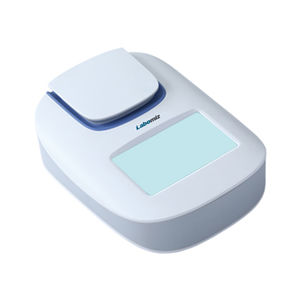
Twinkle, the dedicated fluorometer from BERTHOLD TECHNOLOGIES, has been designed without compromise for a variety of measurement modes to support academic and industrial research centres.
Kinetics, scanning, dual ratio measurements plus top and bottom reading make Twinkle a valuable instrument for any researcher using fluorescence in life science.
The bottom reading is instrument of choice for measurements of adherent cells, coloured medium and lids to achieve the most efficient detection. The instrument can be equipped with temperature control to establish ideal conditions for all cell based applications.
MikroWin software allows easy measurement of different plate formats, e.g. up to 384 well microplates, filters, petri dishes or Terasaki plates. The high quality design is well suited for sensitive FRET assays.
The Twinkle provides highest sensitivity due to Single Photon Counting technology and extremely low noise Photomultiplier. For excitation a Tungsten halogen lamp is used. The instrument is standard equipped with filter pairs for FITC and Umbelliferone.
|
|
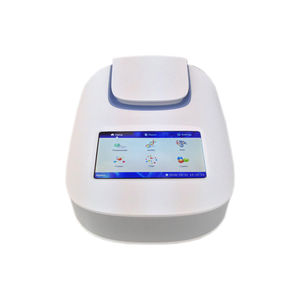
Jenway's new range of filter fluorimeters include three models covering a broad range of applications and options.
Intelligent Filter Modules ensure that the correct filters are always used for your easily defined methods.
Simple raw fluorescence measurements can be made or calibration against one, or up to six, standards will ensure a wide operating range and accurate results in your chosen units of measurement.
Accessories include an electrically heated, temperature controlled sample holder and an automatic sipper pump for discrete or continuous sampling.
These fluorimeters will find application in many applications including water and environmental analysis, molecular biology (DNA/RNA), food and drink analysis and many more...
|
|
The upgrade package for the SLM-4800/48000 and SLM-8000/8100 spectrofluorometers is designed to modernize the instruments manufactured by SLM Instruments, using the state-of-the-art ISS hardware and software for instrument control, data acquisition and data analysis.
Two types of upgrades are available:
Steady-state measurements upgrade
Steady-state and time-resolved measurements upgrade
|
|
The NanoDrop® ND-3300 Fluorospectrometer is a multi-source optical instrument for measuring fluorescence. This space-saving fluorometer offers exclusive features that allow investigators the flexibility to use fluorometry in valuable new ways.
The uniquely clean optics of the patented retention system, combined with virtual filtering (see below) for the white LED applications, enables measurements across a wide range of wavelengths using sample volumes of 1-2 ul without cuvettes and costly filter changes.
The excitation source comes from one of the three solid-state LEDs housed in a block adjacent to the measurement pedestal (see below for more details about the LEDs). Emitted light is collected using the traditional 90° angle from the respective excitation source. A 2048-element CCD array detector, covering 400-750nm, is connected by an optical fiber to the optical measurement surface. The spectrometer is configured with a cut filter to eliminate light transmission below 395 nm.
|
|
The USB2000-FLG is a high-sensitivity spectrofluorometer that is preconfigured for fluorescence applications from 380-1050 nm.
We utilize a proprietary thin film technology and a time-gated spectrometer to provide a spectrofluorometer that is 20 percent more sensitive than the standard USB2000 Spectrometer
Features
AgPlus Mirrors increase system sensitivity by 20% over standard USB2000
Gated mode eliminates scattered excitation light to enhance phosphorescence measurements
Full 380-1050 nm range analysis
|
|
|
|
|
|
Features Include :
- Guaranteed S/N ratio of >6000:1
- Count rates of up to 100MHz
- Resolution from 0.05 – 18nm
- Stray Light Suppression of 1 x 10⁵ (1 x 10¹⁰ optional)
- Automated spectral correction
- Complete PC control
The FS920 is a modular, computer controlled L - geometry spectrometer for acquiring steady state luminescence spectra in the ultraviolet - visible - near infra red spectral range with single photon counting sensitivity. It combines ultimate sensitivity with high spectral resolution and excellent stray light rejection.
The configuration of the FS920 consists of the following hardware :
- Excitation monochromator: 300mm focal length, Czerny-Turner design triple grating turret facility with computer controlled wavelength selection and computer controlled continuously adjustable slits. Stray light rejection 1:105 , resolution down to 0.05nm
- versatile sample chamber with integral controller, safety shutters, signal attenuator and filter holders
- Emission monochromator: 300mm focal length, Czerny-Turner design triple grating turret facility with computer controlled wavelength selection and computer controlled continuously adjustable slits. Stray light rejection 1:105 , resolution down to 0.05nm
- single photon counting stop photomultiplier
- PCS900 card for single photon counting data acquisition
- Dedicated PC running F900 software for comprehensive spectrometer control, performance monitoring, fluorescence spectral data acquisition, correction and analysis library.
|
|
PC1 is a very sensitive, compact, computer-controlled Photon Counting Spectrofluorimeter designed for applications in physical chemistry, biochemistry, physiology, neurochemistry, molecular biology, environmental analysis, and immunoassay research.
Measurements (Steady-State Fluorescence) include:
Corrected excitation and emission spectra
Excitation-emission matrices
Excitation polarization spectra
Polarization (anisotropy) measurements at fixed wavelengths
Millisecond kinetics in photon counting mode
Dual-wavelength ratiometric excitation or emission
|
|
ISS has over 20 years of experience in producing time-resolved instrumentation and has instruments available in both Frequency Domain and Time Domain techniques.
For Frequency Domain, ISS provides the K2 and Chronos. The K2 features automatic instrument control for steady-state and time-resolved fluorescence measurements. The light source for the K2 is typically a xenon arc lamp. The Chronos is based on laser diodes and LEDs. This powerful tool offers all the benefits of a complete time-resolved fluorometer but at an affordable price. The Chronos can be upgraded to steady-state measurements.
For Time Domain, ISS provides the ChronosBH which combines ISS technology with Becker & Hickl electronics for precise TCSPC measurements with a variety of pulsed light sources.
|
|
|
|
|
|
The FL920 is a modular, computer controlled fluorescence lifetime spectrometer. Based on an L - geometry hardware configuration, the FL920 utilises the technique of Time Correlated Single Photon Counting (TCSPC) to measure time resolved luminescence spectra and luminescence lifetimes spanning the range from 100picoseconds to 10microseconds, with the accuracy and the resolution that only the technique of TCSPC can offer.
Features Include :
- Fluorescence lifetimes from 100picoseconds to 10microseconds
- High dynamic range and temporal resolution
- Time Correlated Single Photon Counting operation
- PC plug-in card for TCSPC
- Fully computer controlled through Windows (XP and VISTA 32 bit) software
- Full data reconvolution using a non-linear least square fitting routine
Based on the measurement principle of Time Correlated Single Photon Counting (TCSPC), the FL920 offers the highest dynamic range and temporal resolution available. The system comes complete with our F900 software for comprehensive spectrometer control, data acquisition and decay curve analysis for up to four independent lifetimes. The modular construction of the spectrometer allows easy upgrade routes and customised configurations to suit specific measurement requirements.
|
|
The BTF113 miniature array Spectrofluorometeris a versatile spectrometer forfluorescence application from 200-850nm. Interchangeable excitation narrowline width filters provide the flexibility of2D fluorescence measurement at a verylow cost. An optimally designed collectinglens collects the maximum fluorescencesignal from samples. The user friendlysoftware allows customers tospecify their own parameters for phosphorescencedetection. And, compactmechanical design uses less valuable “Real Estate” whether in the lab or field
Highlights
- Compact design and no moving parts
- 16 Bits A/D Resolution
- Long lifetime pulsed Xenon lamp
- TE cooled and temperature regulated CCD array detection for fi eld use environmental conditions
- Fast warm-up time for fast measuring
- Modular excitation source design for optional wavelengths and replacements
- Optimally designed optics enables high effi ciency and wide linear range detection
- Multifunctional and fl exible
- Best performance to cost ratio
|
|
These instruments are miniature fiber optic spectrometers used to measure fluorescence. They connect to a sampling area using a 1000um fiber optic cable. The units have a spectral range of 350-1000nm or 200-850nm or 250-900nm depending on the model selected. The detector is a highly sensitive Charge Coupled Device (CCD) which provides 7 decades of dynamic range. The spectrograph has a permanently installed slit to set the spectrofluorometer optical resolution to at 6nm.
Operationally, the spectrofluorometer is connected to a fiber optic cuvette sample holder or directly to a fiber optic chemical sensor. In either case, the sample is excited with a specific range of light wavelenths and then monitored for fluorescent emissions at higher wavelengths. Additional optical channels can be attached to configure for traditional dual-beam and other multi-beam process monitor configurations.
|
|
|
|
|
|
The TemPro lifetime system is so affordable that any lab can now exploit the power of fluorescence dynamics using time-correlated single photon counting (TCSPC), the most sensitive method for fluorescence measurements. HORIBA Jobin Yvon now offers this most powerful of time-domain techniques in a compact desktop instrument that can measure lifetimes ranging from picoseconds to seconds. The TemPro takes advantage of interchangeable pulsed laser-diode and LED light-sources covering discrete emission wavelengths from 255 nm to the near-IR.
Product Features:
- Lifetimes from picoseconds to seconds
- Fast, reliable USB 2.0 interface ensures trouble-free data-transfer to laptop or desktop PC
- Complete electronics and analysis software included
- Detector range is 185 to 650 nm
- Optional extended detection to 850 nm
- Measure rotational correlation times using optional polarizers
- Expand the optical system easily into a monochromator-based system capable of Time-Resolved Emission Spectra (TRES)
- Full range of NanoLED and SpectraLED diode light sources from UV to near-IR available as an option
- Optional front-face sample-holder
- Easy upgrades to monochromator-based spectrofluorometer
|
|
The technique of Time Correlated Single Photon Counting (TCSPC) has been developed and introduced more then 25 years ago. The technique is now widely accepted to be the most sensitive fluorescence detection technique with the inherent temporal resolution required for fluorescence decays.
The advent of sub-nanosecond and picosecond pulsed Diode Pumped Solid State Lasers (DPSSL) with appropriate wavelengths, the availability of suitable detectors of sufficiently fast response time, and modern timing electronics that incorporate the complex acquisition technique into one PCI computer board makes it possible to design a very compact Fluorescence Lifetime Measurement Systems for the use in biological environments, medicine, chemical technology semiconductor's nanotechnology, advanced optics materials technology, etc.
|
|
|
The FluoTime 200 spectrometer is a high performance fluorescence lifetime system featuring modular construction, single-photon timing sensitivity and research flexibility. It contains the complete optics and electronics for recording fluorescence decays by means of Time-Correlated Single Photon Counting (TCSPC). The system is designed for use with a femtosecond or picosecond laser system e.g. the picosecond diode lasers from PicoQuant. With the FluoTime 200 decay times down to some picoseconds can be resolved. The system allows operation at more than 80 MHz repetition rate and count rates up to several million counts/second.
|
|
Alba FCS is a dual channel spectrometer that combines a confocal scanning microscope with fluorescence correlation spectroscopy (FCS) and is optimized for both single-photon and multi-photon excitation.
Applications:
Measurement of molecular dynamics
Measurement of kinetic rate constants
Antibody-antigen interactions
Ligand-receptor interactions
Nucleic acid hybridization
Molecular aggregation and polydispersity
Chemical reactions
Measurement Parameters :
a) When using autocorrelation and cross-correlation functions:
Diffusion coefficient
Diffusion time
Concentration
Triplet state decay time constant
Triplet function
Flow rate
Size of excitation volume
Number of molecules
b) When using Photon Counting Histogram (PCH):
Number of molecules
Molecular brightness
|
|
|
|
|
|
Hammamatsu's FCS (fluorescence correlation spectroscopy) system, the C9413, consists of:
Main Unit (detection unit).
The FCS unit consists of a laser to excite fluorescence molecules, a confocal optics to focus laser beams onto a very small volume and a high sensitivity photodetector to detect fluorescence. The laser is a compact, LD-pumped low-noise solid-state laser. The confocal has a simple structure that minimizes optical loss and allows easy alignment of the optical axis. The photodetector is a specially designed module comprised of a photomultiplier tube using a GaAsP photocathode with high quantum efficiency, a cooling element, a high-voltage power supply and a photon counting circuit. The signal output from the photodetector is transferred to a digital correlator installed in a PC for arithmetic operation and analysis.
Digital correlator.
Measurement data counted by the digital correlator is transferred and stored into the main memory of a PC through the PCI interface. Using this data, autocorrelation is then calculated by the CPU in the PC. A molecular model is then fitted to the calculated autocorrelation function to find the number of molecules and translational time. Fitting can be performed on 3 components and a triplet. For example, bound molecules and free molecules have different diffusion times so their fitting profile contains two components being mixed. All measurement data are stored in the memory of the PC and can be further analyzed with your own calculation algorithm.
|
|
|
|