


{{product.productLabel}} {{product.model}}
{{#if product.featureValues}}{{product.productPrice.formattedPrice}} {{#if product.productPrice.priceType === "PRICE_RANGE" }} - {{product.productPrice.formattedPriceMax}} {{/if}}
{{#each product.specData:i}}
{{name}}: {{value}}
{{#i!=(product.specData.length-1)}}
{{/end}}
{{/each}}
{{{product.idpText}}}
{{product.productLabel}} {{product.model}}
{{#if product.featureValues}}{{product.productPrice.formattedPrice}} {{#if product.productPrice.priceType === "PRICE_RANGE" }} - {{product.productPrice.formattedPriceMax}} {{/if}}
{{#each product.specData:i}}
{{name}}: {{value}}
{{#i!=(product.specData.length-1)}}
{{/end}}
{{/each}}
{{{product.idpText}}}


The photodiodes and LEDs from Jenoptik can be easily integrated into your existing systems or adapted to optoelectronic applications, and can also eliminate the need for external filters. Jenoptik Photodiodes ...


The S16008 series is a surface mount type Si photodiode with high sensitivity in the visible to near infrared region. This provides higher sensitivity than the previous S2387 series. Features -High sensitivity in ...
HAMAMATSU

... This high-speed photosensor was developed for optical fiber communication in the 0.85 µm band. This receptacle type Si PIN photodiode is compatible with GI-50 multimode optical fiber. Features - High-speed response: ...
HAMAMATSU

These are premolded package photodiodes that offer low dark current. There is little stray light incident from the side and back of the package to the photosensitive area, and they can measure from low to high illumination ...
HAMAMATSU


IR optical Senser Chip High ESD design, high responsiveness, low dark current, positive illumination type, anode on the front and cathode on the back, round active area size is Ф 1000μ m. It has extremely high responsiveness in the ...
PHOGRAIN TECHNOLOGY(SHENZHEN) CO., LTD.

Description This 25Gbps APD light detector chip is a GSG electrode structure, which is a high-speed avalanche light detector chip with positive light entry, and the photosensitive zone size is Φ16μm. The main features of the product ...
PHOGRAIN TECHNOLOGY(SHENZHEN) CO., LTD.

Description The 25Gbps APD light detector chip is a GS electrode structure, for the front into the light of high-speed avalanche light detector chip, the photosensitive area size is Φ16um, the main characteristics of the product is ...
PHOGRAIN TECHNOLOGY(SHENZHEN) CO., LTD.
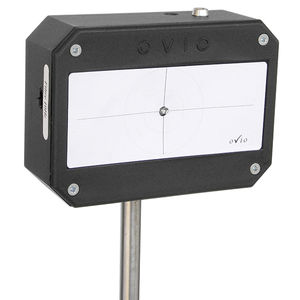


- Digital Diagnostic Devices - Vital Sign Monitoring Features - Package: clear epoxy - ESD: 2 kV acc. to ANSI/ESDA/JEDEC JS-001 (HBM, Class 2) - Enhanced green sensititvity - Especially suitable for applications from 400 nm to ...


Silicon PIN Photodiode FEATURES Package type: surface-mount Package form: 1206 Dimensions (L x W x H in mm): 4 x 2 x 1.05 APPLICATIONS High speed photo detector
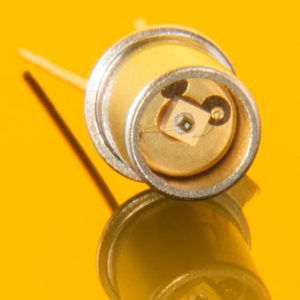

The SG01S-18 is a broadband SiC UV photodiode that provides the unique property of extreme radiation hardness, near-perfect visible blindness, low dark current, high speed and low noise. These features make SiC the best ...
Scitec Instruments


PD-LD Inc. offers a variety of standard and custom PIN Photodiodes and APDs is fiber coupled packages, of proven manufacture and design. Our Germanium devices are suitable from 800 to 2100nm. All devices are available ...
PD-LD
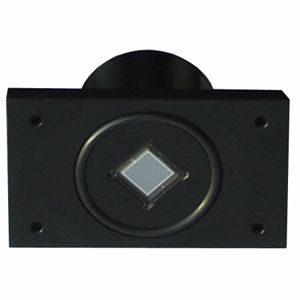

The DH-Si is a general purpose UV-enhanced silicon photodiode offering excellent linearity and low noise over the wavelength range of 200-1100nm. In addition to its' use throughout the UV-NIR range, the DH-Si, in certain ...



he high-reliability Lumentum 1310/1550 nm 10G XFP ROSA receiver optical sub-assembly (ROSA) product, designed specifically for the XFP transceiver, provides excellent performance over extended operating temperatures in high-speed applications ...
LUMENTUM


Silicon Avalanche Photodiodes Si-APD are suitable for the spectral range from 255 nm to 1100 nm. Wide range of APDs Since the foundation of Laser Components Detector Group Inc. in 2004 we have built a product range ...
LASER COMPONENTS


Report of Signal conditioning for a UV Senso - Gallium Nitride Based Material - Schottky-type Photodiode - Photovoltaic Mode Operation - Good Visible Blindness - High Responsivity & Low Dark Current ...
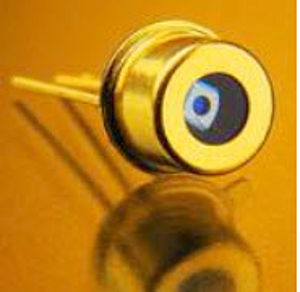
A photodiode is an electronic component composed of two semiconductors (p-n junction) which transforms light (photons) into an electrical signal (electrons).
ApplicationsThe photodiode is used principally to detect and measure radiation. For example, the indium-gallium-arsenide (InGsAs) photodiode is a near-infrared (NIR) detector used to measure the power of a laser beam, in infrared spectroscopy and in optical communications.
TechnologiesThis device is a member of the photodetector family, as are phototransistors, photoconductors and photovoltaic cells. Many different materials can be used in its fabrication, the choice determining the range of detectable wavelengths. For example, PbSe, InSb and InGaAs versions are sensitive to the infrared spectrum. Most are manufactured using MOS technology, while others use BICOMS or bipolar technologies.
How to chooseThe wavelength to be detected will determine the materials to be used. Constituents also govern photosensitivity. Dark current characteristics also should be considered.
- Sensitivity
- Price
- Broad detection range
- Dark current
Please specify:
Help us improve:
remaining