


{{product.productLabel}} {{product.model}}
{{#if product.featureValues}}{{product.productPrice.formattedPrice}} {{#if product.productPrice.priceType === "PRICE_RANGE" }} - {{product.productPrice.formattedPriceMax}} {{/if}}
{{#each product.specData:i}}
{{name}}: {{value}}
{{#i!=(product.specData.length-1)}}
{{/end}}
{{/each}}
{{{product.idpText}}}
{{product.productLabel}} {{product.model}}
{{#if product.featureValues}}{{product.productPrice.formattedPrice}} {{#if product.productPrice.priceType === "PRICE_RANGE" }} - {{product.productPrice.formattedPriceMax}} {{/if}}
{{#each product.specData:i}}
{{name}}: {{value}}
{{#i!=(product.specData.length-1)}}
{{/end}}
{{/each}}
{{{product.idpText}}}


Temperature: 90 °C - 150 °C
KLIXON® automatic motor protectors (AM series) are small, light weight and sensitive to temperature and current. The sealed steel cases will stand most dip and bake processes and can be mounted directly on motor windings for fast detection ...
Sensata Technologies

Temperature: 90 °C - 150 °C
KLIXON® automatic motor protectors (AM series) are small, light weight and sensitive to temperature and current. The sealed steel cases will stand most dip and bake processes and can be mounted directly on motor windings for fast detection ...
Sensata Technologies

Temperature: 90 °C - 150 °C
KLIXON® automatic motor protectors (AM series) are small, light weight and sensitive to temperature and current. The sealed steel cases will stand most dip and bake processes and can be mounted directly on motor windings for fast detection ...
Sensata Technologies


Temperature: 60 °C - 190 °C
EPHYMESS PTC thermistors are predominantly motor protection PTC thermistors as per DIN 44081/44082 that are used in the winding of electric motors, generators and transformers. Combining a motor protection ...
EPHYMESS GmbH

Temperature: -55 °C - 190 °C
EPHYMESS PTC thermistors are predominantly motor protection PTC thermistors as per DIN 44081/44082 that are used in the winding of electric motors, generators and transformers. Combining a motor protection ...
EPHYMESS GmbH

Temperature: 60 °C - 200 °C
... mechanical protection. The outstanding electrical insulation also enhances the thermometer’s resistance to high voltages. PTC thermistors in ceramic sleeves are therefore predominantly used for installation in the winding ...
EPHYMESS GmbH


Temperature: -55 °C - 150 °C
Auxitrol Weston has supplied high quality/high accuracy thermistor probes for use in aerospace applications including cockpit air temperature, galley air temperature and cabin air temperature for over 30 years. These ...


Temperature: 0 °C - 100 °C
... C accuracy from 0 °C to 60 °C in a calibrated thermistor probe for about one-third the cost of an uncalibrated SPRT alone? Each temperature thermistor probe uses an ultra-stable glass thermistor ...


Temperature: -55 °C - 150 °C
NCG series / NTC thermistors SMD type / for temperature sensing (Conductive Glue) NCG series is a temperature sensor of a chip type. NCG series can use for wide temperature sensing and compensation. Available Market ...
Murata Electronics


Temperature: -25 °C - 150 °C
Vishay delivers high sensitivity and accuracy with its thermistor and sensor products. These products are ideal when fast response time, limited space, high reliability, or wide temperature range is required.
VISHAY


Temperature: -50 °C - 125 °C
Model TS665 and TS667 offer extremely sensitive NTC thermistors for applications with small temperature changes. Model TS667 also features waterproof construction, making it suitable for continuous immersion.


Temperature: 7 °C - 135 °C
Mobile Electronics,Consumer equipment Please refer to Our Website and specifications, etc. for information about the performance, functions, quality, management, and safety required for the above applications, and use Products after ...
IPDiA
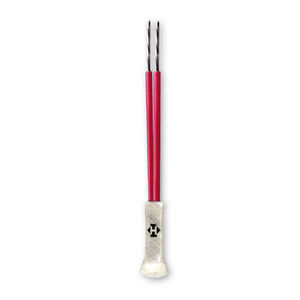

Temperature: 70 °C - 180 °C
Insulation material: Mylar-Nomex Nominal response temperature: 70 C - 180 C Operating voltage: 2.5 VDC - 30 VDC Max. operating voltage:30 VDC Max. recomended sensor voltage: 2.5 VDC - 7.5 VDC High voltage insulation: 2,5 kV Length of ...
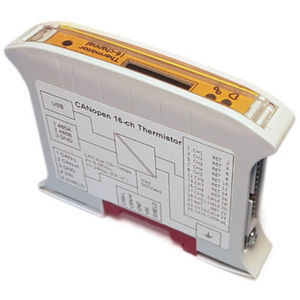

... design; this CANopen® interface for 16 thermistors. Note that this device is not particularly intended for high-accuracy applications, mostly because that does not fit the capabilities of low cost NTC thermistor ...


Temperature: 60 °C - 180 °C
Application: The sensors can be widely used at those work sites which need overheat protection. When the sensors are fixed in those facilities that need overheat protection, they are able to keep the facilities from accidents and damages ...


Temperature: -40 °C - 250 °C
Focus Sensing and Control Technology Co.,LTD
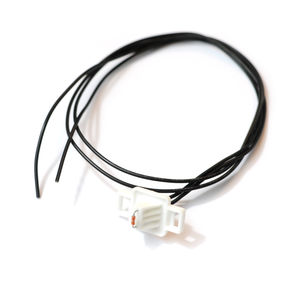

Temperature: -50 °C - 300 °C
... to learn more. CP series: Selco Products’ custom NTC thermistor probes are custom built, durable, accurate, and reliable. Selco Products offers design services to help develop custom thermistor probe ...
Selco Products


Temperature: -55 °C - 125 °C
Features SMD type thick film NTC chip thermistors. Thinner (0.5mm in 1608, 2012 sizes,0.6mm in 3216 size) than the multilayer type. Excellent mountability due to higher mechanical strength. Excellent mountability ...


Temperature: -40 °C - 125 °C
The TT1 series NTC Disc Thermistors are available in wide range of sizes and resistance characteristics as a bare discs and in leaded configuration. Available with tinned copper bare wire and stranded copper leads with ...
TEWA Sensors
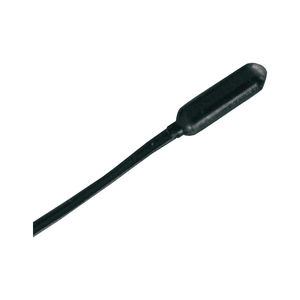

ELECTRICAL CONNECTION wiring and connector SENSING ELEMENT NTC -PTC- PT100- PT1000
Euroswitch


Temperature: -40 °C - 125 °C
FEATURES NEGATIVE TEMPERATURE COEFFICIENT FAST RESPONSE TO TEMPERATURE VARIATIONS MAKE THEM IDEALLY FOR TEMPERATURE SENSORS AND COMPENSATORS STANDARD EIA 0402, 0603 AND 0805 SIZES NICKEL BARRIER SOLDER PLATE TERMINATIONS TAPE AND ...


Temperature: -55 °C - 300 °C
Littelfuse low cost glass encapsulated thermistors are manufactured using super stable NTC chips which are hermetically sealed in a glass (DO-34 diode style) package. The result is a device which exhibits excellent long ...
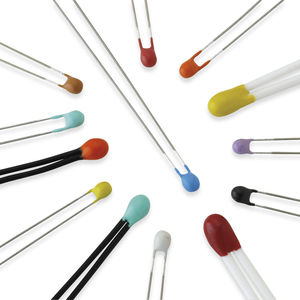
Temperature: -55 °C - 150 °C
Littelfuse miniature leaded epoxy coated thermistors are manufactured using the same state of the art manufacturing techniques as those used to produce Littelfuse precision interchangeable devices. This results in devices ...


Temperature: -40 °C - 175 °C
... abnormal currents, including surge currents when energized. Inrush Current Limiting NTC Thermistors used as current protection devices are also called power thermistors. ● Wide Product Diameter Range ...

Temperature: -40 °C - 175 °C
... abnormal currents, including surge currents when energized. Inrush Current Limiting NTC Thermistors used as current protection devices are also called power thermistors. ● Wide Product Diameter Range ...
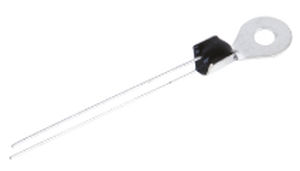

Temperature: 70 °C - 120 °C
Connected to the relays it protects motors against overtemperature. PTC : Positive temperature coefficient. PTC 120, for INTERNAL mounting. Temperature threshold 120ºC. PTCEX 70, for EXTERNAL mounting. Temperature ...
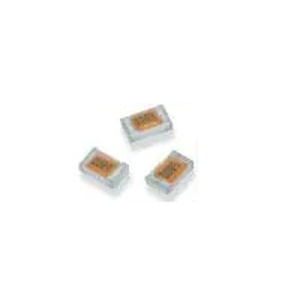

1K Ω Thermistor, 0805, Positive Temperature Coefficient, 5 %, Citec LT73 • TE Internal Description: LT73 3000 2A 1K0 5% 4KRL • Alias #: LT7330001K0JTG LT7330002A1K0JTG • Resistance Value (Ω): 1K • Package Size Code : ...


Temperature: -40 °C - 125 °C
... TDK Corporation (TSE:6762) has announced the introduction of its new NTCWS series of NTC thermistors, available with Au wire bonding. These bondable NTC thermistors can be mounted with Au wire bonding ...
TDK Electronics Europe
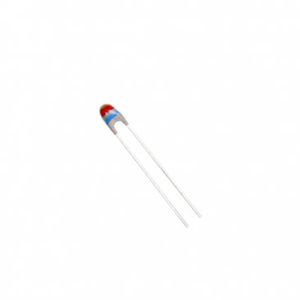

Battery Thermistor for most Snap-On & Craftsman Drill Packs If you're rebuilding a Snap-On or Craftsman battery pack you'll need to replace the existing thermistor with a new one.

Temperature: -90 °C - 130 °C
... typically used in thermistors is either a ceramic or polymer. Material allows for thermistors to typically achieve a higher precision within a limited temperature range, typically −90 °C to 130 °C. We ...

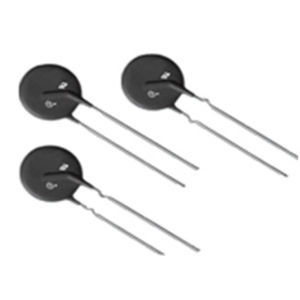
A thermistor is a resistor whose electrical resistance varies with temperature. The two main types are positive temperature coefficient (PTC) and negative temperature coefficient (NTC) versions.
ApplicationsThese devices are used to monitor temperature in engine protection and fire alarm systems. In electronics, they prevent excess voltage and act as temperature compensators. Very small models are suitable for use with surface mounted devices.
TechnologiesSuch thermal resistors consist of metal oxide or silicon encased in a small epoxy or glass bead. The resistance of PTC thermistors increases with increased temperature, while that of NTC models decreases as temperature rises. They are more accurate than resistance thermometers, but operate over a narrower range of temperatures, from about -90 to 130° C.
Please specify:
Help us improve:
remaining