


- Metrology - Laboratory
- Metrology and Test Equipment
- Abrasion tester
- Taber Industries
Abrasion tester 17 series


Add to favorites
Compare this product
Description
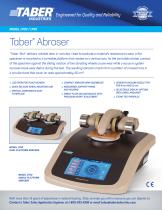
The TABER® Rotary Platform Abrasion Tester - Model 1700 / 1750 is commonly referred to as the Taber Abraser (Abrader) or Rotary Platform Dual (Double) Head Tester. First introduced in the 1930's, this precision built instrument was developed to perform accelerated wear testing. Capable of providing reliable data in a matter of minutes compared to the years that may be required by in-use testing, the Taber Abraser (Abrader) rapidly became the world standard for evaluating abrasion resistance.
Since its inception, the Taber Abraser has been used for quality & process control, research & development and material evaluation. Used to test a wide spectrum of materials, the instrument has been referenced in numerous standards and specifications (including plastics, coatings, laminates, leather, paper, ceramics, carpeting, safety glazing, etc.).
Description
Taber tests involve mounting a flat specimen approximately 100mm square or round to a turntable platform that rotates on a vertical axis at a fixed speed. The standard material thickness that can be evaluated with the Taber Rotary Abraser is 6.35 mm (materials greater than 6.35 mm but less than 40 mm can be tested with optional accessories). Two genuine Taber abrasive wheels, which are applied at a specific pressure, are lowered onto the specimen surface.
Characteristic rub-wear action is produced by contact of the test specimen against the sliding rotation of the two abrading wheels. As the turntable rotates, the wheels are driven by the sample in opposite directions about a horizontal axis displaced tangentially from the axis of the sample.
VIDEO
Catalogs
Other Taber Industries products
WEAR / ABRASION


Related Searches
- Test machine
- Material testing machine
- Automatic test machine
- Automatic test equipment
- Micrometer
- Manual test kit
- Resistance test machine
- Mechanical test machine
- Manual test machine
- Torsion test machine
- Precision test equipment
- Material test equipment
- Analog micrometer
- Leather test machine
- Electrical resistance test equipment
- Quality control test equipment
- Abrasion tester
- Abrasion and wear testing machine
- Research and development test kit
- Film test equipment
*Prices are pre-tax. They exclude delivery charges and customs duties and do not include additional charges for installation or activation options. Prices are indicative only and may vary by country, with changes to the cost of raw materials and exchange rates.