
- Home page
- buying guide
- industrial motor
industrial motor
industrial motor: A technical guide
4 Criteria to choose your industrial motor
Energy Efficiency Class
Efficiency ratings directly dictate long-term operational costs and compliance with European Ecodesign and American NEMA premium standards.
Torque Speed Load Profile
Matching the motor's torque curve to load requirements prevents mechanical failure and ensures stable production throughput.
Ingress Protection Rating
Protection levels determine suitability for harsh washdown food environments or dusty heavy industrial manufacturing conditions.
Duty Cycle Thermal Rating
Thermal management and duty ratings prevent overheating during continuous operation or high-frequency start-stop production cycles.
Available technologies and advantages
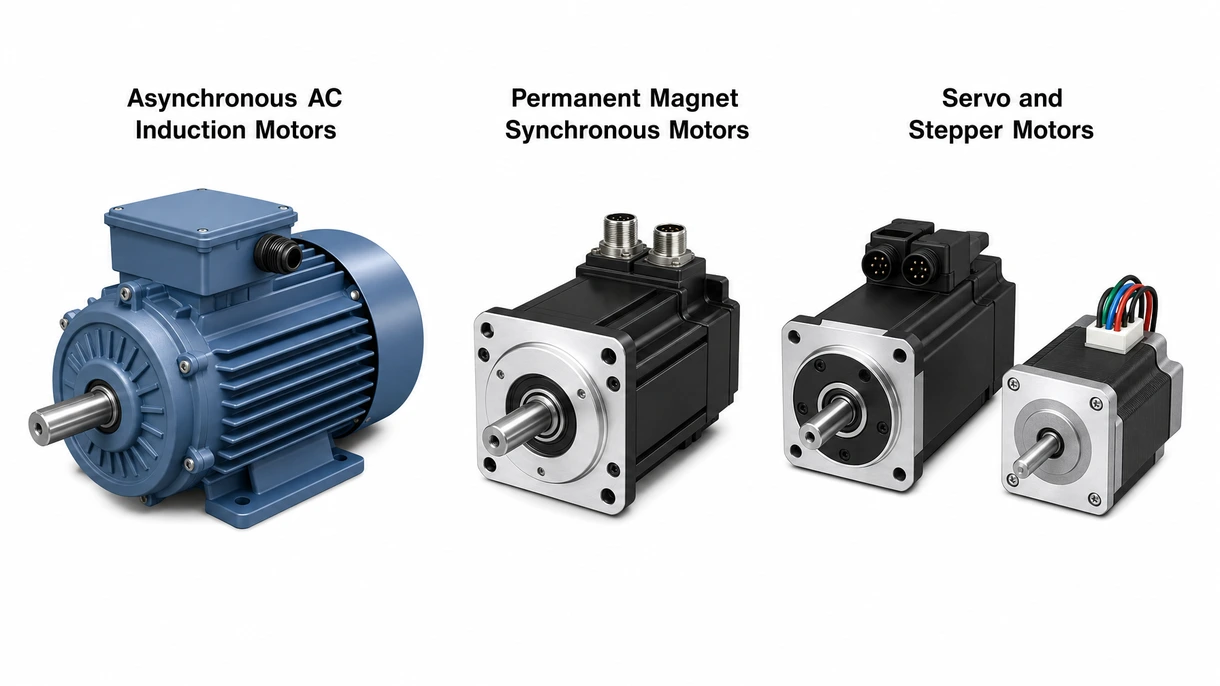
Asynchronous AC Induction Motors
Asynchronous designs dominate industrial grids due to robust simplicity, offering cost-effective reliability for constant speed fans and pumps. They provide high durability but exhibit lower partial-load efficiency.
Permanent Magnet Synchronous Motors
These provide superior power density and high efficiency across variable speeds, though they require sophisticated electronic drive control. They offer compact footprints but rely on expensive magnetic materials.
Servo and Stepper Motors
Designed for high-precision motion control, these systems trade high torque at low speeds for positioning accuracy. They ensure exact repeatable movements but require complex integration and feedback loops.
6 expert tips
Prioritize ultra-premium efficiency classes to minimize total cost of ownership through significant electricity consumption reductions.
Conduct a complete load profile analysis to avoid motor oversizing which leads to poor power factor performance.
Integrate variable frequency drives to optimize energy use and reduce mechanical stress during startup and shutdown sequences.
Select modular frame designs to simplify replacement and ensure compatibility with existing international NEMA or IEC mounting.
Invest in integrated thermal and vibration sensors to enable predictive maintenance and prevent unscheduled production line downtime.
Always verify the technical certification to ensure compliance with local building safety standards and long-term durability.
Innovations and Trends
Virtual modeling allows for real-time performance simulation and proactive mechanical adjustments to optimize throughput and energy efficiency.
New ferrite and synchronous reluctance technologies mitigate supply chain risks while meeting strict international environmental sustainability goals.
Smart sensors process vibration data locally to provide immediate health status updates and reduce network bandwidth requirements.
The transition to ultra-premium efficiency standards helps corporations meet tightening carbon neutrality mandates and industrial regulations.
*Prices are pre-tax. They exclude delivery charges and customs duties and do not include additional charges for installation or activation options. Prices are indicative only and may vary by country, with changes to the cost of raw materials and exchange rates.
About DirectIndustry
DirectIndustry is a marketplace that offers B2B players a complete experience, from product sourcing to purchase. DirectIndustry is an entity of VirtualExpo Group.
Are you a buyer?
Are you a supplier?
About Us
- VirtualExpo Group
- Our Partners
- Recruitment
- Testimonials