
- Home page
- buying guide
- hydraulic press
hydraulic press
hydraulic press: A technical guide
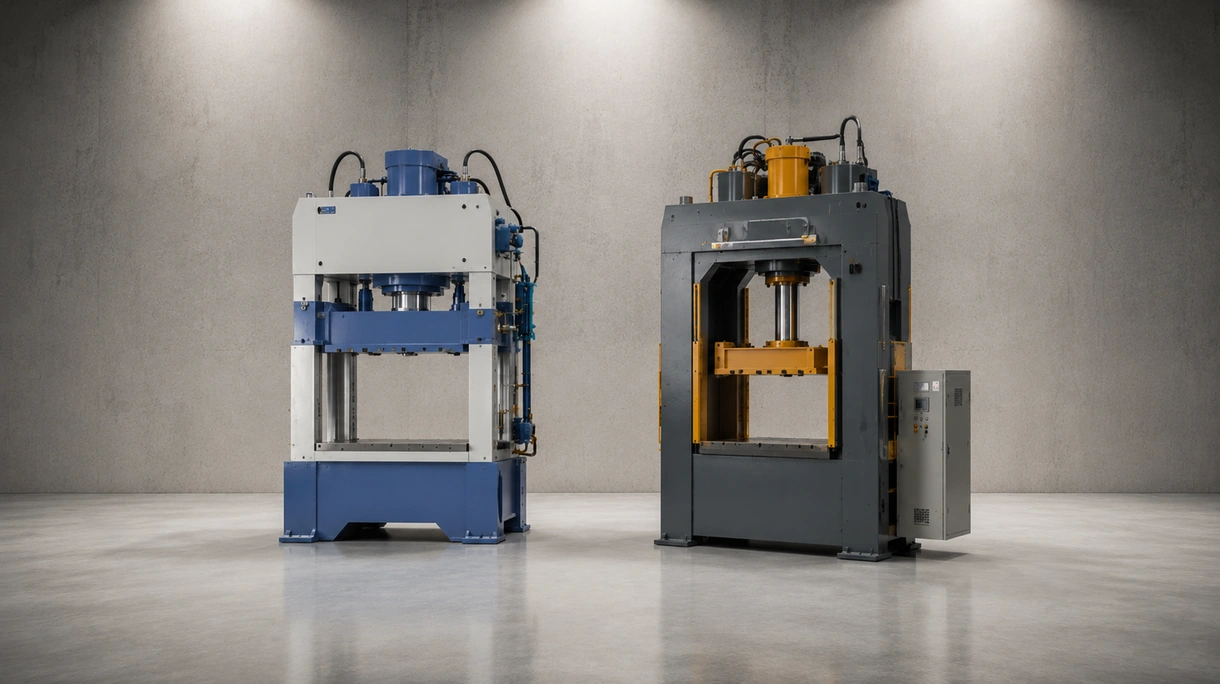
4 Criteria to choose your hydraulic press
Nominal Tonnage Capacity
Determines maximum force exerted for specific material thicknesses to avoid frame deflection and ensure consistent part quality across cycles.
Vertical Daylight Opening
Clearance between the bolster and ram must accommodate total tool height plus part clearance for efficient loading and extraction.
Approach Pressing Speed
High speed cycles improve throughput while controlled pressing speeds prevent material fracture and ensure uniform deformation in precision operations.
Frame Deflection Rating
Structural stiffness under maximum load dictate tool alignment longevity and final dimensional accuracy of processed industrial components during runs.
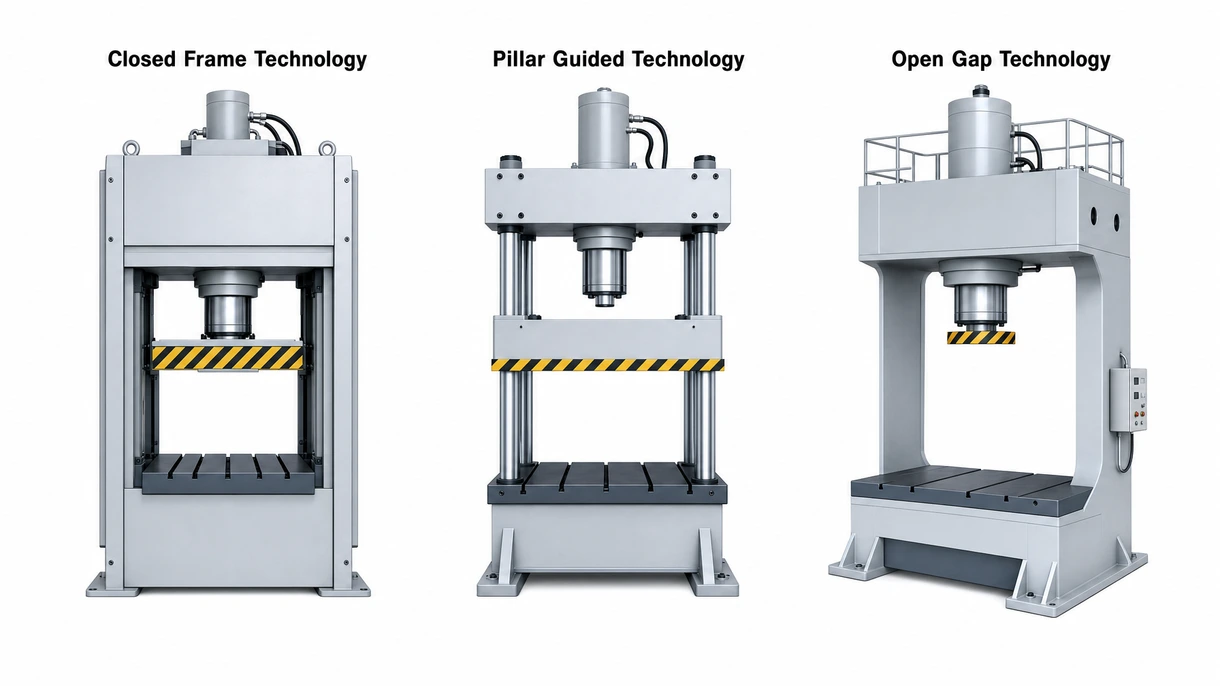
Available technologies and advantages
Closed Frame Technology
Featuring a fully enclosed steel welded structure these units provide maximum stiffness and minimal deflection under load. They offer superior stability for heavy stamping but restrict side access. The rigid architecture ensures prolonged tool life and extreme precision during high tonnage operations. Operational trade-offs include restricted material feeding paths and significantly higher machine weight requirements.
Pillar Guided Technology
These systems utilize precision machined pillars to guide the bolster ensuring balanced load distribution. They offer excellent accessibility for automation but require frequent maintenance on bushings. Superior accessibility allows for seamless robotic integration and oversized dies. However, the design trades structural rigidity for flexibility, requiring careful load balancing to prevent pillar fatigue.
Open Gap Technology
This configuration maximizes floor space efficiency and provides multi sided access for manual or automated part feeding operations. Their design allows for some angular deflection under heavy pressure. Users benefit from compact footprints and low acquisition costs for light assembly. The primary limitation involves frame yawning which restricts these machines to lower tonnage precision tasks.
6 expert tips
Prioritize integrated servo hydraulic systems to significantly reduce energy consumption while maintaining precise control over complex stamping and forming cycles.
Select machines with modular hydraulic manifolds to simplify maintenance procedures and decrease downtime during critical production line failures.
Calculate total cost of ownership by including long term fluid filtration requirements and cooling system efficiency for continuous operation.
Evaluate control interface compatibility with existing factory automation protocols to ensure seamless data logging and predictive maintenance monitoring.
Ensure structural frames are stress relieved after welding to prevent geometric warping and maintain high precision throughout the machine life.
Always verify the technical certification to ensure compliance with local building safety standards and long term durability.
Innovations and Trends
These technologies reduce electricity usage by substantial energy portions through on demand motor speed control and regenerative braking cycles.
Virtual modeling enables real time monitoring of structural stress and thermal expansion to optimize tool life and production precision.
Modern valves provide micron level position accuracy allowing for the processing of sensitive high strength alloys in professional applications.
Evolving regulatory standards require integrated redundant channel monitoring to prevent unintended ram movement and ensure operator protection protocols.
*Prices are pre-tax. They exclude delivery charges and customs duties and do not include additional charges for installation or activation options. Prices are indicative only and may vary by country, with changes to the cost of raw materials and exchange rates.
About DirectIndustry
DirectIndustry is a marketplace that offers B2B players a complete experience, from product sourcing to purchase. DirectIndustry is an entity of VirtualExpo Group.
Are you a buyer?
Are you a supplier?
About Us
- VirtualExpo Group
- Our Partners
- Recruitment
- Testimonials