
- Home page
- buying guide
- simulation software
simulation software
simulation software: A technical guide

4 Criteria to choose your simulation software
Multi-physics integration capability.
Seamlessly coupling thermal, structural, and fluid dynamics ensures accurate performance validation for complex heavy industrial equipment and machinery.
Hardware-in-the-loop connectivity.
Direct connection to industrial controllers allows virtual commissioning, reducing physical prototyping costs and startup time for automated lines.
High-fidelity solver scalability.
Support for high-performance computing enables massive parallel processing of complex finite element models without compromising results accuracy.
Digital twin synchronization API.
Bi-directional data flow between physical sensors and virtual models facilitates real-time predictive maintenance and operational optimization strategies.
Available technologies and advantages
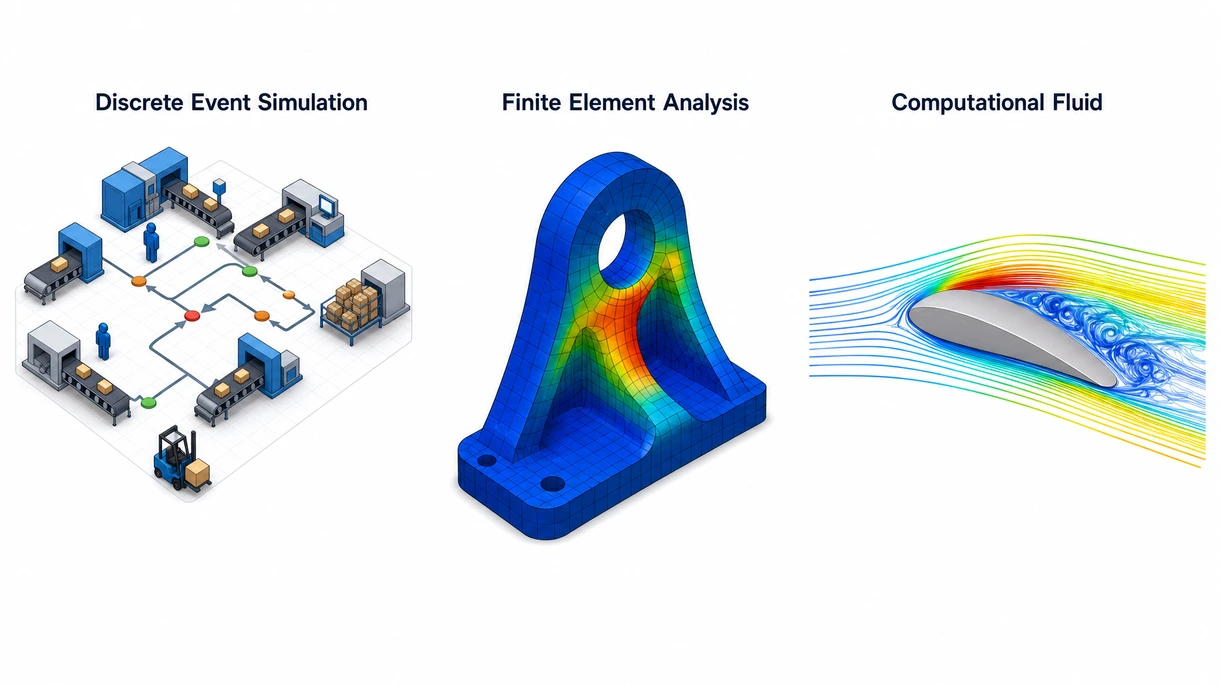
Discrete Event Simulation
This technology models industrial logistics and manufacturing throughput as a sequence of distinct events to optimize factory floor layout. It maximizes production efficiency and resource allocation but requires extensive historical data and often struggles with modeling continuous processes.
Finite Element Analysis
This family utilizes numerical techniques to predict how structural components react to physical forces, vibrations, and heat during operation. It provides exceptional structural safety assurance and material optimization while demanding significant computational resources and highly specialized engineering expertise.
Computational Fluid Dynamics
These tools simulate fluid flow and heat transfer patterns within industrial thermal systems and complex piping networks for validation. This technology improves energy efficiency and cooling system design but involves complex mesh generation and long simulation convergence times.
6 expert tips
Prioritize software offering native integration with CAD and PLM systems to eliminate data translation errors and workflow delays.
Select platforms providing modular licensing to scale simulation capabilities across departments without incurring prohibitive upfront capital expenditure costs.
Require comprehensive documentation regarding solver verification and validation protocols to meet stringent European and American safety engineering standards.
Evaluate the availability of specialized technical support and training programs to ensure rapid team adoption and software ROI.
Assess the software’s ability to handle multi-physics interactions for components subjected to simultaneous thermal and mechanical stress profiles.
Verify the technical certification to ensure compliance with local building safety standards and long-term durability.
Innovations and Trends
AI-driven reduced order modeling provides real-time simulation results by training neural networks on high-fidelity historical physics data.
Cloud-native simulation platforms enable global engineering teams to collaborate on massive datasets while reducing local hardware maintenance.
Virtual reality integration for industrial design reviews allows engineers to identify ergonomic and maintenance access issues before manufacturing.
Automated generative design algorithms optimize material distribution to meet structural requirements while reducing component weight by thirty percent.
*Prices are pre-tax. They exclude delivery charges and customs duties and do not include additional charges for installation or activation options. Prices are indicative only and may vary by country, with changes to the cost of raw materials and exchange rates.
About DirectIndustry
DirectIndustry is a marketplace that offers B2B players a complete experience, from product sourcing to purchase. DirectIndustry is an entity of VirtualExpo Group.
Are you a buyer?
Are you a supplier?
About Us
- VirtualExpo Group
- Our Partners
- Recruitment
- Testimonials