



Solar panel detergent-degreaser SOLAR WASH PROTECT RTU


Add to favorites
Compare this product
Characteristics
- Applications
- for solar panels
Description
2 in 1 product to clean organic dirt from your solar panels and to protect from the adherence of dirt.
Biodegradable solution to remove dust, bird droppings and more from solar panels
Did you know that failure to clean your solar panels can lead to irreversible damage and costly repairs?
Solar Wash Protect RTU is a ready-to-use product developed for cleaning and protecting photovoltaic solar panels, effective in cleaning a wide range of organic dirt on the solar module. Its antistatic properties protect the panel from adhesion of dirt to the module, thus facilitating future cleanings, keeping the panel cleaner between cleanings, and reducing cleaning time and water consumption by up to 50%.
Using the SWP solution to wash the solar modules instead of just water allows for an increase in efficiency of up to 5% of the solar panel, resulting in significant economic benefits for the PV system owner.
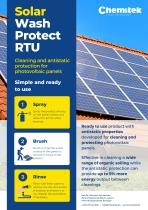
How to use: Simply spray the product directly onto the solar module, brush until the most encrusted dirt comes off, and rinse until the product is completely removed. After washing, the non-stick coating that this solution gives to the panel will reduce the accumulation of dirt, leading to maintaining the efficiency of your panels for longer.
Industries & Applications:
- Cleaning and protection of photovoltaic solar panels, photovoltaic solar tiles, etc.
- Residential
- Small installations of solar panels
Available Formats:
- 2kg drum
- 5kg drum
FAQs
- Do solar photovoltaic panels need to be cleaned?
The surface of photovoltaic solar panels must be clean in order to ensure full operation and maximum efficiency. Any kind of dirt that may be on the surface of the solar module, be it dust, pollen, tree sap, bird droppings, sand, salt crystals, etc., will reduce the footprint of the sun's rays, i.e. reduce the amount of sunlight reaching the solar module cells, and thus the panel will produce less energy.
- How do I know that my solar panels are clean?
To the naked eye the panels may appear clean, however there will be dirt accumulated, even if it is just the air pollution itself. A simple test to see if your panel is in need of cleaning is to wipe the surface of the panel with a white cloth or cotton pad before the actual cleaning.
- If the solar panel is dirty is it less efficient at producing energy?
According to recent studies, when a solar panel is very dirty it can lose up to 50% of its efficiency compared to a clean solar panel. However, an energy loss of 10 to 15% can be observed in panels with some dirt.
- Can climate alone keep solar panels clean?
In fact, rain, snow, or wind alone do not clean the solar panels, because wind carries particles, snow blocks sunlight, and rainwater is not enough remove incrusted soiling such as bird droppings. Also if the modules have low inclination, the dirt will accumulate on the bottom frame and, when dried, we cause the appearance of hotspots that can permanently damage your modules.
- What products can I use to safely clean my solar panels?
To avoid the risk of losing the warranty of your solar modules, you should only use solar panel cleaners that meet the manufacturers' requirements, such as the Solar Wash Protect. Use only products with neutral pH that are tested by international laboratories and are approved by the solar panel manufacturers, as they rule out any negative effect of their use for washing solar panels.
- What is the dilution ratio of the SWP cleaning and protection solution?
This solution is ready-to-use. No dilution in water is required to apply the product to the solar panel.
- What kind of dirt can be cleaned with the SWP solution?
The SWP antistatic cleaning and protection solution effectively removes bird droppings, dust, grease, ash, pollen, salt, and any other kind of organic soiling.
- What is the recommended amount of SWP solution to use?
ChemiTek recommends using between 150mL and 200mL per m² of photovoltaic solar glass. For example, if you have a solar photovoltaic panel with a surface area of 2 m², the usage per solar panel is between 300mL and 400mL, but if you have solar photovoltaic panels with a surface area of 3 m², the usage per solar panel is between 450mL and 600mL.
- Is there any way to keep the panels from getting dirty so easily?
Solar Wash Protect is a 2 in 1 product, in addition to efficiently removing different types of dirt, it does not allow the soiling to adhere as easily to the surface of the solar panel, due to its antistatic properties. Therefore, by slowing down the soiling rate of the modules, it prevents the rapid decrease in the solar panel's power generation. Since dirt does not stick to the surface of the panel, in subsequent cleanings you will notice an easier and faster removal of dirt.
Technical Specifications / Features:
- Biodegradable, ready-to-use solution
- Antistatic properties to prevent dirt adhesion
- Reduces cleaning time and water consumption by up to 50%
- Increases solar panel efficiency by up to 5%
- Removes a wide range of organic dirt: bird droppings, dust, grease, ash, pollen, salt, etc.
- Recommended usage: 150-200mL per m²
- Available in 2kg and 5kg drums
- For residential and small solar installations
VIDEO
Catalogs
Solar Wash Protect RTU
1 Pages
Other ChemiTek products
Complete Range


*Prices are pre-tax. They exclude delivery charges and customs duties and do not include additional charges for installation or activation options. Prices are indicative only and may vary by country, with changes to the cost of raw materials and exchange rates.
About DirectIndustry
DirectIndustry is a marketplace that offers B2B players a complete experience, from product sourcing to purchase. DirectIndustry is an entity of VirtualExpo Group.
Are you a buyer?
Are you a supplier?