


- Hydraulics - Pneumatics
- Pipe, Tube and Fitting
- Gas nozzle
- DELAVAN France
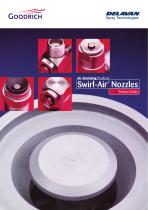
Air atomizing nozzle Swirl-Air™ gassprayfull-cone

Add to favorites
Compare this product
Characteristics
- Fluid
- air, gas
- Function
- spray
- Stream
- full-cone
- Material
- stainless steel
- Applications
- industrial
- Spray angle
- 60°, 90°
- Other characteristics
- control, application
- Flow
Min.: 0.63 l/min
(0.17 us gal/min)Max.: 12.62 l/min
(3.33 us gal/min)- Pressure
Min.: 20 psi
Max.: 150 psi
Description
Spray Characteristics Air, steam, or a process gas is introduced tangentially into the nozzle chamber in the low pressure region of the swirling mixture, creating extreme turbulence and primary atomization. As the fuel leaves the orifice, it impinges against the deflector ring which serves a dual purpose: close control of spray angle and breakup of the spray into even finer droplets (secondary atomization). Upon leaving the nozzle, the mixture swirls in a clockwise direction, looking downstream. The nozzle can achieve mean droplet diameters in the 50 to 100 micron range at modest air pressures and air volumes (SCFM). When using steam instead of air, the steam pressure should be approximately four times greater to achieve the same spray characteristics. The degree of atomization is also variable by controlling the ratio of air to fuel flows.
In combustion applications, Delavan’s two-fluid Swirl-Air can produce fine atomization at flow rates up to 300 gph. Fuel enters the mixing chamber axially coming in contact with tangentially introduced streams of air (or steam). Interaction of the two creates extreme turbulence and mixing. Finally, the fuel-air mixture impinges against a circular deflector ring, or pintle plate, before leaving the nozzle as a finely atomized spray. The progressive application of shear and inertial forces in the nozzle helps to provide high efficiencies.
Swirl-Air Advantages
• Large fuel passages and lack of torturous paths reduce chances for clogging.
• Air consumption (SCFM) and power requirements are relatively low, permitting the use of smaller, more economical air compressors and blowers.
• Good atomization ratios.
Catalogs


Other DELAVAN France products
Air Atomizing Nozzles


Related Searches
- DELAVAN spray nozzle
- DELAVAN liquid nozzle
- DELAVAN stainless steel nozzle
- DELAVAN metal nozzle
- DELAVAN cleaning nozzle
- DELAVAN multi-jet nozzle
- DELAVAN air nozzle
- DELAVAN screw-in nozzle
- DELAVAN cooling nozzle
- DELAVAN industrial nozzle
- DELAVAN flat nozzle
- DELAVAN brass nozzle
- Chemical nozzle
- DELAVAN plastic nozzle
- DELAVAN full-cone nozzle
- DELAVAN water nozzle
- DELAVAN washing nozzle
- DELAVAN 90° nozzle
- Compact atomizing nozzle
- DELAVAN 60° nozzle
*Prices are pre-tax. They exclude delivery charges and customs duties and do not include additional charges for installation or activation options. Prices are indicative only and may vary by country, with changes to the cost of raw materials and exchange rates.
About DirectIndustry
DirectIndustry is a marketplace that offers B2B players a complete experience, from product sourcing to purchase. DirectIndustry is an entity of VirtualExpo Group.
Are you a buyer?
Are you a supplier?