


- Company
- Products
- Catalogs
- News & Trends
- Exhibitions
Indoor air quality meter Nanoenvi IAQfor total suspended particulateCO2VOC


Add to favorites
Compare this product
Characteristics
- Type
- indoor
- Applications
- for total suspended particulate
- Measured parameter
- CO2, temperature, CO, relative humidity, PM2.5, PM10, VOC, PM1, atmospheric pressure, noise
- Configuration
- portable, compact, wall-mounted
- Communication
- WiFi, LoRaWAN
- Other characteristics
- IAQ, with display, with data logger, real-time, autonomous
Description
Control CO₂, airborne particles and volatile organic compounds in gyms, CrossFit facilities and high-performance facilities with Nanoenvi IAQ's professional air quality solution.
Optimise ventilation and build member loyalty by controlling odour risk through parameters such as CO₂ and relative humidity with real-time data during times of high occupancy in sports facilities.
A ‘stuffy’ environment is not only unpleasant: it directly affects athletic performance and the perception of the centre's quality. Transform and control the air in your gym through continuous monitoring and turn it into a competitive advantage, improving the health and comfort of your members and creating a more positive experience, even compared to outdoor sports.
Why is it important to control air quality in gyms? There is a widespread belief that practising sport outdoors is healthier than doing so in an enclosed space, such as a gym. However, this is not necessarily true. Outdoor athletes are often exposed to high levels of pollution caused by road traffic. Gases such as CO and particulate matter (PM₂.₅ and PM₁₀) are very harmful to health, especially during exercise, when there is a high demand for air.
On the contrary, enclosed spaces such as gyms and sports centres with air control and filtration systems guarantee optimal indoor air quality for users.
This translates directly into greater comfort for gym users and fewer complaints. Optimal air quality makes all the difference. In addition, optimising ventilation based on occupancy levels generates significant energy cost savings by activating only when necessary.
The Nanoenvi IAQ smart sensor is accredited by RESET® Air, a guarantee of reliability for certifying air quality in the most demanding environments.
Users need optimal hygrothermal conditions to maximise their effort and avoid being adversely affected by excessive temperature or humidity during training.
Nanoenvi IAQ allows you to generate customised automatic alerts when any of the monitored parameters exceed the set thresholds. This means that if there is a spike in pollution due to excess CO2, humidity or even bad odours during a group class or in a multipurpose room, it is detected instantly and the maintenance manager is notified.
Thanks to these alerts, immediate corrective measures can be taken (such as turning on the ventilation or activating a cleaning protocol) before the feeling of a ‘stuffy atmosphere’ causes uncomfortable reactions and complaints from users.
VIDEO
Catalogs
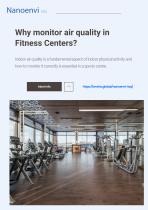
Nanoenvi IAQ Fitness centers
8 Pages

Catalogue IAQ
4 Pages
Related Searches
- Air quality monitor
- Air quality sensor
- Indoor air quality sensor
- Temperature air quality sensor
- Indoor air quality monitor
- Real-time air quality monitor
- Temperature air quality monitor
- CO2 air quality monitor
- Relative humidity air quality sensor
- PM2.5 air quality monitor
- CO2 air quality sensor
- Relative humidity air quality monitor
- Air quality monitor
- PM10 air quality monitor
- CO air quality monitor
- VOC air quality sensor
- Environmental analysis air quality monitor
- Mobile air quality monitor
- Compact air quality monitor
- Industrial air quality monitor
*Prices are pre-tax. They exclude delivery charges and customs duties and do not include additional charges for installation or activation options. Prices are indicative only and may vary by country, with changes to the cost of raw materials and exchange rates.
About DirectIndustry
DirectIndustry is a marketplace that offers B2B players a complete experience, from product sourcing to purchase. DirectIndustry is an entity of VirtualExpo Group.
Are you a buyer?
Are you a supplier?