


- Industrial machines and equipment
- Surface Treatment Equipment
- Hegman grindometer
- ERICHSEN GmbH & Co. KG
Hegman grindometer Model 232-15ISO 1524ASTM

Add to favorites
Compare this product
Characteristics
- Type
- Hegman
- Certifications
- ASTM, ISO 1524
Description
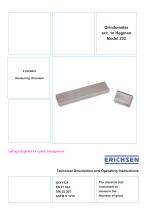
The Model 232 Hegman Grindometer is used to determine the ground fineness of coating materials. A liquid wedge of the test substance is generated on the testing device. If the grain dimensions are larger than the local wedge thickness, this is easily detected visually. At the boundary between the disturbed and smooth liquid surface, the operator can read the associated wedge thickness, this value refers to the fineness of grinding.
Design and Function
The Grindometer acc. to Hegman, Model 232, consists of a block of hardened steel which has been specially treated to ensure dimensional stability. Two precisely defined, wedge-shaped channels are cut into the block. The depth of each channel can be read off on a μm scale engraved into one of the longitudinal sides (length 125 mm) of the block. The corresponding Hegman scale (HS) is shown on the opposite side.
Desired Combination
In addition to the standard version with scale combination Hegman/μm, versions with other scale combinations (max. two – alternatively from Hegman/μm/North/mils/FSPT) are available on request. The desired combination should be specified when ordering. The relationship between the most commonly used Grindometer scales is evident from the nomogram.
Test Procedure
A sufficient quantity of the test material is poured into the deep end of the channels of the Grindometer taking care to avoid trapping air bubbles. The material is then spread in an even motion to the shallow end of the channels, holding the straightedge scraper vertical to the surface of the test instrument and also vertical to the channels, and allowing about 1 - 2 s for the stroke.
The evaluation should be conducted within 3 seconds of applying the material. To do this, the surface of the specimen is examined by viewing it at right angles to the channels by counter light coming at a flat angle (20 - 30). A reading is taken of the point at which aggregated particles or scratch marks become visible. The corresponding channel depth at this point is then defined as the fineness of grind.
Maintenance
The Grindometer should be cleaned immediately after use by washing with solvent. The use of hard, sharp implements for scraping off residue paint should be avoided.The blades used as straightedges are subject to constant wear. The straightedge should always be applied with a minimum of pressure and checked at regular intervals. For this purpose, the blade edge is placed on a level surface (e.g. lengthwise on a runner of the test instrument) and examined by the light-slit method.
Reference Class
The Model 232 is supplied with a Manufacturer’s Certificate M (factory calibration) that includes among others the following information:
Design and Function
The Grindometer acc. to Hegman, Model 232, consists of a block of hardened steel which has been specially treated to ensure dimensional stability. Two precisely defined, wedge-shaped channels are cut into the block. The depth of each channel can be read off on a μm scale engraved into one of the longitudinal sides (length 125 mm) of the block. The corresponding Hegman scale (HS) is shown on the opposite side.
Desired Combination
In addition to the standard version with scale combination Hegman/μm, versions with other scale combinations (max. two – alternatively from Hegman/μm/North/mils/FSPT) are available on request. The desired combination should be specified when ordering. The relationship between the most commonly used Grindometer scales is evident from the nomogram.
Test Procedure
A sufficient quantity of the test material is poured into the deep end of the channels of the Grindometer taking care to avoid trapping air bubbles. The material is then spread in an even motion to the shallow end of the channels, holding the straightedge scraper vertical to the surface of the test instrument and also vertical to the channels, and allowing about 1 - 2 s for the stroke.
The evaluation should be conducted within 3 seconds of applying the material. To do this, the surface of the specimen is examined by viewing it at right angles to the channels by counter light coming at a flat angle (20 - 30). A reading is taken of the point at which aggregated particles or scratch marks become visible. The corresponding channel depth at this point is then defined as the fineness of grind.
Maintenance
The Grindometer should be cleaned immediately after use by washing with solvent. The use of hard, sharp implements for scraping off residue paint should be avoided.The blades used as straightedges are subject to constant wear. The straightedge should always be applied with a minimum of pressure and checked at regular intervals. For this purpose, the blade edge is placed on a level surface (e.g. lengthwise on a runner of the test instrument) and examined by the light-slit method.
Reference Class
The Model 232 is supplied with a Manufacturer’s Certificate M (factory calibration) that includes among others the following information:
- Actual and setting comparison of groove depth
- Product identification
- Test equipments used with calibration status
- Date
- Name of inspector.
- By means of a digital dial gauge the depth of the grooves is measured in each groove at 5 measuring points evenly spread over the groove. The deviation from the setting value should not exceed 2.5 μm.
Catalogs
Exhibitions
Meet this supplier at the following exhibition(s):


Related Searches
- Coating machine
- Coating machine for pharmaceutical applications
- Laboratory coating machine
- Paper coating machine
- Conductive film coating machine
- Battery research coating machine
- Grindometer
- Plastic film coating machine
- Slot-die coating machine
- ASTM grindometer
- ISO 1524 grindometer
- Hegman grindometer
- Knife-over-roll coating machine
- Winding coating machine
*Prices are pre-tax. They exclude delivery charges and customs duties and do not include additional charges for installation or activation options. Prices are indicative only and may vary by country, with changes to the cost of raw materials and exchange rates.
About DirectIndustry
DirectIndustry is a marketplace that offers B2B players a complete experience, from product sourcing to purchase. DirectIndustry is an entity of VirtualExpo Group.
Are you a buyer?
Are you a supplier?