

- Metrology - Laboratory
- Analytical Instrumentation
- Adiabatic calorimeter
- NETZSCH Analyzing & Testing


- Company
- Products
- Catalogs
- News & Trends
- Exhibitions
Differential scanning calorimeter MMC 315 Nexus®isothermalautomatedwith automatic pressure detection

Add to favorites
Compare this product
Characteristics
- Options
- differential scanning, isothermal, automated, with automatic pressure detection, ARC, for biomolecular stability analysis, battery, thermal stability screening, modular for multiple applications, adiabatic, high-pressure, heat-flow, high-sensitivity, high-temperature, reaction
Description
Product overview
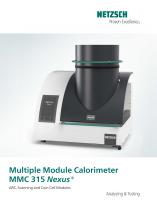
NETZSCH Multiple Module Calorimeter MMC 315 Nexus® is a modular benchtop calorimeter consisting of a base unit with integrated electronics and interchangeable measurement modules. It is designed for advanced reaction calorimetry, process-safety testing and coin-cell/battery investigations on gram-size samples. Multiple calorimetric methods can be applied on a single platform to increase information yield.
Main capabilities
Modular concept
The MMC 315 Nexus® base unit accepts plug-in calorimeter modules that can be used separately or simultaneously according to test needs.
Measurement modes
Software & data handling
Applications
Technical specifications
NETZSCH Multiple Module Calorimeter MMC 315 Nexus® is a modular benchtop calorimeter consisting of a base unit with integrated electronics and interchangeable measurement modules. It is designed for advanced reaction calorimetry, process-safety testing and coin-cell/battery investigations on gram-size samples. Multiple calorimetric methods can be applied on a single platform to increase information yield.
Main capabilities
- Measurement of chemical reactions and reaction enthalpies
- Detection and quantification of phase changes
- Process-safety analysis including thermal runaway and worst-case scenario evaluation
- Characterization of coin-cell batteries (charge/discharge, thermal signature)
- Materials characterization for pharmaceuticals, polymers and multiphase organic/inorganic mixtures
Modular concept
The MMC 315 Nexus® base unit accepts plug-in calorimeter modules that can be used separately or simultaneously according to test needs.
- ARC® Module — adiabatic/isothermal process-safety and thermal runaway testing
- Scanning Module — high-enthalpy scanning, DSC-like analyses and constant-power tests
- Two Coin Cell Modules (High-Temperature and High-Sensitivity) — battery and life-science testing using coin-cell containers
Measurement modes
- Adiabatic mode (ARC®) with Heat-Wait-Search (HWS) for realistic thermal runaway simulation
- Isothermal mode, including isothermal charging/discharging for batteries
- Scanning mode: constant heating rate or constant power (DSC-like behavior)
- Ramp and rapid screening modes for unknown samples
- Pressure measurement capability for modules that support sealed containers
Software & data handling
- Automatic data saving during runs and persistent measurement files
- Firmware monitoring of sensors and active components with integrated safety interlocks
- Seamless integration with Proteus® analysis software and other advanced tools
- Ability to merge battery cycler data (current, voltage, power) with calorimetric heat data
Applications
- Chemical process development, reaction kinetics and safety assessment
- Energetic materials testing and screening
- Storage and transport stability studies
- Battery testing (coin cells): component screening, full-cell charge/discharge studies and combined thermal/electrical analysis
- Materials characterization for polymers, pharmaceuticals and life-science materials
Technical specifications
- Base concept: modular bench-top calorimeter with a base unit and interchangeable modules
- Temperature ranges (by module): ARC / Scanning modules: RT to 500 °C; Coin Cell modules: RT to 300 °C (High-Temperature) and RT to 200 °C (High-Sensitivity)
- Temperature readability: 0.01 K
- Heating rates: typical 0–5 K/min (module-dependent); tracking rates up to 50 K/min for some modules
- Heating modes: isothermal, constant heating rate, constant power
- Pressure capability (where supported): up to 150 bar; pressure readability 0.01 bar
- Sample containers / volumes (module-dependent): ARC module 0.1–8.5 ml (stainless steel, Inconel, Hastelloy, glass inlet); Scanning module ≈2.6 ml; Coin cell containers: typical CR2032, diameters 5–30 mm, volumes up to ≈1000 mm³, minipouch options (e.g. 25 × 30 mm), thickness 1–5 mm
- Detection / sensitivity (Coin Cell modules): detection limits down to ≈0.05 mW (high-sensitivity); sensor ranges ±4500 mW (HT) and ±350 mW (HS) depending on module
- Proteus® compatible measurement and analysis software
- Safety & modes: ARC®-style adiabatic testing (HWS), ramp screening, injection options (where supported) and pressure monitoring for sealed reactions
Catalogs
Other NETZSCH Analyzing & Testing products
Accelerating Rate Calorimeter (ARC)


Related Searches
- NETZSCH gas analyzer
- Concentration analyser
- Monitoring analyser
- Liquids analyser
- NETZSCH automatic analyzer
- NETZSCH benchtop analyzer
- NETZSCH solids analyzer
- Spectrometer
- Process analyser
- Portable analyser
- Continuous analyser
- Water analyser
- Oxygen analyser
- Integration analyser
- Laboratory analyser
- Compact analyser
- Digital analyser
- NDIR analyzer
- Calibration analyser
- NETZSCH temperature analyzer
*Prices are pre-tax. They exclude delivery charges and customs duties and do not include additional charges for installation or activation options. Prices are indicative only and may vary by country, with changes to the cost of raw materials and exchange rates.
About DirectIndustry
DirectIndustry is a marketplace that offers B2B players a complete experience, from product sourcing to purchase. DirectIndustry is an entity of VirtualExpo Group.
Are you a buyer?
Are you a supplier?