


Incremental rotary encoder SH950opticalhollow-shaftanalog

Add to favorites
Compare this product
Characteristics
- Type
- incremental
- Technology
- optical
- Construction
- hollow-shaft
- Output signal
- analog, sine wave, Line Driver
- Supply voltage
- 5 V DC, 8-30 V DC
- Material
- aluminum, stainless steel
- Protection level
- rugged, vibration-resistant, shock resistant, IP65
- Applications
- industrial, for motors, for OEM, for robotics, for elevators, for handling systems
- Other characteristics
- compact, high-resolution, high-accuracy, heavy-duty, for motor feedback, large-diameter
- Incremental encoder résolution (pulses per revolution
1,024 unit, 2,048 unit
- Housing diameter
95 mm
(3.74 in)- Shaft diameter
Max.: 30 mm
(1.18 in)Min.: 15 mm
(0.59 in)- Rotational speed
6,000 rpm
(37,699 rad.min-1)- Output frequency
100 kHz
- Process temperature
Max.: 100 °C
(212 °F)Min.: -20 °C
(-4 °F)
Description
A sine-cosine encoder is an incremental rotary encoder with a special type of code disk and optoelectronic evaluation that provides an output with sine and cosine signals.
Sine-cosine encoders are sensors for measuring position changes (linear or rotary) that can measure distance, angle and also direction. These sensors are used as feedback systems, for example in servo drives, robotics and automation. However, sine-cosine encoders do not determine absolute position.
Because sine-cosine encoders are very similar to incremental encoders, it is helpful to review the information on incremental encoders beforehand. The difference between incremental encoders and sine encoders is that the A and B data channels are sent to the controller as 1 volt peak-to-peak sine waves instead of the digital pulse format. Common output signal levels are TTL, HTL (both digital signals) and 1 Vpp and 12 μA (analogue signals).
The sine-cosine signals are processed by downstream signal conditioning.
The stable sine and cosine shape of the signals enables internal interpolation with corresponding components, which further increases precision and resolution.
Catalogs
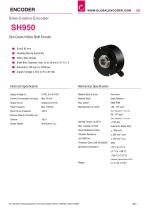
Datasheet SH950 (EN)
4 Pages
Encoders Product Overview (EN)
22 Pages
Other W+S Meßsysteme GmbH products
Sine-Cosine Encoder


Related Searches
- W+S rotary encoder
- W+S incremental encoder
- W+S incremental rotary encoder
- W+S absolute rotary encoder
- W+S solid-shaft rotary encoder
- W+S optical rotary encoder
- W+S industrial rotary encoder
- W+S hollow-shaft rotary encoder
- Magnetic rotary encoder
- W+S IP65 rotary encoder
- IP67 rotary encoder
- W+S compact rotary encoder
- W+S aluminum rotary encoder
- W+S DC rotary encoder
- W+S stainless steel rotary encoder
- W+S single-turn rotary encoder
- W+S flange rotary encoder
- W+S ultra-rugged rotary encoder
- W+S high-resolution rotary encoder
- W+S SSI rotary encoder
*Prices are pre-tax. They exclude delivery charges and customs duties and do not include additional charges for installation or activation options. Prices are indicative only and may vary by country, with changes to the cost of raw materials and exchange rates.
About DirectIndustry
DirectIndustry is a marketplace that offers B2B players a complete experience, from product sourcing to purchase. DirectIndustry is an entity of VirtualExpo Group.
Are you a buyer?
Are you a supplier?