|
|
|
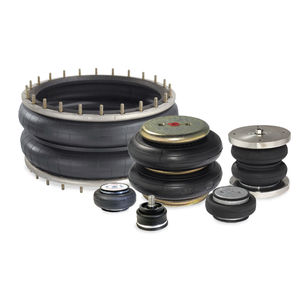
Firestone Industrial Products is the leader in air spring technology. Our technical resources and experienced sale engineers have the skills required to respond to your air suspension requirements.
|
|
|
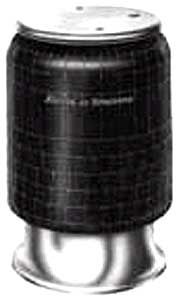
Sport-Rite airide springs are the answer to all your ride performance needs. These air springs mount between the frame and the suspension, utilizing a state of the art, oem, tapered air spring. Sport-Rite kits enhance the ride while empty or loaded. The tapered style air spring will support up to 3,000 lbs per set.
|
|
|
Firestone Industrial Products is the leader in air spring technology. Our technical resources and experienced sale engineers have the skills required to respond to your air suspension requirements.
|
|
|
|
|
|
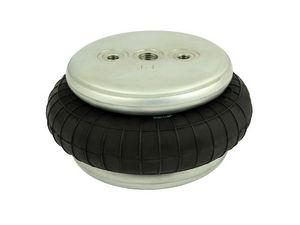
Enidine Air Springs are highly durable, precisely engineered and cost-effective for use in a wide variety of actuation and vibration isolation applications. With time-tested designs incorporating fabric-reinforced Wingprene%u2122 or natural rubber flex-member construction and corrosion-protected end retainers, Enidine Air Springs provide superior quality and performance. As an actuator, Enidine Air Springs can provide either linear or angular motion. These air springs offer a favorable stroke-to-compressed-height ratio when compared to air cylinders, and can accept a wide variety of actuation media such as air, water, nitrogen or anti-freeze. As an isolator, Enidine Air Springs are effective in reducing the harmful effects of vibration.
Specifications
Flex Members:
Fabric - reinforced Wingprene
Fabric - reinforced natural rubber
End Retainers: Forged steel
Cast zinc alloy
Cast aluminum
Fabric - reinforced Wingprene: -40°F to 150°F (-40°C to 65°C)
Fabric - reinforced Natural Rubber: -76°F to 150°F (-60°C to 65°C)
Evironmental Considerations: Good for most industrial applications.
Can be affected by certain chemicals.
|
|
|
|
|
|
Air Spring vs. Steel Spring
The advantage that air-spring cab suspension has over conventional steel-spring suspension is that of a low natural frequency, which greatly enhances a commercial vehicle's riding comfort. So-called sleeve air springs are the type normally used in truck and tractor cab suspension. Depending on space availability and the design of add-ons, they can be set up directly with the vibration damper as a one-piece spring strut or alternatively installed in parallel arrangement to the dampers.
As a rule air springs used for cab suspension are arranged as four-corner suspension between the driver's cab and the chassis frame. In addition to improving comfort, air-spring cab suspension offers the advantage that a manufacturer can use a uniform component regardless of customer variant and equipment preferences. The air spring equalizes any force differences as may occur because of differences in cabin weight (raised roof, air-conditioning system etc.) or driving speed. It does this by means of a control valve that automatically varies the internal pressure in such a way that the driver's cab is statically always in the manufacturer's specified design position vis-à-vis the vehicle chassis.
|
|
Air Spring Systems for Commercial Vehicles
Buses
Buses make good use of the advantages of air springs to achieve a consistently high degree of ride comfort and constant entry/exit height irrespective of load.
Trucks
Air suspension is fitted to all types of trucks with great success.
Trailers and Semitrailers
Trailers and semitrailers are increasingly fitted with air springs to ease the transportation of fragile goods and to protect the vehicle body.
|
|
| ... products without technical information |
| |
| ... products without technical information |
| |
|
|
|
|
As the name implies, it is a device that prevents one object from affecting another. It allows both objects to exist in their natural state without influence from the other. With an isolator, one of the objects is allowed to vibrate without transmitting all of the energy of that vibration to the other object.
For many years, Firestone has been in the business of designing and developing a wide range of mounts and supports to isolate vibrations that are detrimental to many industrial and manufacturing environments. The range of isolators offered by Firestone has been redefined to include two major lines of isolators - Firestone Airmount isolators and Firestone Marsh Mellow springs. Each have their distinct benefits over other typical industrial vibration isolators, and each has advantages over the other. Many industrial vibration isolation problems can be solved using either line, and a complete analysis of potential solutions to these problems should include investigating options using both lines of isolators.
|
|
|
|
|
|
|
The Air Spring Insulator BiAir consists of a cast steel or aluminum housing, within which the air space is contained by thin-walled flexible and pressure-resistant rolling membrane. A piston sits on top of the membrane and is pressed into the air space. This design allows a highly-effective isolation of vibration. In order to simultaneously achieve a high degree of damping, the air space is divided into two chambers connected with an air tube. (load/damping volume) A choke valve can be used to adjust from outside the cross-section of air flowing into the connecting tube from outside according to the degree of damping required. The friction on the flow of air caused by the choke valve can create a damping effect of up to 20%. Damage to the rolling membrane caused by overpressure is prevented by additional safety valves. Air springs are available for greater maximal loads and lower natural frequency. Level control provides an important contribution toward the optimal function of an air spring system. If a change in load likely occurs on equipment mounted with an air spring system, such that compression of one of the springs or an inclination of the equipment will result, a leveling system might be the only solution available. The change in air pressure in the air spring insulators adjusts the height of the individual elements (BiAir or FAEBI). By quickly pressurizing or de-pressurizing the springs, the proper level can be maintained despite variations in the position of the load.
|
|
- Isolation active and passive
- Isolation equivalent frequency
- Isolation low frequency
- Automatic correction of the level of precision 100 µ m
- Unparalleled Performance
- Small
- Acoustic Performance
- Can operate without air (SLM)
- Excellent stability
- Range includes: materials, mechanical control system with a system with electronic control, tables and work plans.
|
|
|
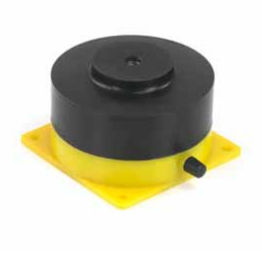
MaxDamp®, a highly damped version of our Gimbal Piston™ Air Isolator. MaxDamp® is ideal for OEM equipment with motorized X-Y stages or robots which require high performance vibration isolation and aggressive settling time for stage induced motion of the isolated payload..
|
|
Air spring type SLM
Material elastomer part: CR with steel insert, black
Material base plate: aluminium
Product description: The air springs are based on an elastomer body reinforced with a steel ring. It enables an effective oscillation insulation. The elements are specified primarily of the frequency ratio and dynamic forces.
Execution: Depending on build height and load a natural frequency is reached between 3 and 5 Hz. By increasing or reducing the air pressure, the object can be leveled to the working height H.
Application: They are suitable for passive insulation of scales, gauges etc. also for the active insulation of slow running devices such as ventilators, compressors etc.
Assembly: Adhere to the assembly instructions!
Attention: SLM-elements may only be placed under load and according to type with maximal 4 to 5 bar of pressure. A load on the full surface is permit even w/o pressure. The specified load capacity Fz is valid for the maximum static load.
|
|
|
|
|
|
The Fabreeka® Precision-Aire PLM series pneumatic/elastomeric isolation mounts are low frequency vibration and shock isolators which provide both attenuation of disturbing vibration and equipment leveling.
For vibration control applications, the pneumatic portion of these mounts provides isolation of vibration occurring at frequencies above 5.0 Hz.
For shock or impact applications, the outer elastomeric wall construction provides a high deflection shock mount. A low natural frequency (3.0 Hz) can be maintained by utilizing an external spacer to prevent "bottom out" condition.
Some features and benefits of PLM mounts:
PLM isolation mounts will continue to isolate with no pressure having a vertical natural frequency of approximately 10.0 Hz
The vertical to horizontal natural frequency ratio is approximately 1:1 with a degree of horizontal stability
1/8 NPT female fitting molded into sidewall allows for tank valve or pneumatic fitting
Viscous damping option provides increase in damping for large dynamic inputs.
|
|
|
|
|
|
Low frequency high performance shock and vibration isolator for passive and active applications
Construction
Moulded CR (Neoprene) oil resistant and non ageing rubber upper chamber with integral aluminium (SLM 1-12) and zinc plated steel (SLM24+) support plate with tapped attachment hole, side wall reinforcement and integral base ring bolted and sealed onto a aluminium (SLM 1-12) and zinc plated steel ( SLM24+) baseplate.
Baseplate can be bolted down to support surface if required. Standard version with Schraeder Inlet Valve.
Other valves on request.
Features
Ratio of vertical to horizontal stiffness ca 1:1
Shock absorption amplitude up to 15mm
Natural Frequency range (depending on load) 2.8-5 Hz (see table).
Deflated (no air pressure): ca 8Hz See Load Spreader Plates LSP.
Applications:
CMMs, Surface Plates, Presses, Test Beds, Turret Punch Presses, HVAC Scientific and Test Equipment.
Levelling Range
+/- 5 (6)mm (see table)
Delivered with Grade 8.8 Zinc plated attachment screw (Other screw lengths available)
Control Systems
Self controlled levelling versions available with either mechanical-pneumatic or electro-pneumatic controllers.
Full proposals on application
Accessories
Load spreader plates LSP, It is important that the foot of the supported equipment covers the SLM fully.
Load spreader plates LSP can inserted between the top of the SLM and the underside of the machine foot if necessary.
|
|
| ... products without technical information |
| |
Firestone Airstroke actuators have long been used in the industrial market as pneumatic actuators incorporated into new and innovative machinery designs as well as replacement actuators for existing applications that had previously used traditional pneumatic or hydraulic cylinders.
These replacement markets are created by the advantages of a flexible walled pneumatic actuator that is durable, operates well in corrosive and abrasive industrial environments, easily accepts misalignment, and has a high ratio of stroke to collapsed height. Each of these features give Firestone Airstroke actuators the advantage over traditional cylinders.
|
|
Mustpress lifting bags are adapted to any industrial equipment and usually replace hydraulic and mechanical jacks to Press, Lift, Grip, Guide, Dampen, Handle.... They are made of elastomer coated fabrics and supprt high inflation pressure (up to 100 bars).
Available in different shapes and dimensions (square, round, rectangular, toric).
. Compact when empty
. High homogenous thrust
. High temperature resistance
. Important stroke (multi-stage)
. No maintenance required
|
|
ContiTech Air Actuators - Our All-Around Talents
ContiTech air actuators as complete systems are all-around talents for industrial pneumatics.
With a broad range of products and individual developments to deal with specific customer requirements, we solve even difficult pneumatic tasks in machine, apparatus and equipment engineering.
ContiTech air actuators can be used instead of pneumatic or hydraulic cylinders in a wide range of applications.They have effective diameters of between 60 mm and 950 mm, can execute strokes up to 455 mm and can exert forces of between 0.5 kN to 440 kN.
|
|
| ... products without technical information |
| |
|
|
|
|
Ortlinghaus multiplate safety clutches are permanently engaged, this condition being maintained by spring pressure. They are able to transmit torque up to a particular, preset level, after which in the case of an overload in the transmission, they are designed, to slip for a limited period of time. They can thus be used to safeguard all types of transmission lines in machines and equipment from overloading and destruction. They have the task of smoothing out high torque peaks, at start ups, and during the operating of a line. This is done by the clutch plates slipping past each other for a short period of time when the desired maximum torque is reached.
The torque at which a clutch starts to slip can be varied, within limits. In this way these clutches safeguard gear wheels, shafts and other drive elements from damage and thus guarantee operational reliability for an extended period of time; in this way they also help to prevent the need for repairs. It must be kept in mind that when the clutch is slipping, frictional heat is produced and released within the set of plates and that the permissible amount of heat is limited. This thermal loading must be kept within the required limit with the aid of a slip monitoring device, which would switch off the drive. This is necessary with fast running drives where the critical amount of heat is reached very rapidly when slipping commences.
|
|
... see all the products in the category
Clutches
|
|
|