|
|
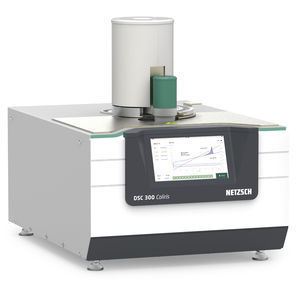
The new DSC 404 F1 Pegasus® by NETZSCH is capable of high precision sample analysis across an extremely broad temperature range from -150°C to 2000°C in a number of applications such as ceramics, metals, plastics, and composites. Unique among high-temperature DSC instruments is the optional temperature-modulated DSC (TM-DSC), which can separate reversible from irreversible energetic effects.
A great variety of both standard and optional features makes the DSC 404 F1 Pegasus® particularly flexible and effective. Various furnaces can be easily interchanged by the user and combined with a swiveling double furnace lifting device. Also, different sample carriers (DSC, DTA), an automatic sample changer (ASC) for up to 20 samples, and plenty of accessories, such as crucibles in numerous shapes and materials, are available.
Its proven vertical format and vacuum-tight construction not only make the DSC 404 F1 Pegasus® easy to operate and very robust, but also enable the implementation of measurements under pure gas atmospheres, which is particularly important for samples sensitive to oxidation. The various DSC sensors are characterized by optimal sensitivity, short response times and high reproducibility.
As with all NETZSCH instruments, this excellent product is complemented by expert application support and first-rate service.
|
|
DTA - Differential Thermal Analysis - & DSC - Differential Scanning Calorimetry - measure, respectively, the temperature difference and the heat flow difference between a sample and a reference material (subjected to the same temperature variation in a controlled atmosphere).
DTA detects any change in all categories of materials; DSC determines the temperature and heat of transformation.
SETARAM Instrumentation offers:
- the widest temperature range of all DTA systems (from –150°C to 2400°C°) using high-precision tri-couple probes;
- the most complete choice of DSCs (from Q&C system to the highest sensitivity DSC, and 3D-Sensor Inside DSC).
Properties measured by DTA / DSC include phase changes, glass transition, melting, purity, evaporation, sublimation, crystallization, pyrolysis, heat capacity, polymerization, denaturation / aggregation, compatibility, etc.
|
|
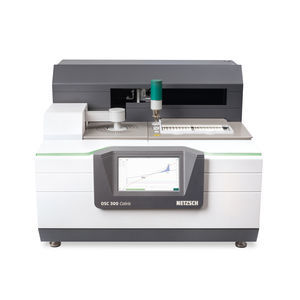
DSC 200 F3 Maia® - Differential Scanning Calorimeter
This newest Differential Scanning Calorimeter development at NETZSCH unites compactness, robustness and simple operation with high detection sensitivity for your preferred application in material quality control and failure analysis, especially in polymer processing.
The DSC 200 F3 Maia® combines the advantages of modern technology, high sensitivity and a robust, easy-to-operate work horse. Using liquid nitrogen, the temperature range extends from -170°C to 600°C. The main features of the DSC 200 F3 Maia® are the newly developed monolithic DSC sensor and a new silver furnace with long-life heating element.
The heat flux sensor of the DSC 200 F3 Maia® combines high stability, improved resolution and fast response time. Laser-guided welding processes for the sensor disk and thermocouple wires yield high sensitivity and robustness.
For routine applications we offer the upgrade with an automatic sample changer (ASC) for up to 20 samples and reference materials, also in different crucible types.
|
|
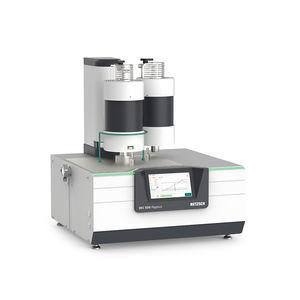
The versatile Premium DSC 204 F1 Phoenix® fascinates with its unique concept: all essential operational components are integrated into the instrument and optional add-ons can be installed anytime on site.
The DSC measuring cell consists of a cylindrical high-conductivity silver block with an embedded heating coil for broad thermal symmetry (3D symmetry) in the sample chamber, the cooling ports for liquid nitrogen or compressed air cooling and a cooling ring for connection of the intracooler (also with simultaneous liquid nitrogen cooling). The gas-tight construction and integrated mass flow controllers for the purge and protective gases allow coupling to an FTIR or MS for gas analysis.
Exchangeable sensors are tailored to their tasks:
With its disk-shaped silver carrier plate and supersensitive thermosensors of nickel-chromium constantan, the Tau-sensor offers a high level of calorimetric sensitivity along with extremely short signal time constants of only 0.6 seconds, which guarantees good separation of overlapping thermal effects.
The µ-sensor stands out for its high level of calorimetric sensitivity, never before achieved with a DSC. For example, it is extremely well suited for pharmaceutical applications with small sample weights.
Important hardware extensions like the automatic sample changer (ASC) for up to 64 sample and reference crucibles, the new UV-extension for photocalorimetry and software features such as BeFlat® for an optimized baseline or the optional temperature modulation of the DSC signal (TM-DSC) make the DSC 204 F1 Phoenix® the most versatile DSC system for R & D, QA, failure analysis and process optimization on the market today.
|
|
Numerous physical processes and chemical reactions are influenced by the surrounding gas pressure. In practise it is therefore often necessary to conduct DSC measurements under an increased pressure.
With the high-pressure DSC 204 HP Phoenix®, thermal effects in a sample can be analyzed in the pressure range from vacuum to 15 MPa (150 bar) and at temperatures from -150°C to 600°C, depending on the type of gas.
The sample chamber atmosphere can be static or dynamic. The electronic pressure monitor and control, along with exact regulation of the purge gas flow, provide for excellent accuracy and reproducibility of the measurement results.
The proven CC 200 L for liquid nitrogen cooling is available for the low-temperature range.
The safety of the high-pressure DSC system has been certified through design tests and is guaranteed during operation by the appropriate safety components.
|
|
The main advantage of light-curing systems is their fast reaction time. Monomer solutions which are mostly free of solvents can be cured within only a few seconds and already at low temperatures. A combination of thermal and light curing reactions is often applied to dual cure adhesives or paints.
The NETZSCH Photo-DSC 204 F1 Phoenix® works in the temperature range from
-100°C to 200°C. The instrument has a vacuum-tight measuring cell and the purge gas control is regulated by a mass flow controller (MFC).
For our Photo-DSC 204 F1 Phoenix®, most standard industry or laboratory lamps for cationic or radically curing material systems can be used. For the analysis of adhesives, we recommend the DELOLUX04, from the DELO company.
The modified automatic lid-lifting device of the DSC 204 F1 Phoenix® guarantees a defined distance between the two light conductors and the sample and reference.
This achieves high reproducibility of measurement results.
For your normal DSC analyses above 200°C, a retrofit of the standard lid-lifting device is possible, or the manual lid can also be used without problems.
For high sample throughput or for repeat measurements, use of our Automatic Sample Changer (ASC) for up to 64 samples is recommended.
|
|
Differential Scanning Calorimeters (DSC) measures temperatures and heat flows associated with thermal transitions in a material. Common usage includes investigation, selection, comparison and end-use performance evaluation of materials in research, quality control and production applications. Properties measured by TA Instruments’ DSC Differential Scanning Calorimeters techniques include glass transitions, "cold" crystallization, phase changes, melting, crystallization, product stability, cure / cure kinetics, and oxidative stability.
Tzero Differential Scanning Calorimeters TA Instruments' latest development, Tzero™ DSC Differential Scanning Calorimeters technology, is a revolutionary and fundamentally more accurate way of measuring heat flow. It provides significant improvements in baseline flatness, transition resolution and sensitivity. Tzero™ Differential Scanning Calorimeters technology allows direct measurement of heat capacity, and makes Modulated® DSC experiments both faster and more accurate. Three DSC modules (Q2000, Q200, Q20) are now available, all significantly advance the DSC Differential Scanning Calorimeters technique to levels previously unattainable.
|
|
DSC - Differential Scanning Calorimetry - measures the temperature difference and the heat flow difference between a sample and a reference material (subjected to the same temperature variation in a controlled atmosphere).
DSC determines the temperature and heat of transformation.
MICRO DSC III (-20 to 120°)
Thanks to the exclusive "3D-Sensor Inside" technology, the microcalorimeter Micro DSC III offers very high sensitivity detection for the analysis of liquids, gels, powders, solids, etc.
|
|
Fascinating Flexibility in Thermal Analysis
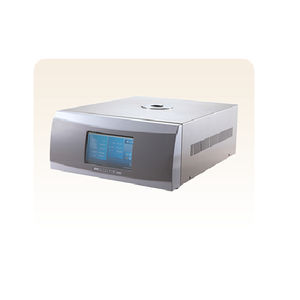
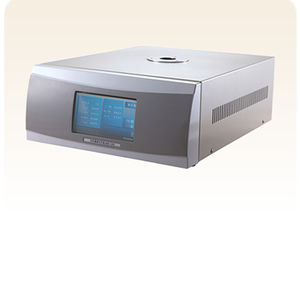
DSC 404 F3 Pegasus® - High-Temperature DSC
The new DSC 404 F3 Pegasus® offers a high flexibility for all DSC and DTA applications in quality control and product development. Furnaces and DSC/DTA sensors are available for a broad temperature range (-150...2000°C). Numerous upgrade possibilities allow adaption of this cost-effective system to sophisticated applications.
The DSC 404 F3 Pegasus® is part of the economical NETZSCH F3-product line, which is specially tailored to the requirements of comparative material characterization and quality control.
The DSC 404 F3 Pegasus® can be operated from -150°C to 2000°C with various DTA and DSC sensors that are easily exchangeable by the user and various furnace types.
The sample chamber can be purged with inert or oxidizing gases in order to remove gases evolved from the sample.
The measuring system is vacuum tight (10-2mbar).
|
|
| ... products without technical information |
| |
STA 449 F1 Jupiter® – Simultaneous TG-DSC
Fascinating Flexibility in Thermal Analysis
The new STA 449 F1 Jupiter® combines unlimited configuration flexibility and unmatched performance in just one instruments.
● Thermal stability, decomposition behavior, composition, phase transitions, melting processes to be analyzed comprehensively and quickly
● Easily to use top-loading system with exceptionally precise balance resolution (25 ng resolution at a weighing range of 5g) and highest long-term stability
● Interchangeable sensors for DSC measurements with highest sensitivity and best reproducibility for reaction/transition temperatures and enthalpies as well as for measurements of specific heat
● A variety of optional system enhancements for ideal system adaption to user-defined applications
● Various furnaces, easily interchangeable by the user, available (optional a swiveling double hoisting device for two furnaces)
● Pluggable sample carriers (TG, TG-DSC, TG-DTA, etc.)
● Automatic Sample Changer (ASC) for up to 20 samples
● Automatic evacuation and refilling (Autovac)
● Plenty of accessories, e.g. sample crucibles in the most varied of forms and materials
● Unique for STA: temperature-modulated DSC (TM-DSC)
By supplementary MS-and/or FTIR-coupling even more comprehensive analyzes are possible.
All these features make the new developed STA 449 F1 Jupiter® to the ideal tool for thermal analysis of materials in the fields of research, developments and quality assurance.
|
|
Fascinating Flexibility in Thermal Analysis
DSC 404 F3 Pegasus® - High-Temperature DSC
The new DSC 404 F3 Pegasus® offers a high flexibility for all DSC and DTA applications in quality control and product development. Furnaces and DSC/DTA sensors are available for a broad temperature range (-150...2000°C). Numerous upgrade possibilities allow adaption of this cost-effective system to sophisticated applications.
The DSC 404 F3 Pegasus® is part of the economical NETZSCH F3-product line, which is specially tailored to the requirements of comparative material characterization and quality control.
The DSC 404 F3 Pegasus® can be operated from -150°C to 2000°C with various DTA and DSC sensors that are easily exchangeable by the user and various furnace types.
The sample chamber can be purged with inert or oxidizing gases in order to remove gases evolved from the sample.
The measuring system is vacuum tight (10-2mbar).
|
|
SETSYS Evolution: High Performance Thermal Analyzers (ambient to 2400°C): DTA, DSC, TGA, simultaneous TGA-DTA/DSC, TMA, coupling to gas analyzers
Widest temperature range (ambient / 2400°C) on the market
Modularity: the different modules DTA, DSC, TGA, TMA can be adapted interchangeably around the same structure
Measurement performance: satisfy unique resolution, precision and sensitivity criteria
SETSYS Evolution is today the state-of-the-art in research-grade thermal analyzers.
It includes:
-SETSYS Evolution DTA (up to 2400°C), DSC (up to 1600°C)
-SETSYS Evolution TGA
-SETSYS Evolution simultaneous TGA-DTA/DSC-EGA
-SETSYS Evolution TMA
|
|
The modular "Canal" elements are cold-pressed channel sections specifically designed to provide the craneway for the electrical chain hoists of the DMK series.
These elements are the key items of a modular load hoisting and handling system that is simple and quick to assemble.
The installation, modification or change of installation site procedure of this system is very simple, as it includes only standard bolted modules, and thus frees the user from the need to perform expansive and time consuming welding operations.
This system is very flexible and easily expandable.
|
|
|
|