


{{product.productLabel}} {{product.model}}
{{#if product.featureValues}}{{product.productPrice.formattedPrice}} {{#if product.productPrice.priceType === "PRICE_RANGE" }} - {{product.productPrice.formattedPriceMax}} {{/if}}
{{#each product.specData:i}}
{{name}}: {{value}}
{{#i!=(product.specData.length-1)}}
{{/end}}
{{/each}}
{{{product.idpText}}}
{{product.productLabel}} {{product.model}}
{{#if product.featureValues}}{{product.productPrice.formattedPrice}} {{#if product.productPrice.priceType === "PRICE_RANGE" }} - {{product.productPrice.formattedPriceMax}} {{/if}}
{{#each product.specData:i}}
{{name}}: {{value}}
{{#i!=(product.specData.length-1)}}
{{/end}}
{{/each}}
{{{product.idpText}}}


... A Holistic Approach to On-site Oil Analysis TruVu 360™ Enterprise Fluid Intelligence simplifies and streamlines the on-site oil analysis process, so high-quality information and actionable intelligence leads to effective decision making. Closes the ...
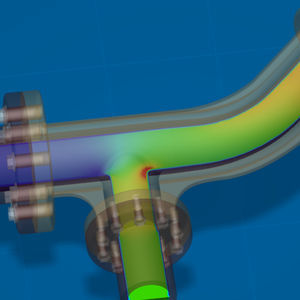

... design concept for defined design spaces and flow tasks. You only need one solver run using industry-standard Computational Fluid Dynamics ( CFD) solvers; no initial design is necessary. Tosca Fluid Key Benefits ...
SIMULIA


... Autodesk CFD (Computational Fluid Dynamics) software creates computational fluid dynamics simulations that engineers and analysts use to intelligently predict how liquids and gases will perform. With ...
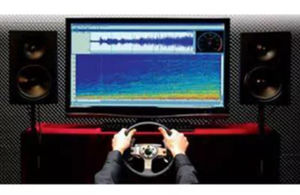

... or electric vehicles (EVs). Reduced Noise Annoyance Psychoacoustics Indicators Listen to Vibroacoustic and CFD Simulations Isolate Sound Sources Quick Specs Define meaningful vibro-acoustic specifications, ...
ANSYS
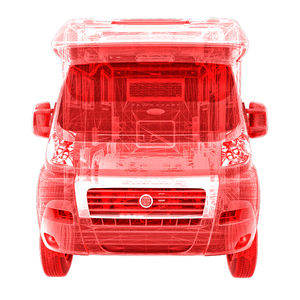

... success of your designs. Why Choose SOLIDWORKS Flow Simulation? SOLIDWORKS® Flow Simulation is an intuitive Computational Fluid Dynamics ( CFD) solution embedded within SOLIDWORKS 3D CAD that enables you to quickly ...
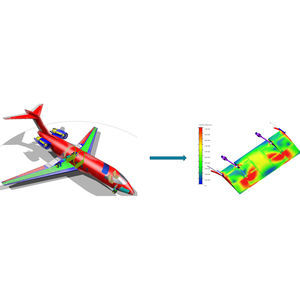

... holistic performance insight by coupling together multiple simulation disciplines. Multibody dynamics (MBD), Computational Fluid Dynamics ( CFD), and structural analysis (FEA) can be connected thanks to MSC CoSim. Depending ...
MSC SOFTWARE - HEXAGON MANUFACTURING INTELLIGENCE
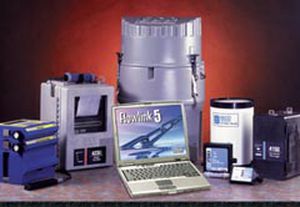

... At last, there's a "Flow Data Manager" with the complete software tools to handle all of your flow monitoring data — from field operations to polished graphs and multi-parameter reports. Flowlink makes it all direct, logical, visual, ...
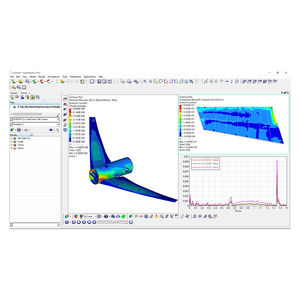

... HyperView is a complete post-processing and visualization environment for finite element analysis, CFD and multi-body system data. It is the new standard for speed and integration of CAE results post-processing. HyperView enables you ...
ALTAIR
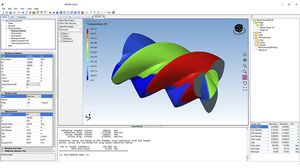

... conditions or boundary conditions for CFD, Structural Analysis by Finite Element Methods (FEM) or Fluid solid interaction (FSI) CFD Performance Calculation Allows accurate CFD performance prediction ...


... STAR-CCM+ is unrivalled in its ability to tackle problems involving multi-physics and complex geometries. STAR-CCM+ has an established reputation for producing high-quality results in a single code with minimum user effort. Designed to fit easily within ...
CD-adapco
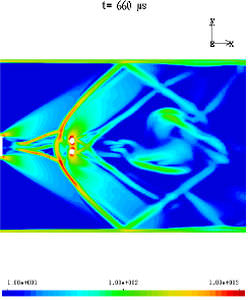

... Fluidyn–NS is the module for Computational Fluid Dynamics ( CFD) designed to simulate internal or external flows in complex 3D geometries with high precision finite volume schemes. The numerous numerical schemes available ...
the best suppliers