


{{product.productLabel}} {{product.model}}
{{#if product.featureValues}}{{product.productPrice.formattedPrice}} {{#if product.productPrice.priceType === "PRICE_RANGE" }} - {{product.productPrice.formattedPriceMax}} {{/if}}
{{#each product.specData:i}}
{{name}}: {{value}}
{{#i!=(product.specData.length-1)}}
{{/end}}
{{/each}}
{{{product.idpText}}}
{{product.productLabel}} {{product.model}}
{{#if product.featureValues}}{{product.productPrice.formattedPrice}} {{#if product.productPrice.priceType === "PRICE_RANGE" }} - {{product.productPrice.formattedPriceMax}} {{/if}}
{{#each product.specData:i}}
{{name}}: {{value}}
{{#i!=(product.specData.length-1)}}
{{/end}}
{{/each}}
{{{product.idpText}}}


... SHARP-CUT BRANCH CUTTER BAR It is the best attachment to guarantee effective pruning. It is resistant and long-lasting, capable of withstanding the heaviest stresses thanks to the HB450 steel blades. The new generation ...


... TKL 22 tree cutter for excavators with 12 to 22t / 26400 to 48400 lbs to cut trees with a diameter of max. 250 mm / 9.84 in. ...
KINSHOFER
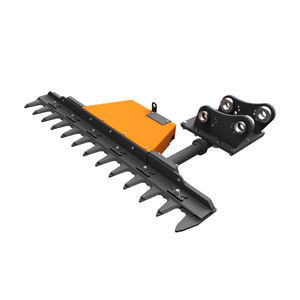

... The Sharp-Cut branch cutter bar is used for pruning branches from 0 to 100 mm. With its clean and precise cut, it does not damage the plant or tear the branch. The bar’s blades are made of HB450, which ...


... The hedge cutters of the HS series cut hedges with branches up to 4.5 cm in diameter. The HS series is offered in working widths of 1.60 m and 2.00 m. The low number of double strokes of the two cutting ...
Dücker, Gerhard, GmbH & Co. KG


... The MULAG free zone cutter FSG 2000 is suitable for clearing branches and twigs up to 150 mm on ways and roads with an optimum cutting pattern. ...
MULAG Fahrzeugwerk Heinz Wössner GmbH u. Co. KG

the best suppliers