


{{product.productLabel}} {{product.model}}
{{#if product.featureValues}}{{product.productPrice.formattedPrice}} {{#if product.productPrice.priceType === "PRICE_RANGE" }} - {{product.productPrice.formattedPriceMax}} {{/if}}
{{#each product.specData:i}}
{{name}}: {{value}}
{{#i!=(product.specData.length-1)}}
{{/end}}
{{/each}}
{{{product.idpText}}}
{{product.productLabel}} {{product.model}}
{{#if product.featureValues}}{{product.productPrice.formattedPrice}} {{#if product.productPrice.priceType === "PRICE_RANGE" }} - {{product.productPrice.formattedPriceMax}} {{/if}}
{{#each product.specData:i}}
{{name}}: {{value}}
{{#i!=(product.specData.length-1)}}
{{/end}}
{{/each}}
{{{product.idpText}}}
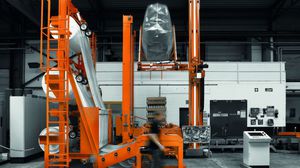

... accessible film feed at ground level • Downtime reduced to a minimum • Reliable opening of the film hood due to natural air accumulation from the parachute movement • Maintenance-free time belt technology The ...
MSK


... The combined shrink hooding machine SH51 hoods and shrinks palletized products with tubular heat shrinking film. The machine combines ...
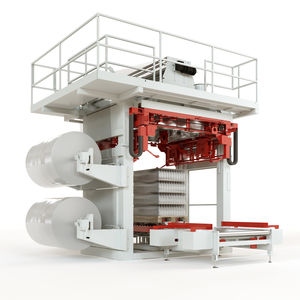

... The full hood- shrink cycle in one module. Bocedi FTB419 is the complete machine which allows pallet hooding and hood shrinking all in one place. Space saving It is a perfect space ...
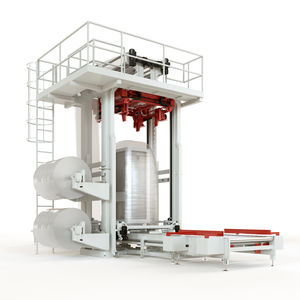
... The hooder from VFB is a hooding machine and it is available with a maximum of six reels. It is designed with automatic size selection and height reading. The device is capable of packing various types of pallets in different ...
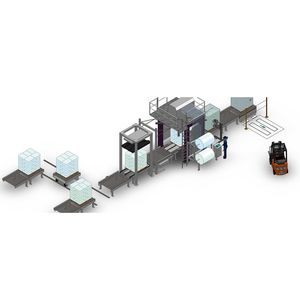

... varieties can be packed in one machine with automatic film change • Films of all types are employable • Automatic film change with film-end ejection device ...
Möllers
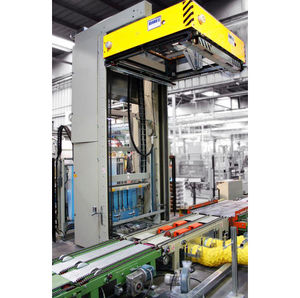

... The automatic hooding machine model AT 53 applies a hood of tubular stretch film to palletized product. Its hot air generation system through linear gas burners is designed to work ...
OFFICINA MECCANICA SESTESE S.p.A.


... heat shrink packaging machine from Lachenmeier. The shrink wrap machine type Combi Flex, where hood application and shrinking take place in one space-saving ...


... occupied. The thickness of the film is 60 – 220 microns. For example, a 1m³ pallet requires 200 g of film for a propane gas shrink frame with a 120 micron hood. The shrink ...


... COMBI-GLASS ROBOT SHRINK HOODING MACHINE Shrink hooder with a robot The COMBI-GLASS with robot pushes the boundaries of automated packaging. Equipped with an independent robotic head, ...
THIMON


... Our shrink- hood systems are designed to provide fully automated perfection, hygene and aesthetics for the products to be transported. Providing a fluent interface, the design is completely user friendly while extremely ...
Keramik Makina Sanayi ve Ticaret A.Ş
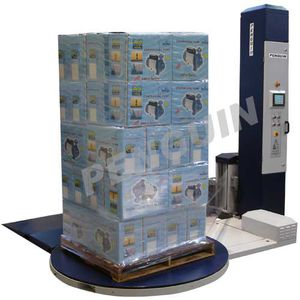

... Penguin Stretch Wrapping Machine is a fully automatic machine for wrapping pallets using stretch cling film. This machine ensures stable and moisture-proof wrapping ...
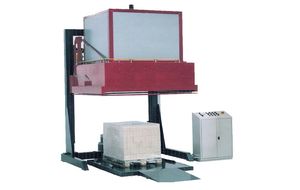

... Hood type thermo shrink machine to be used with natural gas or LPG and electrical system. Mobile hood on a portal frame. Specifications Modell HU-6010, standard version: Max. pallet ...
the best suppliers