


- Products
- Catalogs
- News & Trends
- Exhibitions
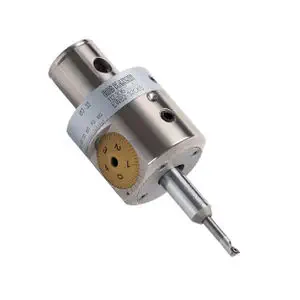
Roughing boring head SW seriesroughingdouble-edgedheavy-duty


Add to favorites
Compare this product
Characteristics
- Options
- roughing, roughing, double-edged, heavy-duty
- Diameter
Max.: 203 mm
(7.99 in)Min.: 20 mm
(0.79 in)
Description
SW Boring Head twin cutters are designed for heavy-duty rough boring and semi-finishing operations. The short and compact design of the components combined with a positive and friction-locked connection between the tool body and insert holders provide maximum rigidity and the highest cutting performance.
This twin cutter series has a unique design feature allowing different roughing methods without the need to change components or use mechanical systems to adjust insert height. Simply reverse the insert holders to switch between balanced and stepped cutting!
Ground serrations on the mating surfaces of both the tool body and insert holder permit a rigid connection and an accurate tool length. A diameter scale on the insert holders allows diameter adjustment without a presetter. The tool body and insert holders are completely protected against corrosion by a high-quality coating.
Balanced and Stepped Cutting
Balanced cutting is just that—both inserts are set to the same height and cutting diameter. It is the more commonly used configuration because it’s easier to set, more stable, and permits higher feed rates because it’s a two-edge effective tool. It also works better for cast holes or pre-existing holes in weldments that are usually either not perfectly round, straight, or have some misalignment (core shift). The equalized cutting forces in a boring head set for twin cutting work best to correct these issues.
When stepped-cutting, you have the inserts staggered in both height and diameter. The lead insert takes approximately half of the total stock allowance and is followed by the second insert, cutting at the desired output diameter.
VIDEO
Catalogs


BIG KAISER Product Guide
28 Pages
Other BIG KAISER products
Boring Tools




Related Searches
- Chuck
- Milling chuck
- Machining tool holder
- Drilling chuck
- Collet chuck
- High-precision chuck
- Collet tool holder
- HSK chuck
- High-speed chuck
- HSK tool holder
- BT chuck
- Morse taper chuck
- Taper shank chuck
- Aggregate head
- Tool holder for turning applications
- Balanced chuck
- Tapping holder
- Machining collet chuck
- ER collet chuck
- Modular chuck
*Prices are pre-tax. They exclude delivery charges and customs duties and do not include additional charges for installation or activation options. Prices are indicative only and may vary by country, with changes to the cost of raw materials and exchange rates.
About DirectIndustry
DirectIndustry is a marketplace that offers B2B players a complete experience, from product sourcing to purchase. DirectIndustry is an entity of VirtualExpo Group.
Are you a buyer?
Are you a supplier?