


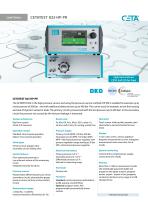
Differential pressure decay leak tester CETATEST 825 HP-PRhigh-pressurefor valvesfor injection valves

Add to favorites
Compare this product
Characteristics
- Type
- differential pressure decay, high-pressure
- Applications
- for automotive applications, for valves, for injection valves
- Other characteristics
- automatic, USB, compact, in-line
Description
The CETATEST 825 HP-PR in the variant high pressure can be used for leak tests (for example, the housing and seat of injection valves) up to a test pressure of 400 bar using the test mode pressure rise. The area in which the leakage is to be measured is enclosed by a measuring chamber (secondary circuit). Hereby the primary circuit is pressurised with the test pressure (up to 400 bar). The leakage test is performed in the secondary circuit using the differential pressure method. The CETATEST 825 HP-PR can be delivered as 1-channel or 2-channel test device.
Pressure sensor
Piezo-resistive differential pressure transducer (in secondary circuit)
Piezo-resistive gauge pressure sensor (in primary and secondary circuit)
Pressure ranges
Primary pressure: 100 bar (MPR), 400 bar (MPR) Pressure regulation range from 30 bar
Secondary pressure: 150 mbar (EPR)
MPR Mechanical pressure regulator EPR Electronical pressure regulator
Measurement range
± 500 Pa, ± 5,000 Pa in 1 Pa-steps
Result units
Pa, hPa, PSI, Pa/s, hPa/s, PSI/s, mbar*l/s, ml/min, ml/h, l/min, l/h, mmHg, Torr, mmWs
Pressure sensor
Piezo-resistive differential pressure transducer (in secondary circuit)
Piezo-resistive gauge pressure sensor (in primary and secondary circuit)
Pressure ranges
Primary pressure: 100 bar (MPR), 400 bar (MPR) Pressure regulation range from 30 bar
Secondary pressure: 150 mbar (EPR)
MPR Mechanical pressure regulator EPR Electronical pressure regulator
Measurement range
± 500 Pa, ± 5,000 Pa in 1 Pa-steps
Result units
Pa, hPa, PSI, Pa/s, hPa/s, PSI/s, mbar*l/s, ml/min, ml/h, l/min, l/h, mmHg, Torr, mmWs
Exhibitions
Meet this supplier at the following exhibition(s):


Other CETA Testsysteme GmbH products
Leak Tester


Related Searches
- Pressure gauge
- CETA leak tester
- Differential pressure indicator
- Digital pressure indicator
- CETA pressure leak tester
- Packaging leak testing device
- CETA automatic leak tester
- Absolute pressure indicator
- Calibration pressure indicator
- Electronic pressure gauge
- Test pressure indicator
- CETA compact leak tester
- CETA leak tester for automotive applications
- Laboratory pressure indicator
- Compact pressure indicator
- Relative pressure indicator
- Bottle leak testing machine
- CETA USB leak tester
- CETA vessel leak tester
- Color display leak testing device
*Prices are pre-tax. They exclude delivery charges and customs duties and do not include additional charges for installation or activation options. Prices are indicative only and may vary by country, with changes to the cost of raw materials and exchange rates.
About DirectIndustry
DirectIndustry is a marketplace that offers B2B players a complete experience, from product sourcing to purchase. DirectIndustry is an entity of VirtualExpo Group.
Are you a buyer?
Are you a supplier?