


- Metrology - Laboratory
- Analytical Instrumentation
- CHROMATOTEC
Industrial electronic nose vigi e-nosewith gas sensor

Add to favorites
Compare this product
Characteristics
- Applications
- industrial
- Options
- with gas sensor
Description
Overview
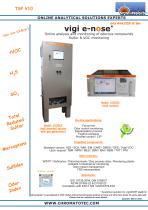
The vigi e-nose is an analytical instrument that simultaneously provides chemical and olfactive fingerprinting for volatile organic compounds (VOCs), sulfur compounds and other odorant molecules such as ammonia. It supports correlation with human sensory evaluation and can be trained with sensory samples to study compliance with standards such as ASTM 679‑E04 and EN 13725.
Main features
Technical Specifications (extracted)
Applications and notes
The vigi e-nose is designed for odor monitoring, control and research. It delivers combined chemical and olfactive fingerprints for correlation with sensory panels and dynamic olfactometry. Training with human sensory samples improves alignment with standards (ASTM 679‑E04, EN 13725) and supports environmental monitoring, process control and nuisance odor investigations.
The vigi e-nose is an analytical instrument that simultaneously provides chemical and olfactive fingerprinting for volatile organic compounds (VOCs), sulfur compounds and other odorant molecules such as ammonia. It supports correlation with human sensory evaluation and can be trained with sensory samples to study compliance with standards such as ASTM 679‑E04 and EN 13725.
Main features
- Chemical and olfactive fingerprinting in a single instrument
- Speciation of sulfur compounds (H2S, mercaptans, DMS, DMDS, etc.) using MEDOR technology
- TVOC quantification via embedded PID detector
- Automatic data validation and internal calibration with an embedded permeation tube
- Stand-alone operation without gas cylinders; a nitrogen generator is recommended for best performance
Technical Specifications (extracted)
- Detection limits*:
- Sulfur detector: < 1 ppb for H2S
- TVOC (PID): < 10 ppb on DMS
- Olfactometry limit: 50 OU e/m3
- *More sensitive configurations available on request
- Detection range:
- Selectable ranges: 0/10, 0/100 or 0/1000 (ppb or ppm)
- Calculated outputs: Odor Index, TVOC, Total Sulfur, OU e/m3 (with appropriate OU sensor)
- Relative Standard Deviation:
- RSD < 3% on concentration over 48 h
- RSD < 0.5% on retention time over 48 h
- < 1% on concentration at 100 ppb over 24 h
- Results / Data:
- Embedded computer (Windows-based) with LCD display
- 128 GB SSD internal storage
- Ethernet connectivity and remote-control capability
- Cycle time:
- Standard compounds (H2S, SO2, MM, EM, DMS, DMDS, DES): 600 s
- Extended panel (IPM, TBM, NPM, 2BM, IBM, NBM, MES, THT) with special application: 1200 s
- Gas supply and pneumatic:
- Carrier gas: dry air or N2 (3 bar) at ≤ 4 ml/min
- CALIB continuous: ~50 ml/min
- CALIB during validation (M52 configuration): ~250 ml/min
- Pneumatic valve consumption: 90 ml per commutation
- Sampling dryer flow: 150–200 ml/min
Applications and notes
The vigi e-nose is designed for odor monitoring, control and research. It delivers combined chemical and olfactive fingerprints for correlation with sensory panels and dynamic olfactometry. Training with human sensory samples improves alignment with standards (ASTM 679‑E04, EN 13725) and supports environmental monitoring, process control and nuisance odor investigations.


Exhibitions
Meet this supplier at the following exhibition(s):


Other CHROMATOTEC products
Odor and Odorants Monitoring Solutions


Related Searches
- CHROMATOTEC gas analyzer
- CHROMATOTEC concentration analyzer
- CHROMATOTEC monitoring analyzer
- CHROMATOTEC liquids analyzer
- CHROMATOTEC automatic analyzer
- Calibration system
- Desktop analyzer
- Dust analyzer
- Gas detector
- CHROMATOTEC process analyzer
- Portable analyser
- CHROMATOTEC continuous analyzer
- Water analyser
- Real-time analyser
- Oxygen analyser
- CHROMATOTEC integration analyzer
- Laboratory analyser
- Compact analyser
- Industrial detector
- CHROMATOTEC calibration analyzer
*Prices are pre-tax. They exclude delivery charges and customs duties and do not include additional charges for installation or activation options. Prices are indicative only and may vary by country, with changes to the cost of raw materials and exchange rates.