


- Metrology - Laboratory
- Analytical Instrumentation
- Stainless steel pycnometer
- ERICHSEN GmbH & Co. KG
Stainless steel pycnometer Model 475ISO 2811

Add to favorites
Compare this product
Characteristics
- Options
- stainless steel
- Certifications
- ISO 2811
- Volume
10 ml, 100 ml
(0.338140227 US fl oz, 3.38140227 US fl oz)
Description
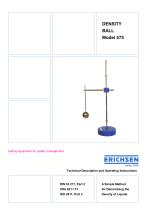
The Density balls, Model 475, are a rapid method for determining the density of paints, coating materials and other non-pasty fluids.
Test Principle
A body immersed in a liquid is subject to an upward buoyant force. Knowing the volume of the body allows calculation of the liquid density.
Design and Function
The device consists of a spherical immersion body made of stainless steel (material no. 1.4305) and a holding rod with a neck section. The sphere can be fixed to a laboratory balance or to a table stand with swivel arm using an adjustable holding device.
Test Procedure and Evaluation
Fill a glass beaker with specimen material large enough to immerse the density ball to the middle of the holding-rod neck. Condition sphere and specimen to 20 ± 0.5 C. Weigh the beaker with the specimen (W1), immerse the sphere to the middle of the neck and repeat the weighing (W2). Calculate density using rh ((W2 - W1)/V) rhL.
W1: weight in g of beaker with specimen before immersion
W2: weight in g after immersing the sphere
V: volume in ml of the sphere up to the middle of the holding-rod neck (10 ml)
rhL: air density 0.0012 g/ml
Report the determined density with an accuracy of 0.001 g/ml and specify the reference temperature. Remove air bubbles from the liquid and from the sphere before measurement. The method is not suitable for rapidly sedimenting specimens; in such cases use a pycnometer (Model 290).
Important Notice
Due to the relatively high mass of the solid-turned sphere, hold the rod with the ball vertically to avoid undue stress on the neck section; do not shake off the liquid or load the ball laterally.
Reference Class
All versions of Model 475 are supplied with a Manufacturers Certificate M in accordance with DIN 55 350-18. The certificate includes, among others:
Test temperature
Ball volume
Product identification
Test equipment used with calibration status
Date
Name of inspector
Standards
DIN 53 217 Part 2
VDA 621-113
ISO 2811 Part 2
Characteristics / technical specifications:
Volume: 10 ml / 100 ml
Volume tolerance: ± 0.1 % (at 20 C)
Material: steel (stainless steel sphere, material no. 1.4305)
Recommended test temperature: measurement at 20 ± 0.5 C
Portable / Stationary: Stationary (fixing to laboratory balance or table stand)
Test Principle
A body immersed in a liquid is subject to an upward buoyant force. Knowing the volume of the body allows calculation of the liquid density.
Design and Function
The device consists of a spherical immersion body made of stainless steel (material no. 1.4305) and a holding rod with a neck section. The sphere can be fixed to a laboratory balance or to a table stand with swivel arm using an adjustable holding device.
Test Procedure and Evaluation
Fill a glass beaker with specimen material large enough to immerse the density ball to the middle of the holding-rod neck. Condition sphere and specimen to 20 ± 0.5 C. Weigh the beaker with the specimen (W1), immerse the sphere to the middle of the neck and repeat the weighing (W2). Calculate density using rh ((W2 - W1)/V) rhL.
W1: weight in g of beaker with specimen before immersion
W2: weight in g after immersing the sphere
V: volume in ml of the sphere up to the middle of the holding-rod neck (10 ml)
rhL: air density 0.0012 g/ml
Report the determined density with an accuracy of 0.001 g/ml and specify the reference temperature. Remove air bubbles from the liquid and from the sphere before measurement. The method is not suitable for rapidly sedimenting specimens; in such cases use a pycnometer (Model 290).
Important Notice
Due to the relatively high mass of the solid-turned sphere, hold the rod with the ball vertically to avoid undue stress on the neck section; do not shake off the liquid or load the ball laterally.
Reference Class
All versions of Model 475 are supplied with a Manufacturers Certificate M in accordance with DIN 55 350-18. The certificate includes, among others:
Test temperature
Ball volume
Product identification
Test equipment used with calibration status
Date
Name of inspector
Standards
DIN 53 217 Part 2
VDA 621-113
ISO 2811 Part 2
Characteristics / technical specifications:
Volume: 10 ml / 100 ml
Volume tolerance: ± 0.1 % (at 20 C)
Material: steel (stainless steel sphere, material no. 1.4305)
Recommended test temperature: measurement at 20 ± 0.5 C
Portable / Stationary: Stationary (fixing to laboratory balance or table stand)
Catalogs
Exhibitions
Meet this supplier at the following exhibition(s):

Other ERICHSEN GmbH & Co. KG products
Density


Related Searches
- Spectrophotometer
- USB spectrophotometer
- Color measurement spectrophotometer
- Portable spectrophotometer
- ERICHSEN film applicator
- Reflectance spectrophotometer
- Compact spectrophotometer
- 220 V spectrophotometer
- 110 V spectrophotometer
- LED spectrophotometer
- ERICHSEN automatic film applicator
- Pycnometer
- Gloss measurement spectrophotometer
- ERICHSEN adjustable film applicator
- Stainless steel film applicator
- 4-sided film applicator
- ERICHSEN micrometric film applicator
- Baker type film applicator
- Spiral film applicator
- Casting knife film applicator
*Prices are pre-tax. They exclude delivery charges and customs duties and do not include additional charges for installation or activation options. Prices are indicative only and may vary by country, with changes to the cost of raw materials and exchange rates.