


- Metrology - Laboratory
- Analytical Instrumentation
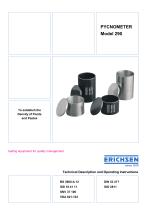
- Stainless steel pycnometer
- ERICHSEN GmbH & Co. KG
Paint pycnometer Model 290stainless steelISO

Add to favorites
Compare this product
Characteristics
- Options
- for paint, stainless steel
- Certifications
- ISO
- Volume
50 ml, 100 ml
(1.690701135 US fl oz, 3.38140227 US fl oz)
Description
The Model 290 pycnometers are used to determine the density of paints and other liquid or paste-like products. The density (r) of a substance is the quotient of its mass (m) and its volume (V). The reference temperature for the density of paints is 20 C, unless otherwise agreed. The density at 20 C is designated as r20. The pycnometers used to determine the density are filled with the liquid or paste to be tested. The density is calculated from the weight difference between the filled and empty pycnometer and the known filling volume.
Design and Function
The Pycnometers consist of a container and a lid with an overflow hole. There are two versions of Pycnometers available:
Test Procedure
After being brought to 20 C the Pycnometer is weighed and then filled with the specimen material, also at a temperature of 20 C, up to a level just below the top edge, in such a way that trapping of air is avoided. The lid is then placed into position with a light turning movement and surplus material escaping through the overflow hole is wiped off. The instrument is then weighed again. To open the Pycnometer a special opening
aid can be supplied as accessory. For exact calculations please refer to the formula described in DIN 53 217 - Part 2.
All Models 290 are supplied with a Manufacturer’s Certificate M in accordance with DIN 55 350-18 that includes among others the following information:
Design and Function
The Pycnometers consist of a container and a lid with an overflow hole. There are two versions of Pycnometers available:
- Instruments made of anodized aluminium
- Instruments made of stainless steel
- 50 ccm
- 100 ccm.
Test Procedure
After being brought to 20 C the Pycnometer is weighed and then filled with the specimen material, also at a temperature of 20 C, up to a level just below the top edge, in such a way that trapping of air is avoided. The lid is then placed into position with a light turning movement and surplus material escaping through the overflow hole is wiped off. The instrument is then weighed again. To open the Pycnometer a special opening
aid can be supplied as accessory. For exact calculations please refer to the formula described in DIN 53 217 - Part 2.
All Models 290 are supplied with a Manufacturer’s Certificate M in accordance with DIN 55 350-18 that includes among others the following information:
- Volume (in cm3) of Pycnometer
- Product indification
- Test equipment used with calibration status
- Date
- Name of inspector
Catalogs
Exhibitions
Meet this supplier at the following exhibition(s):

Other ERICHSEN GmbH & Co. KG products
Density


Related Searches
- Spectrophotometer
- USB spectrophotometer
- Color measurement spectrophotometer
- Portable spectrophotometer
- Reflectance spectrophotometer
- ERICHSEN film applicator
- Compact spectrophotometer
- 220 V spectrophotometer
- 110 V spectrophotometer
- LED spectrophotometer
- ERICHSEN automatic film applicator
- Pycnometer
- Gloss measurement spectrophotometer
- ERICHSEN adjustable film applicator
- Stainless steel film applicator
- 4-sided film applicator
- ERICHSEN micrometric film applicator
- Baker type film applicator
- Spiral film applicator
- Casting knife film applicator
*Prices are pre-tax. They exclude delivery charges and customs duties and do not include additional charges for installation or activation options. Prices are indicative only and may vary by country, with changes to the cost of raw materials and exchange rates.