

- Metrology - Laboratory
- Metrology and Test Equipment
- Temperature test bench
- GÖPEL electronic GmbH

- Products
- Catalogs
- News & Trends
- Exhibitions
Endurance test bench CARMEN temperaturepowerautomatic

Add to favorites
Compare this product
Characteristics
- Test type
- power, temperature, endurance
- Operating mode
- automatic
- Test material
- vehicle, for electric motors
Description
Electric motors must not only be highly efficient but also withstand adverse environmental conditions and operate reliably over the entire service life of a vehicle. Depending on the application, such motors must also be controllable in their power output or remain in sleep mode until they are "woken up" by commands from the bus system in the vehicle.
Manufacturers and suppliers serve a global market with applications in the temperature range from -40 °C to well over 70 °C and with enormous humidity. These, sometimes extreme, climatic conditions have to be simulated over several weeks or months during the validation of the engines in endurance tests.
CARMEN repeatedly runs the above-mentioned load scenarios under climatic conditions over a very long period of time and monitors thereby the parameterised limits. In a selection or random sampling test, components are tested for fatigue and wear by means of load tests, e.g. under pressure and temperature changes.
Applications
These CARMEN endurance test systems are designed in such a way that a gap-free and time-synchronous recording of all measurement data over a long period of time is guaranteed and enables subsequent analysis. For reasons of time, several test objects must usually be tested simultaneously (up to 4 channels) in endurance testing. CARMEN therefore controls several test sections in parallel and records or logs the results.
Since not all working ranges from idling to block usually have to be controlled dynamically and without gaps in the service life test, simpler hysteresis brakes, mechanically fixed brakes or even systems without a load unit can also be implemented here.
Catalogs
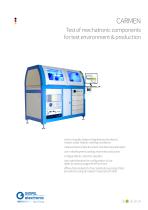
CARMEN
4 Pages
Automotive Test Solutions
17 Pages
Exhibitions
Meet this supplier at the following exhibition(s):

Other GÖPEL electronic GmbH products
Test Systems


*Prices are pre-tax. They exclude delivery charges and customs duties and do not include additional charges for installation or activation options. Prices are indicative only and may vary by country, with changes to the cost of raw materials and exchange rates.
About DirectIndustry
DirectIndustry is a marketplace that offers B2B players a complete experience, from product sourcing to purchase. DirectIndustry is an entity of VirtualExpo Group.
Are you a buyer?
Are you a supplier?