

- Packaging - Logistics - Handling
- Conveying
- Driven roller conveyor
- Maschinenbau Kitz GmbH

- Company
- Products
- Catalogs
- News & Trends
- Exhibitions
Roller conveyor RBF 2000driven rollercurvedinclined


Add to favorites
Compare this product
Characteristics
- Technology
- roller, driven roller
- Form
- inclined, curved, straight
- Function
- transport, for materials handling, transfer, accumulation
- Construction
- modular, roller
- Drive mechanism
- belt-driven, non-motorized, motorized
- Transported product
- for cardboard boxes, for containers, tray
- Applications
- for medium loads
- Sector
- for logistics
- Other characteristics
- aluminium
- Maximum load
Max.: 400 kg
(881.849 lb)- Speed
Min.: 0 m/s
(0 ft/s)Max.: 1.67 m/s
- Effective width
Min.: 320 mm
(13 in)Max.: 700 mm
(28 in)- Length
Max.: 6,000 mm
(236.22 in)
Description
Overview
The roller conveyor RBF 2000 is a modular conveyor system for intralogistics and production logistics, configurable from standard modules to meet complex layouts and application requirements. Suitable for transporting containers, boxes and trays up to 55 kg per item. Available modules include straight sections (motor driven rollers, gearmotors or gravity), curves, aligners, infeed/outfeed modules, 90° transfer and multi-transfer units. The conveyor frame uses anodised aluminium profiles with concealed cable routing for a compact, durable and tidy installation that integrates into the mk modular system.
Key functional principles
Modules and functions
Design and construction
Accessories
Benefits
Technical specifications
The roller conveyor RBF 2000 is a modular conveyor system for intralogistics and production logistics, configurable from standard modules to meet complex layouts and application requirements. Suitable for transporting containers, boxes and trays up to 55 kg per item. Available modules include straight sections (motor driven rollers, gearmotors or gravity), curves, aligners, infeed/outfeed modules, 90° transfer and multi-transfer units. The conveyor frame uses anodised aluminium profiles with concealed cable routing for a compact, durable and tidy installation that integrates into the mk modular system.
Key functional principles
- Zone-operated 24 V motor driven rollers enable zero-pressure accumulation (ZPA): the conveying path is divided into zones, each driven separately so only one item is present per zone; zones communicate so items stop automatically when the next zone is occupied.
- Motor power transmission: motor driven rollers transmit power to additional rollers via poly-V or V-ribbed belts.
- Geared roller conveyors: gearmotor-driven rollers use pulleys for cost-effective long-distance transport.
- Gravity roller conveyors: non-powered transport for gravity feed or manual feeding; brake rollers available on request.
Modules and functions
- Straight sections: powered (motor driven rollers), geared or gravity-driven; segment length up to 6000 mm (total length unlimited via connection).
- Curve modules (45°/90°): conical rollers (plastic cones on steel rollers) maintain product orientation through direction changes; curves can be driven by one or more motor driven rollers depending on length, load and speed.
- Alignment roller conveyors: driven rollers tilt to move products laterally toward side rails for alignment before processing units or to reduce usable width.
- 45° infeed/outfeed modules: staggered rolls enable merging or branching of conveyor flows (merge two conveyors or branch with multi-transfer).
- Multi-transfer module: omnidirectional rollers arranged perpendicular to each other to discharge products at 45° while maintaining orientation or at 90° where products stop briefly and orientation is changed; configurations for alignment, rotation or U-turn on request.
- 90° transfer module: transfers products perpendicular to the flow, changing orientation; mounted in a motor driven roller conveyor (ZPA) with 75 mm pitch; adaptable layouts (L, T, cross) and belt guide arrangements to match conveyor width and product base dimensions.
Design and construction
- Conveyor frame: two anodised aluminium frame profiles, perforated throughout; upper section with hexagonal holes for spring-loaded roller axles, lower section with round holes for crossbeams and accessories.
- Concealed cable routing within the conveyor frame profile for tidy electrical installation and easy integration of sensors and controls.
Accessories
- Stands for straight, curved and inclined sections.
- Side rails in fixed or adjustable designs.
- Light barriers (fixed or adjustable) for sensing and control logic.
- Cable entry points and guides for sensor cables and additional accessories; brake rollers on request.
Benefits
- Standardised modules enable implementation of complex route layouts.
- Durable, low-maintenance design for reliable continuous operation.
- High-performance, energy-efficient drive options with decentralised control capability.
- Concealed cable routing and modular details simplify electrical installation and maintenance.
- Flexibly expandable and adaptable to changing requirements.
Technical specifications
- Widths (standard): 320, 400, 420, 500, 620, 700 mm (other widths on request).
- Length per segment: up to 6000 mm; total length unlimited by connecting segments.
- Total load: up to 400 kg (maximum 55 kg per conveyed item; other capacities on request).
- Speed: up to 100 m/min.
- Rollers: diameter Ø 50 mm (standard for RBF 2000).
- Modules available: straight (powered/gravity), curves, aligners, infeed/outfeed, 90° transfer, multi-transfer.
- Drive options: zone-operated 24 V motor driven rollers (ZPA), gearmotors, belt-driven roller transmissions (poly-V or V-ribbed belts).
- Curve design: conical rollers (plastic cones on steel rollers) to maintain product orientation through direction changes.
VIDEO
Catalogs
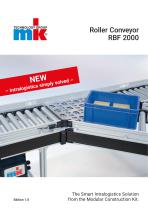
Roller conveyor RBF 2000
28 Pages
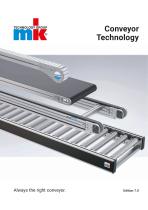
mk Conveyor Technology
428 Pages
Other Maschinenbau Kitz GmbH products
Roller Conveyors


Related Searches
- Maschinenbau Kitz conveyor
- Maschinenbau Kitz transport conveyor
- Maschinenbau Kitz belt conveyor
- Maschinenbau Kitz horizontal conveyor
- Conveyor for the food industry
- Roller rail conveyor
- Electric drive conveyor
- Maschinenbau Kitz inclined conveyor
- Maschinenbau Kitz chain conveyor
- Machine foot
- Materials handling conveyor
- Food conveyor
- Maschinenbau Kitz modular conveyor
- Bulk products conveyor
- Maschinenbau Kitz pallet conveyor
- Feeding conveyor
- Discharge conveyor
- Elastomer foot
- Maschinenbau Kitz transfer conveyor
- Curved rail conveyor
*Prices are pre-tax. They exclude delivery charges and customs duties and do not include additional charges for installation or activation options. Prices are indicative only and may vary by country, with changes to the cost of raw materials and exchange rates.