


- Metrology - Laboratory
- Optical Component
- Glass lens element
- MICRO-CONTROLE / Spectra-Physics
Aspherical lens element KPA seriesglassprecisionoptical

Add to favorites
Compare this product
Characteristics
- Material
- glass
- Optical characteristics
- aspherical
- Applications
- optical, precision, coupling
- Other characteristics
- focusing, CNC polished
- Diameter
Max.: 50 mm
(1.97 in)Min.: 15.5 mm
(0.61 in)- Wavelength
Max.: 50 mm
(1.969 in)Min.: 11.3 mm
(0.445 in)
Description
Our uncoated precision polished aspheric lenses are computer-optimized to achieve diffraction limited optical performance over high numerical apertures without requiring multiple elements. This may be used to reduce weight, complexity and cost for optical systems.
•Uncoated L-BAL 35 (589/611) substrates
•Computer optimized to provide diffraction limited performance
•Low f-numbers for optimal light gathering and focusing
•Reduces spherical aberrations
Advantage of Aspheric Lenses
In applications that require large acceptance angles, such as light gathering for illumination, spherical lenses are unsuitable due to spherical aberration, or the effect of refractive power of a spherical surface becoming greater with increasing aperture. Aspheric lenses maintain constant focal length or very high NA, avoiding the need for multiple elements to correct spherical aberration. This simplifies system design by reducing weight and component count. It also results in less transmission loss, and less ghosting due to having fewer surfaces. The primary drawback of aspheric lenses is off-axis performance is poor. This is not a problem for coupling to and from optical fibers or collimating light sources, but aspheric lenses are not usable over a wide field of view.
Efficiently Focus or Collect Light
Our Precision Aspheric Lenses have diffraction limited performance on axis, and are available in a range of high numerical apertures. They are ideal for applications such as coupling light into and out of optical fibers, efficiently collecting output from optical sources, or focusing beams onto small high speed detectors.
Catalogs
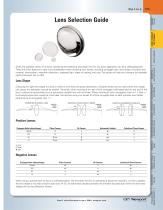
Spherical and aspherical lenses
35 Pages

newport ressource
1640 Pages
Other MICRO-CONTROLE / Spectra-Physics products
Optics


Related Searches
- Glass lens element
- Optical filter
- Spectrum lens element
- Optical prism
- Optical window
- Colored optical filter
- Optical lens element
- Visible lens element
- Glass optical prism
- Convex array lens element
- Laser lens element
- Round mirror
- Spherical lens element
- Crystal lens element
- UV lens element
- Round optical window
- Silica lens element
- Glass optical filter
- Fused silica lens element
- Plano-convex lens element
*Prices are pre-tax. They exclude delivery charges and customs duties and do not include additional charges for installation or activation options. Prices are indicative only and may vary by country, with changes to the cost of raw materials and exchange rates.
About DirectIndustry
DirectIndustry is a marketplace that offers B2B players a complete experience, from product sourcing to purchase. DirectIndustry is an entity of VirtualExpo Group.
Are you a buyer?
Are you a supplier?