


Smart vision sensor solino®colorfor defect detectionfor optical detection


Add to favorites
Compare this product
Characteristics
- Type
- smart, color
- Applications
- for defect detection, for optical detection
- Other characteristics
- stand-alone, with LED light source
Description
Overview
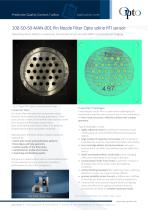
solino® transforms how surface quality control is performed by enabling continuous, automated monitoring across a wide field of view using Reflectance Transformation Imaging (RTI). The sensor captures the visual appearance of materials via BRDF-based optical detection combined with computational algorithms, revealing anomalies beyond human perception and operating reliably under typical factory lighting.
Key capabilities
Measured / derived surface attributes
How solino® works
Software and integration
solinoStudio configures and executes image capture and CPI generation. The Studio Playground enables manual acquisition and preview, with settings saved in project files for consistent batch capture and processing. Imaging Modules SDK and solino CPI SDK support integration into customer software. The system supports industrial automation interfaces (I/O, Ethernet/IP, OPC UA) and can feed data to AI-driven inspection and MES/QMS systems.
Product options — Field of View
Available sample capture sizes: 10 x 10 mm, 25 x 25 mm, 50 x 50 mm. Detailed factsheet available for specifications and optical performance.
Applications & examples
Typical examples include electronic components, metal parts, PCBs, coins, crystals, leather and other surfaces requiring automated surface quality inspection and predictive anomaly detection.
Technical specifications
solino® transforms how surface quality control is performed by enabling continuous, automated monitoring across a wide field of view using Reflectance Transformation Imaging (RTI). The sensor captures the visual appearance of materials via BRDF-based optical detection combined with computational algorithms, revealing anomalies beyond human perception and operating reliably under typical factory lighting.
Key capabilities
- Digitise the visual impression of any surface
- Assign a unique digital fingerprint (BRDF optical signature) to each sample
- Computational imaging sensor integrating hardware and software
- Plug & Play installation, ready for use in minutes
- Statistical and reproducible evaluation for batch inspection
- Eliminate specular reflections, including on shiny metals
- Predict product failure through AI correlation of BRDF data
Measured / derived surface attributes
- Colour, waviness and roughness
- Reflectivity and local inclination
- Surface stress indicators and microstructure anomalies
How solino® works
- Image acquisition: Photometric-stereo setup captures multiple images of the same surface using 64 calibrated LEDs with known positions and intensities.
- Compute BRDF-based images: From the 64-image set, solino generates specific images that reveal distinct visual information and remove irrelevant reflections; each image highlights particular characteristics (gloss, texture, structure).
- BRDF data extraction: Consistent capture and calibration produce complete BRDF information as a reliable data foundation for AI analysis.
- Anomaly visualization & analysis: Clean, repeatable Computational Particular Images (CPIs) are generated for anomaly heatmaps and AI image processing.
Software and integration
solinoStudio configures and executes image capture and CPI generation. The Studio Playground enables manual acquisition and preview, with settings saved in project files for consistent batch capture and processing. Imaging Modules SDK and solino CPI SDK support integration into customer software. The system supports industrial automation interfaces (I/O, Ethernet/IP, OPC UA) and can feed data to AI-driven inspection and MES/QMS systems.
Product options — Field of View
Available sample capture sizes: 10 x 10 mm, 25 x 25 mm, 50 x 50 mm. Detailed factsheet available for specifications and optical performance.
Applications & examples
Typical examples include electronic components, metal parts, PCBs, coins, crystals, leather and other surfaces requiring automated surface quality inspection and predictive anomaly detection.
Technical specifications
- Product name: solino® (computational imaging RTI sensor)
- Optical principle: BRDF (Bidirectional Reflection Distribution Function) measurement
- Illumination: 64 white LEDs arranged in a calibrated dome
- Measured outputs: colour, waviness, roughness, reflectivity, inclination, surface stress indicators, microstructure anomalies
- Sample size range: designed for samples between 10 x 10 mm and 50 x 50 mm (depending on FOV option)
- Field of view options: 10 x 10 mm; 25 x 25 mm; 50 x 50 mm
- Software: solinoStudio (live display, CPI preview, project files, batch processing)
- SDKs: Imaging Modules SDK and solino CPI SDK for integration
- Industrial interfaces: I/O, Ethernet/IP, OPC UA (for inline automation and MES/QMS logging)
- Image processing: CPI generation and >200 analysis/evaluation algorithms available in the Studio environment
- Typical processing time: depends on PC hardware; can be under 5 seconds per capture on adequate systems
- Use cases: automated surface inspection, anomaly detection, AI-driven predictive quality control
VIDEO
Catalogs


Exhibitions
Meet this supplier at the following exhibition(s):


Other OPTO products
Predictive Quality Control with RTI Vision Sensor solino® for High-Precision Surface Analysis


Related Searches
- Digital camera system
- Visible camera system
- CMOS camera module
- Industrial camera system
- Full-color camera system
- Surveillance camera
- Calibration system
- USB camera module
- Detection imager
- Monochrome camera module
- Vision processing camera
- Inspection system
- Gigabit Ethernet camera
- Compact camera module
- Inspection camera system
- Robust camera
- Portable calibration system
- Automated inspection system
- CCD video camera
- High-performance camera module
*Prices are pre-tax. They exclude delivery charges and customs duties and do not include additional charges for installation or activation options. Prices are indicative only and may vary by country, with changes to the cost of raw materials and exchange rates.
About DirectIndustry
DirectIndustry is a marketplace that offers B2B players a complete experience, from product sourcing to purchase. DirectIndustry is an entity of VirtualExpo Group.
Are you a buyer?
Are you a supplier?