


Optical inspection system solino®electro-opticalmulti-spectralsemiconductor


Add to favorites
Compare this product
Characteristics
- Technology
- optical, camera, electro-optical, multi-spectral, digital, 2D, solid-state, AI, backscatter, non-contact, LED, CMOS, with dynamic range analysis, semiconductor, fluorescence
- Operational mode
- automatic, automated
- Type
- quality control, for defect detection, surface defect, visual, surface, for reflective surfaces, BGA, color, damage detection
- Applications
- for production, for the packaging industry, for the automotive industry, for the electronics industry, for the pharmaceutical industry, for the printing industry, for PCB, for the aerospace industry, for non-destructive testing, for the metallurgical industry
- Product applications
- for cables, for wafers, film, weld seam, fabric, for composite structure, for aluminum plate, solar cell string, for steel plates, for transparent parts
- Other characteristics
- high-resolution, computer-controlled, non-contact
Description
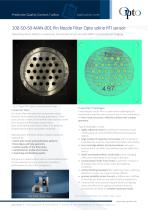
Pin Nozzle Filter Opto solino RTI sensor
100-SO-10-MAN-001 / AN_SO_PN_26-05
Customer task: Pin nozzle filters are precision micro‑perforated components used in filtration, fluid control and dosing. Manufacturers need reliable inspection to verify micro‑hole arrays, hole geometry, edge condition, surface finish and contamination inside holes.
Inspection challenges: Conventional vision struggles with these parts due to micro‑scale repetitive features and reflective metal surfaces. Typical challenges include:
Technology principle: The solino® RTI sensor applies BRDF‑based computational imaging. In milliseconds it captures a series of 64 images under multi‑directional illumination and reconstructs reflectance information to reveal surface structures otherwise hidden. Key elements:
Application: The solino® 50×50 sensor inspects pin nozzle filters after drilling, machining or finishing. Typical targets:
Technology benefits: Controlled multi‑directional illumination and computational reconstruction improve detection of:
Solution architecture: Typical system components:
Conclusion: By combining controlled multi‑directional illumination with BRDF‑based computational imaging, the solino® RTI sensor reveals micro‑scale surface structures and defects that conventional vision misses. This enables reliable inspection of pin nozzle filters, earlier defect detection and consistent quality for filtration and fluid control applications.
100-SO-10-MAN-001 / AN_SO_PN_26-05
Customer task: Pin nozzle filters are precision micro‑perforated components used in filtration, fluid control and dosing. Manufacturers need reliable inspection to verify micro‑hole arrays, hole geometry, edge condition, surface finish and contamination inside holes.
Inspection challenges: Conventional vision struggles with these parts due to micro‑scale repetitive features and reflective metal surfaces. Typical challenges include:
- strong specular reflections and glare on polished or machined metals
- hundreds of small, repetitive holes requiring consistent detection
- burrs and edge defects at hole boundaries that affect flow
- depth and shadow variations inside holes that alter appearance with lighting
- particles, residues or blockages inside micro‑holes
- surface finishing variations (machining marks, polishing differences) that mask defects
- process variability across the component causing inconsistent surfaces
Technology principle: The solino® RTI sensor applies BRDF‑based computational imaging. In milliseconds it captures a series of 64 images under multi‑directional illumination and reconstructs reflectance information to reveal surface structures otherwise hidden. Key elements:
- 64 multi‑directional LED illumination (integrated dome)
- photometric stereo image capture
- reflectance‑based surface reconstruction
- computational defect enhancement
Application: The solino® 50×50 sensor inspects pin nozzle filters after drilling, machining or finishing. Typical targets:
- micro‑hole arrays and perforation patterns
- bore edges and hole geometry
- filter plate surface finish
- contamination, particles and blockages inside holes
- structural uniformity across the component
Technology benefits: Controlled multi‑directional illumination and computational reconstruction improve detection of:
- burrs and edge defects around micro‑holes
- contamination or blockages inside holes
- micro scratches and machining marks
- surface roughness variations across the plate
Solution architecture: Typical system components:
- solino® RTI sensor with integrated 64 LED dome illumination
- high‑resolution 20 MP industrial camera (system component)
- solinoStudio software for acquisition, reconstruction and analysis
- place filter component under the solino® sensor
- capture a series of images under varying illumination directions
- reconstruct surface reflectance computationally
- analyze and visualize results in solinoStudio
Conclusion: By combining controlled multi‑directional illumination with BRDF‑based computational imaging, the solino® RTI sensor reveals micro‑scale surface structures and defects that conventional vision misses. This enables reliable inspection of pin nozzle filters, earlier defect detection and consistent quality for filtration and fluid control applications.
- Technical specifications:BRDF‑based computational imaging principle
- Capture of 64 images under multiple illumination directions
- 64 multi‑directional LED illumination (integrated dome)
- Photometric stereo capture and reflectance‑based surface reconstruction
- Computational defect enhancement and structural CPI imaging modes
- Typical sensor: solino® 50×50 sensor / solino® RTI sensor
- Item number referenced on page: 100-SO-50-MAN-001 solino® 50x50-Viewer & Stand
- High‑resolution 20 MP industrial camera (system component)
- solinoStudio software for acquisition, reconstruction and analysis
- Compact design for integration into automated production or inspection stations
VIDEO
Catalogs


Exhibitions
Meet this supplier at the following exhibition(s):


Other OPTO products
Predictive Quality Control with RTI Vision Sensor solino® for High-Precision Surface Analysis


Related Searches
- Digital camera system
- Visible camera system
- CMOS camera module
- Industrial camera system
- Full-color camera system
- Surveillance camera
- Calibration system
- USB camera module
- Detection imager
- Monochrome camera module
- Vision processing camera
- Inspection system
- Gigabit Ethernet camera
- Compact camera module
- Inspection camera system
- Robust camera
- Portable calibration system
- Automated inspection system
- CCD video camera
- High-performance camera module
*Prices are pre-tax. They exclude delivery charges and customs duties and do not include additional charges for installation or activation options. Prices are indicative only and may vary by country, with changes to the cost of raw materials and exchange rates.
About DirectIndustry
DirectIndustry is a marketplace that offers B2B players a complete experience, from product sourcing to purchase. DirectIndustry is an entity of VirtualExpo Group.
Are you a buyer?
Are you a supplier?