


- Company
- Products
- Catalogs
- News & Trends
- Exhibitions
3-axis accelerograph Guardian DAtriaxialMEMSfor continuous structure monitoring

Add to favorites
Compare this product
Characteristics
- Number of axes
- 3-axis, triaxial
- Technology
- MEMS
- Other characteristics
- for continuous structure monitoring, digital output, IP67, seismic, programmable
- Acceleration range
Min.: -98 m/s²
(-322 ft/s²)Max.: 98 m/s²
(322 ft/s²)- Frequency
Min.: 10 Hz
Max.: 1,000 Hz
Description
Brief description
Compact, flexible accelerograph with web-based recording software for structural vibration monitoring and threshold alerting.
Main features
Uses internal flash memory for acceleration data storage and supports multiple internet connectivity methods. Operates as FTP/SFTP client and SFTP server and supports real-time transfer protocols such as SeedLink for integration with common software (e.g., SeisComP). Device management via Seismic Web Configurator (SWC) provides full configuration, status monitoring, data handling and real-time waveform display. Available with ±2g full scale and optional ±4g, ±8g. Designed for efficient performance per cost.
Optional configurations
Applications
Technical specifications — Guardian DA
Sensor type: MEMS accelerometer
Axes: 3 orthogonally oriented axes
Full scale: ±2g (optional ±4g, ±8g)
Dynamic range: 73 dB @1000 sps, 83 dB @100 sps, 93 dB @10 sps (2g model)
Noise density: 22.5 μg/√Hz typ
Technical specifications — Guardian DA-Plus
Sensor type: MEMS accelerometer
Axes: 3 orthogonally oriented axes
Full scale: >±10g
Dynamic range: 125 dB @1000 sps, 141 dB @100 sps, 157 dB @10 sps
Noise density: 0.25 μg/√Hz typ @100 sps
General specifications (Guardian DA and DA-Plus)
Sampling rates: 10, 25, 50, 100, 200, 250, 500, 1000 sps
Time sync: RTC (0.5 ppm drift); NTP; optional GNSS
Recording modes: Continuous recording via SeedLink; event recording on configurable thresholds with selectable pre/post-trigger; signal statistics (min, max, mean, RMS) with intervals selectable from 10 to 100 s
Data storage: Internal 32 GB, internal microSD support
Data formats: Solgeo EVE, MiniSEED, ASCII, CSV
Environmental specifications
Operating temperature: -20 to +70 °C without internal battery; -20 to +50 °C with internal battery*
Storage temperature: -40 to +90 °C without internal battery; -20 to +50 °C with internal battery
Humidity: 0–100%
*Recommended temperature range is narrower during battery charging
Physical specifications
Weight: 1.2 kg
Dimensions (LxWxH): 130 mm x 160 mm x 80 mm
Enclosure: painted aluminium
Ingress protection: IP67
Power connector: 6-pin MIL-C-26482 terminal
Operational notes
Supports real-time data transmission and integration with acquisition systems and monitoring platforms; web interface for local/remote configuration and diagnostics.
Key features / technical summary
Compact, flexible accelerograph with web-based recording software for structural vibration monitoring and threshold alerting.
Main features
Uses internal flash memory for acceleration data storage and supports multiple internet connectivity methods. Operates as FTP/SFTP client and SFTP server and supports real-time transfer protocols such as SeedLink for integration with common software (e.g., SeisComP). Device management via Seismic Web Configurator (SWC) provides full configuration, status monitoring, data handling and real-time waveform display. Available with ±2g full scale and optional ±4g, ±8g. Designed for efficient performance per cost.
Optional configurations
- PoE (Power over Ethernet) power supply
- Internal battery (up to 20 h autonomy)
- Internal GNSS receiver for time synchronization
Applications
- Building vibration monitoring
- Operational modal analysis (OMA)
- Structural Health Monitoring (SHM)
- Earthquake Early Warning (EEW)
Technical specifications — Guardian DA
Sensor type: MEMS accelerometer
Axes: 3 orthogonally oriented axes
Full scale: ±2g (optional ±4g, ±8g)
Dynamic range: 73 dB @1000 sps, 83 dB @100 sps, 93 dB @10 sps (2g model)
Noise density: 22.5 μg/√Hz typ
Technical specifications — Guardian DA-Plus
Sensor type: MEMS accelerometer
Axes: 3 orthogonally oriented axes
Full scale: >±10g
Dynamic range: 125 dB @1000 sps, 141 dB @100 sps, 157 dB @10 sps
Noise density: 0.25 μg/√Hz typ @100 sps
General specifications (Guardian DA and DA-Plus)
Sampling rates: 10, 25, 50, 100, 200, 250, 500, 1000 sps
Time sync: RTC (0.5 ppm drift); NTP; optional GNSS
Recording modes: Continuous recording via SeedLink; event recording on configurable thresholds with selectable pre/post-trigger; signal statistics (min, max, mean, RMS) with intervals selectable from 10 to 100 s
Data storage: Internal 32 GB, internal microSD support
Data formats: Solgeo EVE, MiniSEED, ASCII, CSV
Environmental specifications
Operating temperature: -20 to +70 °C without internal battery; -20 to +50 °C with internal battery*
Storage temperature: -40 to +90 °C without internal battery; -20 to +50 °C with internal battery
Humidity: 0–100%
*Recommended temperature range is narrower during battery charging
Physical specifications
Weight: 1.2 kg
Dimensions (LxWxH): 130 mm x 160 mm x 80 mm
Enclosure: painted aluminium
Ingress protection: IP67
Power connector: 6-pin MIL-C-26482 terminal
Operational notes
Supports real-time data transmission and integration with acquisition systems and monitoring platforms; web interface for local/remote configuration and diagnostics.
Key features / technical summary
- Model: Guardian DA (variants including DA-Plus)
- Sensor: triaxial MEMS accelerometer
- Full scale: DA: ±2g (opt. ±4g, ±8g); DA-Plus: >±10g
- Dynamic range: up to 157 dB (DA-Plus @10 sps)
- Noise density: DA: 22.5 μg/√Hz; DA-Plus: 0.25 μg/√Hz @100 sps
- Sampling: up to 1000 sps
- Memory: 32 GB internal + microSD
- Formats: Solgeo EVE, MiniSEED, ASCII, CSV
- Synchronization: RTC, NTP, optional GNSS
- Protection: IP67; aluminium enclosure
- Optional power: PoE, internal battery (up to 20 h)
Catalogs
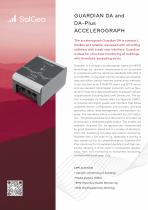
Guardian DA and DA-Plus
4 Pages
Other SOLGEO SRL products
BUILT-IN SENSORS


Related Searches
- Acceleration sensor
- Piezoelectric acceleration sensor
- Tilt sensor
- Uniaxial accelerometer
- Digital tilt sensor
- Triaxial accelerometer
- Compact acceleration sensor
- Analog accelerometer
- General purpose acceleration sensor
- MEMS acceleration sensor
- Voltage output acceleration sensor
- IP68 acceleration sensor
- Accelerometer with built-in electronics
- Rugged accelerometer
- High-sensitivity acceleration sensor
- G-force accelerometer
- IP67 acceleration sensor
- Low-noise acceleration sensor
- Low-frequency acceleration sensor
- Biaxial accelerometer
*Prices are pre-tax. They exclude delivery charges and customs duties and do not include additional charges for installation or activation options. Prices are indicative only and may vary by country, with changes to the cost of raw materials and exchange rates.
About DirectIndustry
DirectIndustry is a marketplace that offers B2B players a complete experience, from product sourcing to purchase. DirectIndustry is an entity of VirtualExpo Group.
Are you a buyer?
Are you a supplier?