



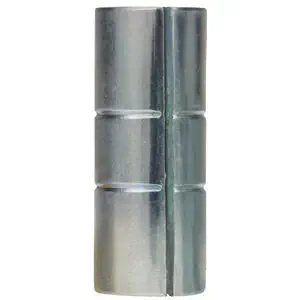
Compression limiter for plastic parts CL seriescarbon steelaluminumbrass

Add to favorites
Compare this product
Characteristics
- Options
- for plastic parts, carbon steel, aluminum, brass
Description
Metal Compression Limiters provide and maintain bolted joint integrity of a plastic assembly. Compression Limiters are designed to protect the plastic components of an assembly from the compressive loads generated when a bolt is tightened to its recommended tightening torque, thereby assuring that the joint remains intact throughout the life of the product.
SPIROL offers a range of both formed and machined Compression Limiters including split seam, moulded in, oval and solid wall designs. Each type of Compression Limiter is designed to accommodate different compressive loads, positional tolerances and installation methods. All formed Compression Limiters, except the Series CL220, are zinc plated and have a supplementary coating of trivalent passivation and an organic sealant for corrosion resistance. This finish provides 144 hours to white corrosion, and 384 hours to red corrosion when salt spray tested in accordance with ASTM B117. SPIROL’s Series CL220 Compression Limiters are coated with ArmorGalv®, a zinc alloy thermal diffusion coating that provides a minimum of 1000 hours corrosion resistance to red rust. Machined Limiters are manufactured from aluminium and brass, both of which have inherent corrosion resistant properties and thus do not require supplementary finishing.
The clearance between the bolt and the inside diameter of the installed Compression Limiter is adequate to meet normal misalignment. The Compression Limiter’s length should be designed to ensure it will bottom out against the surface under the bolt’s head and mating component. The appropriate length and length tolerance is application dependent. While the standard tolerance is sufficient to meet most needs, verification is recommended.
SPIROL offers a comprehensive line of split seam, moulded in, oval and solid wall designs to accommodate different compressive loads, positional tolerances and installation methods for bolts ranging in size from M3 to M12 and #4 to 3/8” - depending on the type of Compression Limiter. For simplicity, SPIROL has broken down the different types by the two different installation methods: Post Mould Installed Compression Limiters and Moulded-In Compression Limiters. Some series of Compression Limiters can be either pressed in or moulded in, while others can only be installed by one method.
- Recommended Tightening Torque: The integrity of the bolted joint requires that none of the components, including the bolt, be stressed beyond the elastic limit. SPIROL recommends a clamping load not to exceed 75% of the proof load of the bolt.
- Determination of Compression Limiter Length: The recommended maximum length of the Compression Limiter is the minimum thickness of the plastic component. This assures that when the proper load is applied to the bolt two critical conditions will be met: (1) The bolt will be in contact with the Compression Limiter, eliminating the possibility of creep. (2) The plastic host will always have a small amount of compression applied.
- Load Rating: SPIROL rates Compression Limiters by matching the load required to compress the Limiter 2.5% of its nominal length to the clamp load of the nominal sized fastener.
- Critical Design Guidelines:
1. Bolt is tightened to 75% of its proof load.
2. Bolt head applies a clamp load on the plastic and bottoms out on the Limiter.
3. Host thickness is greater than or equal to the length of the Limiter, and able to absorb the clamp load.
4. The installed Limiter is aligned with the Insert (when used) to prevent a jack-out condition.
5. Plastic compression ~ 3% - 5%.
6. Limiter is compressed between bolt’s head and mating component.
7. Correct hole size ensures retention of the Limiter.
8. The mating component can withstand compression force generated by bolt.
- Machined or Formed Compression Limiters:
- Machined: Best for short Compression Limiters (L:D ≤ 1), great for plastics with very low viscosity when moulding-in, can be supplied with a head for larger bearing surface, can be moulded-in or pressed into assembly, aluminium is lightweight and lead free.
- Formed: Less expensive, can be heat treated to withstand higher tightening torque, split seam can be pressed-into assembly, suitable for moulding-in with viscous materials, available in oval shape for extra clearance on one axis.
Technical Specifications / Features:
- Product type: Metal Compression Limiters
- Designs: Split seam, moulded in, oval, solid wall
- Materials: High carbon steel, low carbon steel, aluminium, brass
- Corrosion resistance: Zinc plating, trivalent passivation, ArmorGalv® coating
- Diameter range: M3 - M12, #4 - 3/8” (depending on type)
- Installation: Press-in, mould-in, or both (depending on series)
- Applications: Plastic assemblies requiring bolted joint integrity
- Compliance: Salt spray tested to ASTM B117


Exhibitions
Meet this supplier at the following exhibition(s):


Other SPIROL products
Compression Limiters




Related Searches
- SPIROL metal insert
- SPIROL threaded insert
- SPIROL round insert
- Metal washer
- Round washer
- SPIROL pin
- SPIROL metal pin
- Steel washer
- SPIROL brass insert
- SPIROL plastic insert
- Knurled insert
- SPIROL steel pin
- Flat washer
- Stainless steel pin
- Press-in insert
- SPIROL shim
- Aluminum insert
- Self-tapping insert
- Hexagon locknut
- SPIROL spring pin
*Prices are pre-tax. They exclude delivery charges and customs duties and do not include additional charges for installation or activation options. Prices are indicative only and may vary by country, with changes to the cost of raw materials and exchange rates.
About DirectIndustry
DirectIndustry is a marketplace that offers B2B players a complete experience, from product sourcing to purchase. DirectIndustry is an entity of VirtualExpo Group.
Are you a buyer?
Are you a supplier?