


Electronic crack meter ET-28


Add to favorites
Compare this product
Characteristics
- Options
- electronic
Description
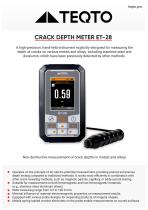
A high-precision, hand-held instrument explicitly designed for measuring the depth of cracks on various metals and alloys, including stainless steel and duralumin, which have been previously detected by other methods. The crack depth meter operates on the principle of AC electro-potential measurement, providing prompt and precise depth testing compared to traditional methods. It works most efficiently in combination with other crack-revealing methods, such as magnetic particle, capillary, or eddy-current testing.
- Suitable for measurement on both ferromagnetic and non-ferromagnetic materials (e.g., stainless steel, aluminum alloys).
- Wide measuring range from 0.2 to 100.0 mm.
- Minimal influence of material electromagnetic properties on measurement results.
- Equipped with various probe designs for inspecting products of irregular shapes.
- Mobile spring-loaded contact electrodes on the probe enable measurements on curved surfaces.
- Suitable for use in field, workshop, and laboratory conditions.
Application:
- Shafts, rolls, rolling mills, construction components, machines, and mechanisms
- Pipes, tubes, oil-and-gas pipelines
- Pressure vessels
- Energy industry devices
Stages of crack depth measuring:
- Setting the “0” – measure on an undamaged area of the object.
- Measuring crack depth – position the contact electrodes on opposite sides of the crack, and the depth measurement in mm will be displayed on the screen.
Requirements for control objects:
- Surface roughness of 40 Rz (10 Ra) or less.
- Stable electrical contact with the probe electrodes.
Technical specifications:
Characteristic | Values
--- | ---
Measuring range (crack depth) | 0.5 – 30 mm
Estimating range (approximate crack depth) | 30 – 100 mm
Measurement accuracy | ±(0.1h + 0.2 mm), where “h” is the crack depth
Maximum crack width (depending on probe design) | up to 3.5 mm
Minimum crack length | 5 crack depths, no less than 3 mm
Power supply | accumulator
Display lighting | yes
Automatic switch off | yes
Dimensions of electronic unit | 150х80х30 mm
Weight | 0.4 kg
Operating temperature range | +5 … +40 °C
Warranty | 1 year
Delivery set:
- Electronic unit
- Accumulator
- Probe “1×4”
- Test block with 3 cracks
- Charger
- Soft case
- Arm cuff for securing the device
- Carrying and storage bag
Accessories:
- Probe “2×2” for hard-to-reach areas (e.g., fillets)
- Probe “3+1” for cracks deeper than 30 mm (with external electrode)
Principles and applications of the electro-potential testing method:
- Identifying delaminations in sheet metals and casting defects.
- Assessing soldered joint quality.
- Detecting defective weld seams.
- Identifying delaminations in bimetallic plates.
- Measuring cracks in metallic components.
- Sorting or identifying metallic objects by conductivity.
Fundamentals of the electro-potential method: The electro-potential method (EPM) is the most widely used electrical NDT technique. It involves measuring the potential distribution on the surface of a test object to detect surface defects. Electric current (AC or DC) is supplied to the examined area, and the potential difference is measured using receiving electrodes. The value is used to evaluate the depth of surface defects as well as their dimensional parameters. The method is highly effective for evaluating crack depth, but may be less suitable for other defect types such as cavities or pores.
Limiting factors:
1. The reliability of crack depth assessment depends on the homogeneity and isotropy of the electrophysical properties of the test object’s material, primarily its specific electrical resistivity.
2. The electro-potential method is effective only if the defect has significant linear extension, as is typical for cracks. The defect's length must be at least three times its depth.
VIDEO
Catalogs
ET-28 - Crack depth meter
2 Pages
*Prices are pre-tax. They exclude delivery charges and customs duties and do not include additional charges for installation or activation options. Prices are indicative only and may vary by country, with changes to the cost of raw materials and exchange rates.