|
|
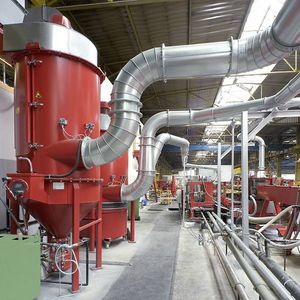
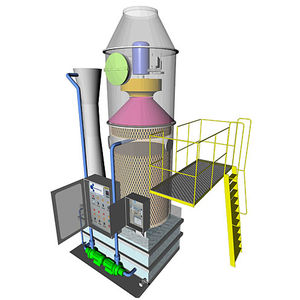
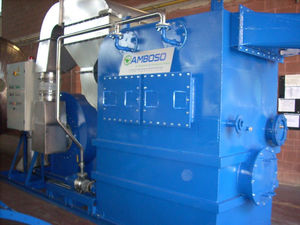
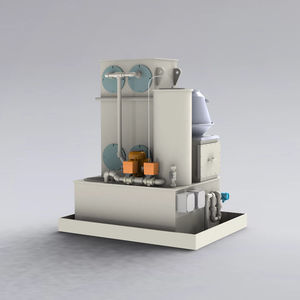
The Type N RotoClone is the best solution to a wide variety of dust collection needs. It combines high efficiency, low maintenance costs, low water usage, and flexibility in one rugged, well proven piece of equipment.
The Type N cleans the air by the combined action of centrifugal force and a thorough intermixing of water and dust-laden air. Our unique airfoil design impeller provides the complete scrubbing necessary to precipitate fine particles. Designed to maximize the cleaning effect of the energy used, the Type N can be selected to operate at specific efficiency levels for individual project requirements. The pressure drop can be varied from 5.3" to 11.7" w.g.
The Type N RotoClone is assembled of heavy gauge hot rolled steel. For highly corrosive conditions, the Type N can be fabricated of stainless steel or lined with coal-tar epoxy. The unit is available in three sludge disposal arrangements, with three water level control options to tailor to your needs.
|
|
|
|
|
|
Anguil's Chlorinated Oxidizers destroy halogenated organic acids and mixed organic vapor contaminants that are discharged from a variety of industrial process streams.
How the Chlorinated Oxidizer Works
The Chlorinated model is selected based on volume of airflow, contaminant type and desired destruction efficiency. Similar to a standard thermal or catalytic oxidizer, destruction of VOC-laden air is achieved through high temperature combustion with heat recovery to reduce operating costs by preheating incoming contaminants. When halogenated hydrocarbons such as chlorine, bromine and fluorine are present in the process gas, Anguil makes special considerations to design an emission control system that will not only protect against corrosion but also scrub the acids produced during oxidation.
Design Considerations:
*Temperature and residence times are increased to ensure halogen destruction efficiency
*Induced draft fan design is used to eliminate acid gas escape
*Critical components are upgraded to higher alloys to withstand the corrosive emissions
*External shrouds are added or vinyl ester coatings applied to prevent acid corrosion of the external shell
*When special coatings are applied they are subject to pre and post application inspections by a third party
*Acid Gas Scrubbers are incorporated into the system for further treatment of acidic emissions
*FRP (Fiberglass Reinforced Plastics) fan and ductwork are used when necessary
Available Options:
*Thermal, Catalytic or Direct-Fired oxidizers for chlorinated emission control
|
|
Series RVE 400 – 3200
Type of construction vertical, single-stage
Volume flow rate of waste air 500 – 50’000 m3 / h
Ø of columns 400 – 3200 mm
Heights 2500 – 9000 mm
Volume flow rate of washing medium 2 – 110 m3 / h
|
|
KLG/KLH MultiClean
Welded enclosure, oil-proof, with large maintenance doors. Models available with one stage (KLG model), and up to four stages, with filter-element clamp for the main filter (KLH model). The filter levels are configured vertically (one above the other).
Special features:
- Models available for up to 0.5 bar overpressure or sub-atmospheric pressure
- Use as last-chance filter with a Pred of 1 bar
- MultiCase filter mounting system can be used
- Can be washed out
- Grid dimensions: 610 / 610
- Equipment installed can be later changed (retrofitted)
- Surface is powder-coat finished; stainless steel also possible
- Snap-on, permanently elastic door gaskets
- Fittings for draining liquids
Application:
Oil and emulsion-mist extraction; dust extraction of medium-level concentrations (e.g., in pharmaceutical and chemical industries; with last-chance filter behind the dust filter, etc.)
|
|
Series RHE 315 – 1250 h
Type of construction horizontal, single or multi-stage
Volume flow rate of waste air 1’000 – 45’000 m3 / h
Width 1000 / 1700 mm
Heights 2500 / 2900 mm
Volume flow rate of washing medium 5 – 55 m3 / h
|
|
|
|
|
|
Sometimes referred to as an After-Burner, the direct fired thermal oxidizer uses a specially designed burner to raise the temperature of a pollutant laden air stream to a predetermined combustion temperature. In operation, the contaminated process exhaust is ducted into a burner chamber. Heat applied by the burner oxidizes the VOCs and HAPs creating harmless products of combustion (water and carbon dioxide). The clean, heated exhaust gas can then be discharged to the atmosphere or sent through an optional heat recovery system.
The Anguil DFTO can achieve over 99% hydrocarbon destruction rate efficiency. To achieve this, the heated air is kept in the combustion chamber for a specified amount of time, called the residence or dwell time. At the inlet to the combustion chamber turbulence is generated to mix the pollutants and oxygen molecules. Proper mixing of the combustion air and process streams not only provides high destruction efficiencies but also safe operation. The Anguil design minimizes the risk of explosion and takes complete advantage of the VOC laden exhaust stream to minimize auxiliary fuel needs. An optional burner system is available to burn inert process streams directly in the burner as fuel.
Anguil Advantage:
-Modular design for system flexibility and future expansion
-Pre-assembly and factory testing reduces installation costs
-PLC based controls guarantee proper system performance
-High destruction efficiencies for regulation compliance
-Safety shutdowns ensures safe operation
|
|
Epcon is an industry leader in Industrial Afterburner technology and can build a custom unit for stand alone or trailer mounted applications. We also offer different purchase/lease/rental agreements to suit any need.
Afterburners are ideal solutions for high solvent loading and fluctuating operating conditions. Flame arrestors are always installed between the vapor source and the thermal oxidizer. Burner capacities in the combustion chamber range from 0.5 to 2 mmBtuH.
Operating temperatures range from 1,250 to 1,800°F, and gas residence times are typically 1 second or less. These conditions cause the process stream's molecular structure to break down into simple carbon dioxide and water vapor.
|
|
Hitemp technology exclusive design features:
All 0.25" steel plate design, not thin sheet metal.
Easy access to all major components for repair and inspection
Both horizontal and vertical orientations available
Two-pass design for maximum turbulence and residence time
All 2200 f ceramic fiber insulation (not oven insulation)
70% efficient heat exchangers (by Exothermics Eclipse and Des Champs Labs)
PLC controls will interface with plant systems
|
|
Flow Rate: 5,000 10,000 15,000 20,000 DATA
Inlet Temp: 70 70 70 70 F
Outlet Temp: 1400 1400 1400 1400 F
Max Burner Input: 10.0 20.0 30.0 40.0 MM Btu
Gas Press: 0.5 0.5 0.5 0.5 PSI
Refractory Lining: 6 6 6 6 In
Chamber Size: 300 600 900 1,200 Cu.ft.
Residence Time: 1 1 1 1 Second
Destruction Eff.: 99 99 99 99 %
SHELL DIM. (OD)
72 84 96 96 DIA.
180 264 300 420 Length
|
|
|
|
|
|
Anguil's HCl Scrubber Module scrubs and neutralizes hydrochloric acid that is created during the oxidation of halogenated or mixed organic vapor contaminants.
How the HCl Scrubber Module Works:
The outlet of a Chlorinated Oxidizer, is directed to the Anguil HCl Scrubber Module. A recirculation pump injects large volumes of water into a hastelloy quench section, inducing vapor flow through the scrubber. The water quenches the hot vapor and absorbs a portion of the HCl. The gases exit the eductor and enter a countercurrent absorption column. Recirculating solution is fed to the top of the absorption column through a nozzle. The remaining hydrochloric acid vapors are absorbed into the solution. The gases pass through a mist eliminator before exiting the column. Sodium hydroxide is added to control pH in the neutral range.
System Components:
Each Standard HCl Scrubber Module is fabricated from FRP and includes hastelloy quench, absorption column (consisting of a cylindrical tower filled with polypropylene spherical media), common liquid sump, recirculation pump, flanged inlet and outlet, hastelloy spray nozzle and liquid level indicator. The system components are assembled on an epoxy-painted steel base that is weather-resistant and corrosion-resistant.
The HCl Scrubber Module is designed as part of Anguil's broad line of technologically advanced, yet user-friendly, air pollution control products.
Anguil strives to provide innovative pollution control technology including process analysis, engineering, equipment manufacturing, installation and post-sale 24-hour service.
|
|
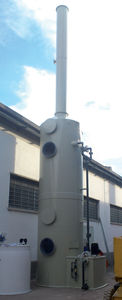
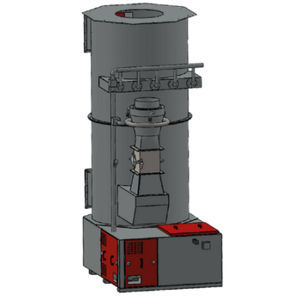
Hydrodinamic wet filter IDRODUST COMPACTI® is a hydrodynamic machine for removal of dust, vapours and gases by means of micro-mixing the gas to be treated with water. Mixing is realized in a duct with a specially designed shape, where water is dragged for the depression created by the fan, where polluted air is centrifuged to enable dust trapping and/or absorption of gases. A high performance drop separator on the outlet avoids dragging of water. Water circulates without the aid of pumps or spraying nozzles, ensuring the reliability of the machine, whose parts are not subject to wear or clogging, reducing maintenance requirements.
APPLICATIONS
Idrodust Compact hydrodynamic wet filters can be used for processing involving sparks or wet dusts
|
|
FRIDURIT® flexible fume scrubbers
The FRIDURIT fume scrubber C20 has been specially designed for decentralised washing of harmful substances for precise extraction directly at source. He is equipped with an integrated fan and can be placed anywhere in the laboratory, e.g. on the worktop, the floor or where the installation of a built-in fume scrubbers is not possible due to shortage of space. Please refrain from installing the fume scrubber C20 inside fume hoods.
|
|
|
More and more, companies operating air pollution control equipment today realize that the initial capital cost of an oxidizer system can be rapidly eclipsed by continued operating expenses if careful attention is not periodically given to the system. Here are ten tips to ensure your oxidizer is operating at peak performance. The first five tips focus on parameters end-users should know about their oxidizer systems, while the last five address energy reduction projects to be considered.
|
|
|
|
|
|
Packed bed system PBS
The horizontal packed bed system PBS, assures the absence of by pass of contaminants and provides a minimum efficiency of 99,9% in the elimination of the target contaminants.
It is designed to stay out of the protected environment and supply clean air and pressure inside the control rooms to protect the delicate electronic equipment that control processes in different kinds of plants.
The machine has two beds of pellets to assure the maximum protection against all kinds of gases.
Specifications
Gauge 14 of stainless steel. All welded.
Pre filter 40% of 2” of depth, with 6” of optional depth for the afterwards use of this filter.
Final filter 95%, of 6” of depth.
Aluminum guides for the filters.
Structural base of iron(protected with epoxy)
Sealed doors with juntas de neoprene
Closing doors with positive pressure and working at one quarter if a turn.
Turbine con motor TEFC A bed of pellets
Sample port. Magnehelic indicators for the pre filter and final filter sections.
|
|
SANTONI offers Gas Scrubbers using a variety of technologies, such as the following:
- Venturi Scrubbers
- Packed Bed Scrubbers
- Combination Venturi-cum-packed bed scrubbers
- Cyclone Scrubbers
- Spray Tower Scrubber
- Orifice Scrubbers
- Fluidized bed scrubbers
Applications:
- Removal of SO2/NOx from boiler flue gas
- Removal of solid particulate matter (SPM) from boiler flue gas
- Dust collection
- Acid fumes from various processes
- Recovery of Chromic acid from Chrome Plating plants
|
|
|
|
|
|
The Anguil Catalytic Oxidizer destroys toxic Volatile Organic Compounds (VOCs) that are discharged in industrial process exhausts. The catalytic reactor achieves destruction of the organics by the process of oxidation. The catalyst oxidizes the hydrocarbons to carbon dioxide and water vapor at significantly lower temperatures than thermal oxidizers.
How the Catalytic Oxidizer Works:
The Catalytic Oxidizer is designed based on volume of airflow, organic vapor concentrations and desired destruction efficiency. During operation, VOC-laden air is drawn into the system fan and is discharged into the system's heat exchanger. The air is preheated through the tube side of the heat exchanger and then passes the burner, where the contaminated air is raised to the operating temperature. As the VOC-laden air passes through the catalyst, an exothermic (heat releasing) reaction takes place. The VOCs in the air stream are converted to carbon dioxide and water vapor. The hot, purified air then passes on the shell side of the heat exchanger where the energy released by the reaction is used to preheat the incoming air. The heat exchanger minimizes the system's fuel consumption with the system being self-sustaining at low LEL levels. Finally, the contaminant-free air is exhausted into the atmosphere.
|
|
Epcon designs systems to accept various selections of catalyst, and with our own internal catalyst expert can assure correct application of our systems to various process exhaust streams. Customers can count on Epcon to design air pollution control systems or any number of custom systems specific to your process.
Catalytic OxidizerEpcon Catalytic Oxidizers convert process exhaust stream Volatile Organic Compounds into harmless amounts of carbon dioxide, water, and thermal energy - which are then safely discharged to the atmosphere. This process is known as oxidation. Catalytic Oxidation occurs through a chemical reaction between the VOC hydrocarbon molecules and a precious-metal catalyst bed that is internal to the oxidizer system.
|
|
TYPICAL HTT GAS/ELECTRIC CATOX SYSTEM
HTT shall supply one Fume Incineration System. The system shall use a gas burner or electric heaters to raise the temperature of the exhaust gases to the required operating temperature. This will assure maximum destruction of the VOC in the exhaust gas. The system shall be packaged complete with an integral preheat exchanger, Inconel sheath low watt density heating elements or gas burner, precious metal ceramic type catalyst module, refractory lined processing chamber, and the field installed stack.
CATOX SYSTEM CHAMBER
The Catox System shall be constructed of 304 stainless steel (Note: We use 316 L for HCl solvent applications) and insulated with a combination of Ceramic Fiber and high temperature insulating materials. The refractory shall be installed with SS anchors to maintain integrity. The lower chamber shall be constructed of carbon steel and coated with an acid resistant epoxy coating.
|
|
Flow Rate : 1000 1500 2000 3000 4000 5000 8000 10K 15K 20K SCFM
Inlet Temp: 70 70 70 70 70 70 70 70 70 70 F
Stack Outlet Temp: 270 270 270 270 270 270 270 270 270 270 F
Catalyst Inlet Temp: 550 550 550 550 550 550 550 550 550 550 F
Catalyst (95%): 1 1.5 2 3 4 5 8 10 15 20 Cu. ft.
Catalyst (98%): 2 3 4 6 8 10 16 20 30 40 Cu. ft.
|
|
|
|
|
|
NOx control systems (DeNOx)
Lowering NOx levels with selective catalytic reduction
Modern power plants reduce emissions to a minimum. For instance, the SCR is deployed following combustion to minimize nitrogen oxide emissions. This modern process produces nitrogen and water vapor; the nitrogen oxides are practically 100% removed.
The SCR technology is used preferably between economizer and air heater since it is here that it can best be operationally incorporated into the overall power plant picture.
HPE provides this DeNOx technology with the delivery of utility steam generators for firing coal.
The main units of a DeNOx plant are:
Ammonia /ammonium hydroxide storage and supply
Ammonia /ammonium hydroxide injection and blender systems
DeNOx reactor with rectifier and sootblower
Catalysts
HPE supplies this units as part of a turn-key installation.
The heart of the process is the catalyst. Plate or honeycomb catalysts are available for deployment in DeNOx systems. All the catalysts on the market can be used in our systems.
Special importance for proper and optimum catalyst operation is attached to ammonia and/or ammonium hydroxide injection and the blender system. The ideal requirements here are created by the static blender system used by HPE with a form of ammonia injection adapted to this blender system.
|
|
|
|
|
|
The Anguil Thermal Oxidizer achieves destruction of the organics by the process of combustion. All hydrocarbons are oxidized to carbon dioxide and water vapor, due to the proper mix of temperature, residence time and turbulence within the reactor chamber.
How the Anguil Thermal Recuperative Oxidizer Works
The Thermal Oxidizer is designed based on volume of airflow, organic vapor concentrations and desired destruction efficiency. During operation, VOC-laden air is drawn into the system fan and is discharged into the system's heat exchanger. The air is preheated through the tube side of the heat exchanger and then passes the burner, where the contaminated air is raised to the thermal oxidation temperature (1,200-1,800ºF or 650-1,000ºC). When the VOC-laden air is raised to the thermal oxidation temperature for the specified residence time (0.5 - 2.0 seconds), an exothermic reaction takes place. The VOCs in the air stream are converted to carbon dioxide and water vapor. The hot, purified air then passes on the shell side of the heat exchanger where the energy released by the reaction is used to preheat the incoming air. The heat exchanger minimizes the system's fuel consumption with the system being self-sustaining at moderate LEL levels. Finally, the contaminant-free air is exhausted into the atmosphere.
Anguil strives to provide innovative pollution control technology including process analysis, engineering, equipment manufacturing, installation and post-sale 24-hour service
|
|
Epcon is an industry leader in Thermal Oxidizer technology and can design a system to fully integrate a customer's heat Processing Equipment with a Recuperative Thermal Oxidizer. This provides tremendous costs savings with respect to minimizing the use of natural gas and mechanical sub assemblies.
Complete integration of an Epcon Thermal Oxidation System includes the following:
* Shell and Tube Heat Exchanger
* Temperature control system
* Oxidation Chamber
Epcon's line of Recuperative Thermal Oxidizers operate at 1400°F, with a residence time of 1 second and a heat recovery efficiency of up to 80%. Turbulent flow allows these systems to achieve such high destruction efficiency, up to 99.99% and high heat recovery as well. Higher operating temperatures are also achievable for hard to oxidize chlorinated compounds. Epcon also offers recuperative systems with catalytic modules suitable for VOC destruction.
|
|
|
|
|
|
How the Regenerative Catalytic Oxidizer Works
Process gas with VOC contaminants enters the Twin Bed RCO through an inlet manifold. A flow control valve directs this gas into an energy recovery chamber which preheats the process stream. The process gas and contaminants are progressively heated in the stoneware bed as they move toward the catalyst bed.
The VOCs are then oxidized across the catalyst, releasing energy in the second stoneware bed, thereby reducing any auxiliary fuel requirement. The stoneware bed is heated and the gas is cooled so that the outlet gas temperature is only slightly higher than the inlet temperature.The flow control valve switches and alternates the stoneware beds so each is in inlet and outlet mode. If the process gas contains enough VOCs, the energy released from their combustion allows self-sustained operation. For example, at 95% thermal energy recovery, the outlet temperature may be only 77° (25°) higher than the inlet process gas temperature.
PLC-based electronics automatically control all aspects of the RCO operation from start-up to shutdown so that minimal operator interface is required.
Anguil's Cost Effective Design
The Regenerative Catalytic Oxidizer is designed as part of Anguil's broad line of technologically advanced, yet user-friendly, air pollution control products. All systems are designed for optimum performance and trouble-free operation.
Anguil strives to provide innovative pollution control technology including process analysis, engineering, equipment manufacturing, installation and post-sale 24-hour service.
|
|
Flow Rate : 1000 1500 2000 3000 4000 5000 SCFM
Inlet Temp: 70 70 70 70 70 70 F
Stack Outlet Temp: 550+ 550+ 550+ 550+ 550+ 550+ F
Catalyst Inlet Temp: 550 550 550 550 550 550 F
Catalyst (95%): 1 1.5 2 3 4 5 Cu.ft.
Catalyst (98%): 2 3 4 6 8 10 Cu.ft.
Destruction Eff.: 95 95 95 95 95 95 % Catalytic
Destruction Eff.: 98 98 98 98 98 98 % Catalytic
|
|
Catalytic materials enhance the chemical reactions that convert VOCs into carbon dioxide and water. A catalyst does not take part in the reaction, but lowers the temperature required to destroy pollutants. The result is lower operating costs and reduced equipment stress.
MEGTEC offers flexible designs and field-tested, proprietary catalyst formulations. Our experience in a wide variety of industries and firsthand process knowledge enable us to build catalytic oxidizers that offer reliability, effectiveness and low operating costs.
|
|
|
|
|
|
At Adwest Technologies, RETOX RTO Dual Chamber Regenerative Thermal Oxidizers are our focused business specialty and dedicated business. Adwest provides cost effective custom RTO Thermal Oxidizer air pollution control solutions from 1,000 scfm to 80,000 scfm with single shop assembled modules, witheach RTO having with the lowest RTO energy usage available, all at very competitive capital costs to provide your VOC abatement project with an affordable sollution to air pollution control.
Count on the team of Adwest Technologies' RETOX RTO specialists to help your firm achieve cost effective VOC abatement and compliance for your next retrofit or new process expansion. Remember, we provide exceptionally efficient RETOX RTO Oxidizers which are designed, built and service by our exceptional team of market proven RTO specialists. Our core technical, design, engineering, sales and service team average over 30 years of dedicated RTO Oxidizer experience. We feel that this market experience, combined with our sole focus on RETOX RTO systems provide our past, current and future clients with an exceptional advantage-the Adwest Advantage!
|
|
|
|
|
|
At Adwest Technologies, RETOX RTO Dual Chamber Regenerative Thermal Oxidizers are our focused business specialty and dedicated business. Adwest provides cost effective custom RTO Thermal Oxidizer air pollution control solutions from 1,000 scfm to 80,000 scfm with single shop assembled modules, witheach RTO having with the lowest RTO energy usage available, all at very competitive capital costs to provide your VOC abatement project with an affordable sollution to air pollution control.
Count on the team of Adwest Technologies' RETOX RTO specialists to help your firm achieve cost effective VOC abatement and compliance for your next retrofit or new process expansion. Remember, we provide exceptionally efficient RETOX RTO Oxidizers which are designed, built and service by our exceptional team of market proven RTO specialists. Our core technical, design, engineering, sales and service team average over 30 years of dedicated RTO Oxidizer experience. We feel that this market experience, combined with our sole focus on RETOX RTO systems provide our past, current and future clients with an exceptional advantage-the Adwest Advantage!
|
|
|
|
|
|
At Adwest Technologies, RETOX RTO Dual Chamber Regenerative Thermal Oxidizers are our focused business specialty and dedicated business. Adwest provides cost effective custom RTO Thermal Oxidizer air pollution control solutions from 1,000 scfm to 80,000 scfm with single shop assembled modules, witheach RTO having with the lowest RTO energy usage available, all at very competitive capital costs to provide your VOC abatement project with an affordable sollution to air pollution control.
Count on the team of Adwest Technologies' RETOX RTO specialists to help your firm achieve cost effective VOC abatement and compliance for your next retrofit or new process expansion. Remember, we provide exceptionally efficient RETOX RTO Oxidizers which are designed, built and service by our exceptional team of market proven RTO specialists. Our core technical, design, engineering, sales and service team average over 30 years of dedicated RTO Oxidizer experience. We feel that this market experience, combined with our sole focus on RETOX RTO systems provide our past, current and future clients with an exceptional advantage-the Adwest Advantage!
|
|
|
For larger flow capacity processes the RETOX LFC (Large Flow Capacity) Design provides cost effective VOC Control from 60,000 scfm to 80,000 scfm with single shop assembled modules. For flowrates larger than 80,000 scfm we can provide multiple module systems with common stacks for up to 320,000 scfm and greater sized systems. Our RETOX LFC RTO Oxidizers are compact in size with a minimal footprint and have a low profile design like all RETOX RTOs for ease of access and maintenance from ground level.
|
|
|
For larger flow capacity processes the RETOX LFC (Large Flow Capacity) Design provides cost effective VOC Control from 60,000 scfm to 80,000 scfm with single shop assembled modules. For flowrates larger than 80,000 scfm we can provide multiple module systems with common stacks for up to 320,000 scfm and greater sized systems. Our RETOX LFC RTO Oxidizers are compact in size with a minimal footprint and have a low profile design like all RETOX RTOs for ease of access and maintenance from ground level.
|
|
|
|