


{{product.productLabel}} {{product.model}}
{{#if product.featureValues}}{{product.productPrice.formattedPrice}} {{#if product.productPrice.priceType === "PRICE_RANGE" }} - {{product.productPrice.formattedPriceMax}} {{/if}}
{{#each product.specData:i}}
{{name}}: {{value}}
{{#i!=(product.specData.length-1)}}
{{/end}}
{{/each}}
{{{product.idpText}}}
{{product.productLabel}} {{product.model}}
{{#if product.featureValues}}{{product.productPrice.formattedPrice}} {{#if product.productPrice.priceType === "PRICE_RANGE" }} - {{product.productPrice.formattedPriceMax}} {{/if}}
{{#each product.specData:i}}
{{name}}: {{value}}
{{#i!=(product.specData.length-1)}}
{{/end}}
{{/each}}
{{{product.idpText}}}


... Corporation(SSS) always keeps innovating on the image sensor after SSS has put CCD out into the world. SSS is advancing more development of the back-illuminated CMOS image sensor ...


... Teledyne e2v is the leading supplier of scientific grade Charge CCD30-11 - 2_bCoupled Device ( CCD) image sensors for the most challenging low light imaging and spectroscopy applications. Teledyne ...
e2v scientific instruments
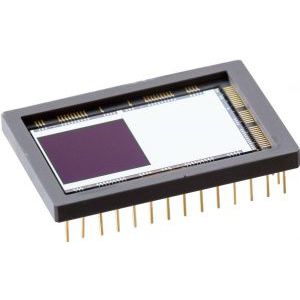
... Multiplication) is a technology that uses on-chip gain in the charge domain to effectively eliminate read noise from an image sensor. This enables advanced ultra-low light applications that require extreme sensitivity ...
e2v scientific instruments
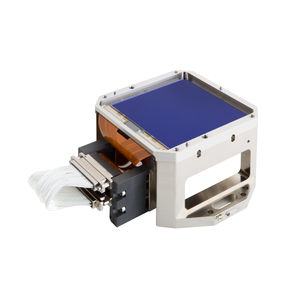
... can be supplied partially or fully customised to fit the application and achieve the best possible system performance. CCD image sensor design, manufacture, test and characterisation are carried out in-house ...
e2v scientific instruments
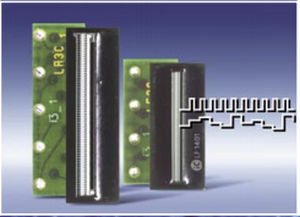

... Applications Optical linear sensors CCD substitute Features 64 photo pixels of 183 µm x 200 µm at a pitch of 200 µm (127 DPI) Integrating L-V conversion with low image lag and track-and-hold feature Integration ...
iC-Haus
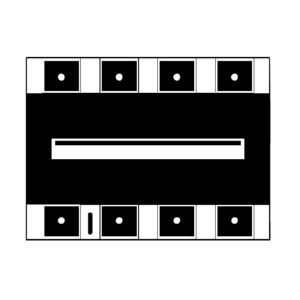
... Applications Optical linear sensors CCD substitute Features 128 active photo pixels of 56 µm at a pitch of 63.5 µm (400 DPI) Integrating L-V conversion followed by a sample-and-hold circuit High sensitivity and uniformity ...
iC-Haus

... Applications Optical linear sensors CCD substitute Features 256 active photo pixels of 56 µm at a gap-free pitch of 63.5 µm (400 DPI) Integrating L-V conversion followed by a sample and hold circuit High sensitivity ...
iC-Haus

A CCD image sensor (charge-coupled device) is a particular type of image sensor.
ApplicationsThe sensitivity of CCDs makes them particularly appropriate for use in high-sensitivity cameras.
TechnologiesThe CCD converts an image to an electrical signal. Each pixel consists of a tiny capacitor which stores the electrons generated by photons striking the sensor's surface. Thus, each pixel carries a charge proportional to its light exposure. Specialized electronics then read these charges line by line.
How to chooseCCD sensors are preferred to CMOS sensors when high resolution and image quality are required. Moreover, new ICCDs (Intensified CCD) and EMCCDs (Electron Multiplying CCD) offer significant gain, shorter exposure times and faster operation.
- Linear
- Over 70% efficient
- Expensive
the best suppliers