


{{product.productLabel}} {{product.model}}
{{#if product.featureValues}}{{product.productPrice.formattedPrice}} {{#if product.productPrice.priceType === "PRICE_RANGE" }} - {{product.productPrice.formattedPriceMax}} {{/if}}
{{#each product.specData:i}}
{{name}}: {{value}}
{{#i!=(product.specData.length-1)}}
{{/end}}
{{/each}}
{{{product.idpText}}}
{{product.productLabel}} {{product.model}}
{{#if product.featureValues}}{{product.productPrice.formattedPrice}} {{#if product.productPrice.priceType === "PRICE_RANGE" }} - {{product.productPrice.formattedPriceMax}} {{/if}}
{{#each product.specData:i}}
{{name}}: {{value}}
{{#i!=(product.specData.length-1)}}
{{/end}}
{{/each}}
{{{product.idpText}}}


... DCC Loss-In-Weight Screw Feeders offer exceptional operating versatility due to highly precise metering performance and excellent user-friendliness. DCC Loss-In-Weight Screw Feeders consist of a micro-screw feeder inside a food-grade polymer body with ...


... A versatile concept for the accurate feeding of liquids and pastes Coperion K-Tron’s liquid loss-in-weight feeders provide accurate continuous volumetric or gravimetric flow control of liquids. The highly accurate gravimetric units combine the pump ...
Coperion


granules loss-in-weight feederTruefeed™ TF
Flow rate: 0.1 lb/h - 280 lb/h
Optimize your feeding process with the Conair TrueFeed™ Gravimetric Feeder. Units are simple to install and use, extremely accurate and economical. These color and additive feeders deliver accurate feeding rates on the basis of continuous loss-in-weight ...
Conair


Flow rate: 200 kg/h
The OPTIYIELD SLIW Extruder Control has been designed specifically to monitor the rate of one material or pre-blended material as it feeds into the extrusion process. TSM’s OPTIYIELD family of single component Loss-in-Weight Measurement feeders offers ...
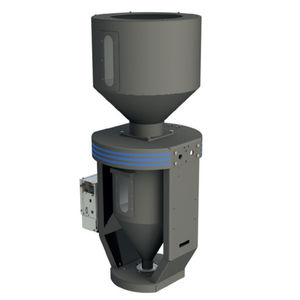
Flow rate: 400 kg/h
TSM’s OPTIYIELD range of Loss-in-Weight systems offer precise measurement, total reliability and advanced extrusion control options to ensure consistent end product quality with reduced material usage. The OPTIYIELD system provides continuous throughput ...
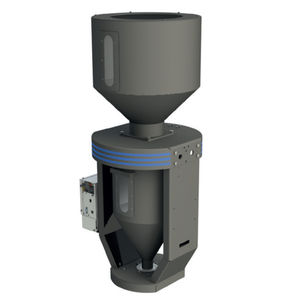
Flow rate: 1,000 kg/h
TSM’s OPTIYIELD range of Loss-in-Weight systems offer precise measurement, total reliability and advanced extrusion control options to ensure consistent end product quality with reduced material usage. The OPTIYIELD system provides continuous throughput ...


Power: 370 W - 750 W
... • Details depend on the characteristics of the medium to be fed (density, viscosity, solids content, temperature, reactivity, toxicological properties, etc.) and the respective process requirements (accuracy, feed rate, turndown ratio, counterpressure, etc.) • ...
Kubota Brabender Technologie GmbH

Power: 10 W
... • No stirring agitator or other rotating parts for ingredient flow without degradation • Vibration amplitude feedback ensuring linear conveyance characteristics over the entire feed rate range Power range 10-450 dm³/h ...
Kubota Brabender Technologie GmbH
Power: min 2000.0 W
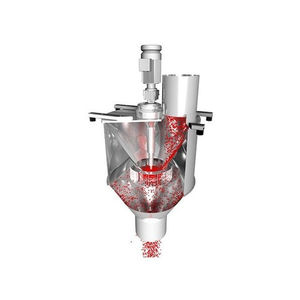
... Feeder with mass flow meter - Coriolis CDW250 - dustproof closed compact device - is suitable for all free-flowing, free-flowing bulk goods - compact design saves space More Options: - explosion-proof design Power range - Different versions 2000 ...
Kubota Brabender Technologie GmbH


... Product overview
The NTE Process Circle Feeder is a circular gravimetric extractor and dosing unit used for lumpy, normally cohesive, fibrous products that are difficult to handle due to low specific weight and tendency to agglomeration (examples: ...

Accuracy: 0.5 %
Flow rate: 3 kg/h - 1,500 kg/h
Power: 1.5, 550 kW
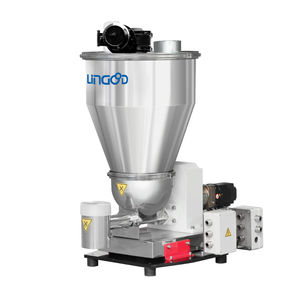
... 1.Model R is designed to provide single feedback feeding control technology. It has improved the PLC signal acquisition, the speed, the response, the accuracy and stability of feeder. 2.The feeding parts can be easily installed and disassembled, and ...
WUXI LINGOOD MACHINERY TECHNOLOGY CORP.


... Advanced Single Component Gravimetric Feeder ColorSave 1000 is a highly accurate and cost-effective single component masterbatch & additive gravimetric feeder for injection molding, extrusion, and blow molding machines, that offers significant cost-savings ...
Liad Weighing and Control Systems Ltd.


... Summary The L-feeder is an innovative loss-in-weight type constant feed weigher, which is based on Yamato's own loadcell technology, optimal control, self-diagnostic function, remote maintenance system and power handling technology. L-feeder serves manufacturing ...
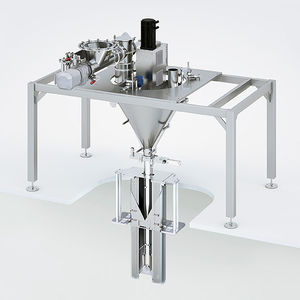

... Besides high-performance packaging machines, we also offer additional accessories, such as volumetric dosing systems. DOSING SYSTEMS VOLUMETRIC AND GRAVIMETRIC inno-tech screw feeders are used for precise dosing of a variety of powdery and fine granulated ...
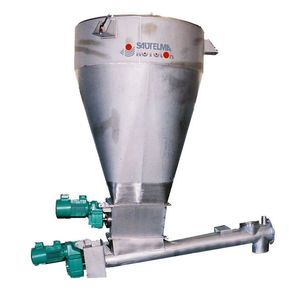

... The Loss-in-Weigh Feeder extracts the product from a hopper and according to the fixed flow rate « set point » adjusts the discharged weight by varying the feeder speed to keep the loss in weight flow constant. The weight of the material in the hopper ...
Sautelma Rotolok


Monomex loss in weight with continuous flow gravimetric dosing, extruders do not have to pre-mix to feed the material at any rate. Materials from extruders fed at more accurate rates and more precise flow rates are of superior quality. Especially twin ...


This MCPI fine dosing loss in-weight feeder is fully hygienic and maintenance-free. It is designed to meet the highest performance and hygienic standards, and is ideal for continuous or batch operations. The design is simple and consists of weighing sensors ...
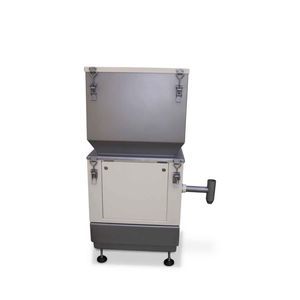

... Page purpose
- This page provides a request form to obtain product or system solutions from Rice Lake Weighing Systems; it is not a product detail page.
- Target audience: engineers, procurement and technical buyers seeking dosing/feeding
Rice Lake Weighing Systems
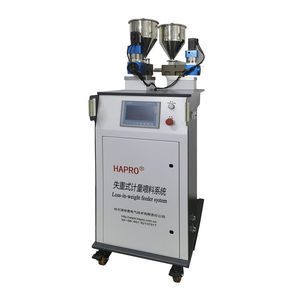

Flow rate: 2 g/min
Loss-in-weight feeder system is used for the compounds of polymer materials and auxiliary formulations by medium and small parallel co-rotating twin-screw extruder in laboratory. The system is composed of several small-flow loss in weight feeder. The ...
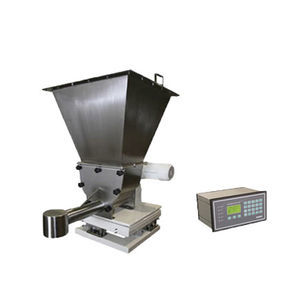

Accuracy: 0.2 % - 0.5 %
Flow rate: 0.1 kg/h - 100,000 kg/h
... For the continuous delivery of powder, ball materials, tablets, granular materials and various fibers. Because of its almost no maintenance, than other forms of feeder to adapt to the industrial environment and process conditions to meet the higher requirements, ...
the best suppliers