


{{product.productLabel}} {{product.model}}
{{#if product.featureValues}}{{product.productPrice.formattedPrice}} {{#if product.productPrice.priceType === "PRICE_RANGE" }} - {{product.productPrice.formattedPriceMax}} {{/if}}
{{#each product.specData:i}}
{{name}}: {{value}}
{{#i!=(product.specData.length-1)}}
{{/end}}
{{/each}}
{{{product.idpText}}}
{{product.productLabel}} {{product.model}}
{{#if product.featureValues}}{{product.productPrice.formattedPrice}} {{#if product.productPrice.priceType === "PRICE_RANGE" }} - {{product.productPrice.formattedPriceMax}} {{/if}}
{{#each product.specData:i}}
{{name}}: {{value}}
{{#i!=(product.specData.length-1)}}
{{/end}}
{{/each}}
{{{product.idpText}}}
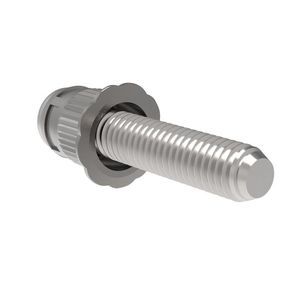

The e-FAST blind rivet stud is the ideal solution for earthing and protective conductor connection in electrical enclosures. Developed by GESIPA, this blind rivet stud offers a high degree of flexibility and enables quick installation of a protective ...
SFS Group Germany GmbH

... Standard Blind rivet nut studs As a combination of blind rivet nut and screw, blind rivet nut studs offer an alternative or replacement for welding studs. The following applications are particularly suitable for the use of GESIPA® blind rivet nut ...
SFS Group Germany GmbH

Diameter: 6 mm - 11 mm
Length: 11 mm - 17 mm
As a combination of blind rivet nut and screw, blind rivet studs provide an alternative to welding studs or other multi-piece T-slot systems from a technological and financial point of view. Blind rivet studs can be used to join thin material applications ...
SFS Group Germany GmbH


... Rivet studs semi hexagonal shank Family Deformation treaded stud Type of product Rivet stud semi hexagonal shank Receiving material Composites, Copper, Inox, Light Alloy, Steel, Thermoplastic, Thermosetting Plastic Assembly Deformation Coating In ...
Specialinsert s.r.l.

... CYLINDRICAL SHANK KNURLED RIVET STUD Family Deformation threaded studs Type of product Cylindrical shank knurled rivet stud Receiving material Composites, Copper, Stainless Steel, Light Alloy, Steel, Thermoplastic, Thermosetting Plastic Assembly Deformation Coating In ...
Specialinsert s.r.l.

... PLAIN OR KNURLED RIVET STUDS WITH CYLINDRICAL SHANK Family Deformable threaded studs Type of product Cylindrical shank rivet studs Receiving material Composites, Copper, Stainless Steel, Light Alloy, Steel, Thermoplastic, Thermosetting Plastic Assembly Deformation Coating White ...
Specialinsert s.r.l.


Diameter: 6 mm - 20 mm
Length: 100 mm - 230 mm


Diameter: 3 mm - 10 mm
Length: 5 mm - 60 mm
... Materials : steel, stainless steel Surfacing material : wide range [Please contact us for details] ...


... The MBO folding spring bolt is designed for use with clevises that conforms to DIN 71752 ISO 8140 . The folding spring bolt is manufactured from top quality materials ensuring high tensile strength and reliability. The folding spring bolt is an ideal ...


Diameter: 2 mm - 10 mm
... For assembly by screwing with high characteristics (tearing stresses, various loads, etc.) in thin sheet metal. This type of stud gives high-performance attachments. Dimensions: from M2 to M10. ...


Diameter: 2.5 mm - 8 mm
The Kerb Konus has manufactured the Clifa series, which has different dimensions from M2.5 up to M8. The tool is suitable for use in press-in flushing to the surface. It can also be used as SP coarse and SR fine toothing. This equipment features either ...


Diameter: 3 mm - 5 mm
Length: 6 mm - 25 mm
... Blind, Threaded – Types LBSO,LBSOA, LBSOSThese standoffs are designed for spacing applications where outer sheet surfaces must be flush and closed for smoother sheet appearance. It is used on the chassis or circuit board to play a role of spacing or ...
Shenzhen In-saiL Precision Parts Co.,Ltd
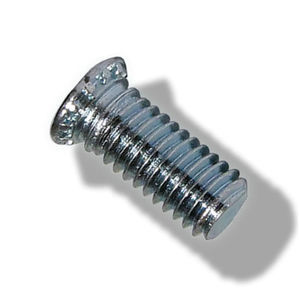

Diameter: 3 mm
Length: 6 mm
... Characteristics / Technical specifications
- Type: Self-clinching stud
- Material: Steel, zinc-plated finish
- Dimensions: M3 x 6
- Reference / internal code: 0006717188
Applications and benefits
- Designed
FIXI


Diameter: 3, 4, 5, 6 mm
Length: 12, 16, 8, 10 mm
Self-clinch studs are fasteners that have a serration under the head. At inserting into the metal sheet it presses the displaced material into the rivet ring to secure the fastener.
HONSEL-Group


Diameter: 7 mm - 11 mm
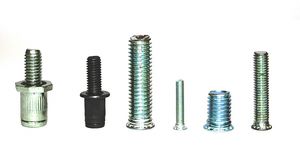
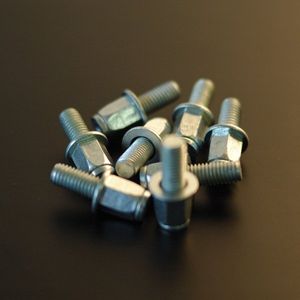
The CLUFIX-STUD™ Insert provides a good solution for applications that involve blind assembly of studs on profiles or thin sheets. The tool enables assembly of several work pieces while still rendering its stud function. The nut and screw requires through ...
clufix
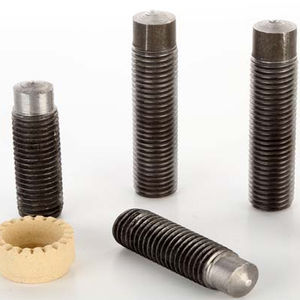

... threaded shear stud without head 1. materials: carbon steel or stainless steel 2. Specs.: EN ISO13918 RD PD type 3.Size range: M8-M25 or manufactured by drawing ...
Hangzhou JIAXIANG Gaoqiang Bolts Company
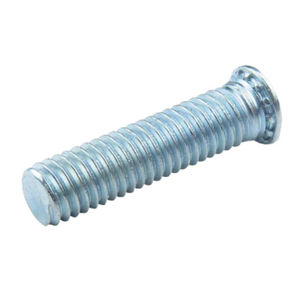

Diameter: 4.6 mm - 9.6 mm
Length: 6 mm - 40 mm
... NOTES The following installation panel material hardness limitations apply when installing Self Clinching Studs. Steel Clinch Studs: 80 HRB Max, 300 Series Stainless Steel Clinch Studs: 70 HRB Max, 400 Series Stainless Steel Clinch Studs: 92 HRB ...
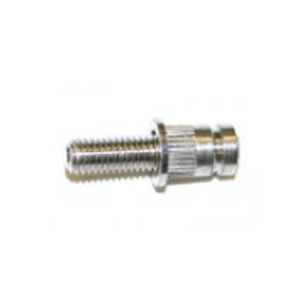

Diameter: 4 mm - 8 mm
... Material : Steel Support : steel zinc plated, stainless steel, aluminium, brass Dimensions : M4 to M8 ...


... The P-FH Clinching Stud is a threaded fastener which incorporates a knurled platform under the head. When embedded in the sheet material, it displaces material into the clinch ring securing the fastener. Advantages : • Easy to assemble with any squeeze ...
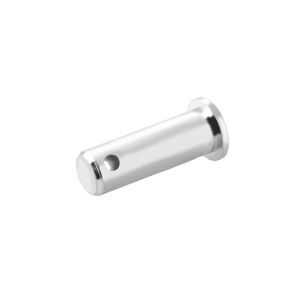

Diameter: 4 mm - 50 mm
Length: 12 mm - 123 mm
... DRILLED FLAT HEAD PIN STANDARD DIN 1434/B MATERIAL 11SMnPb30 (Steel) SURFACE TREATMENT White galvanized ...
Berardi Bullonerie srl
the best suppliers