


{{product.productLabel}} {{product.model}}
{{#if product.featureValues}}{{product.productPrice.formattedPrice}} {{#if product.productPrice.priceType === "PRICE_RANGE" }} - {{product.productPrice.formattedPriceMax}} {{/if}}
{{#each product.specData:i}}
{{name}}: {{value}}
{{#i!=(product.specData.length-1)}}
{{/end}}
{{/each}}
{{{product.idpText}}}
{{product.productLabel}} {{product.model}}
{{#if product.featureValues}}{{product.productPrice.formattedPrice}} {{#if product.productPrice.priceType === "PRICE_RANGE" }} - {{product.productPrice.formattedPriceMax}} {{/if}}
{{#each product.specData:i}}
{{name}}: {{value}}
{{#i!=(product.specData.length-1)}}
{{/end}}
{{/each}}
{{{product.idpText}}}


Length: 480 mm - 1,200 mm
Width: 48.5 mm - 102 mm
Thickness: 2.2 mm - 10 mm
... APPLICATION ADVANTAGES YOU CAN COUNT ON. Linear Timing Belts provide the greatest degree of flexibility for both synchronous conveying and linear positioning applications. Gates TPU manufactures linear timing ...
Gates

Length: 810 mm - 1,200 mm
Width: 450 mm
Thickness: 2.5 mm - 6 mm
... process conveyor belts when product conversion steps occur while it is transported. Wide timing belts are a supplementary solution to flat conveyor belts ...
Gates

Width: 15, 25, 9 mm
Pitch: 5 mm - 815 mm
Temperature: -54 °C - 85 °C
... Gates® Poly Chain® GT® Carbon™ synchronous belts have a renowned industry reputation for high performance and huge cost savings in a range of applications, designed to handle longer center distances at high load-carrying capacities. Gates ...
Gates


Width: 6 mm - 120 mm
Pitch: 5, 8, 14, 3 mm
Temperature: -15 °C - 60 °C
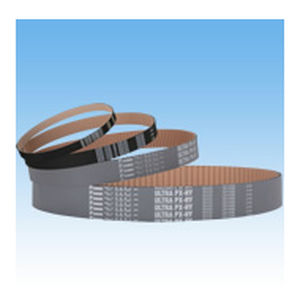
... HC Type Ultra PX Belts enable high load transmission, long life, and compactness thanks to its high strength material and PX belt tooth contour. Next-generation timing belt that pursues ...
Tsubakimoto Chain
Width: 6 mm - 120 mm
Pitch: 5, 8, 14, 3 mm
Temperature: -15 °C - 60 °C
... HY Type Ultra PX Belts use a hybrid core of carbon and glass for dramatically increased strength and durability. Tsubaki pursued maximum performance to bring even higher load transmission and longer life to its belts. *HY ...
Tsubakimoto Chain

Width: 10 mm - 120 mm
Pitch: 5, 8, 14 mm
Temperature: -15 °C - 80 °C
... tooth jumping torque : Large belt teeth provide high tooth jumping torque performance. *Low Noise : Low noise thanks to the adoption of unique dimples on the tooth ends. *High precision : Both the top and bottom of the belt ...
Tsubakimoto Chain
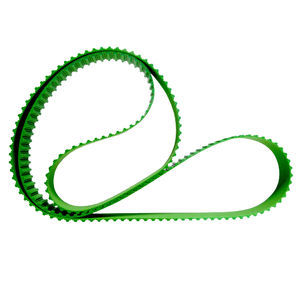

... sources. That means this “eco-friendly” belt solution can support companies that have embraced sustainability as part of their policy and are taking care of the environment. MEGAFLEX Biobased timing belts ...
MEGADYNE
Length: 100, 200, 150 m
Width: 45 mm
Thickness: 4.5 mm
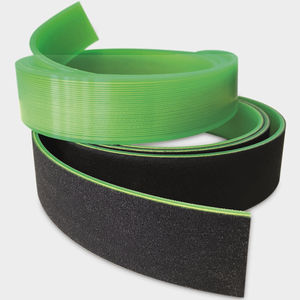
... -45: a durable, reliable and low-maintenance engineered belt for extended life in demanding applications in a Logistics warehouse. In the realm of modern intralogistics, power transmission belt systems must meet rigorous ...
MEGADYNE

Length: 1,800 mm
Width: 50 mm
Pitch: 5, 14, 8 mm
... RPP and MEGASYNC™ Silver. The design of Gold2 timing belts offers the possibility to keep using the same RPP pulleys. MEGASYNC™ Gold2 14M belts have two nylon plies on the teeth to: • Improve belt ...
MEGADYNE
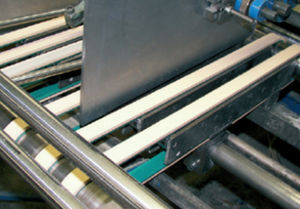

... Our Feeder Belts are used in folder gluer machines in the Corrugated Industry to feed the box dies. Our Ultrafeed 500 cover, with its exceptional friction and wear-resistance, gives Feeder Belts excellent performance ...
AMMERAAL BELTECH


Length: 1,525 mm - 5,085 mm
Width: 16 mm
Thickness: 14 mm
... flexibility of a notched belt, the power of aramid cords and the stability that's exclusive to Gates Super HC™ construction. Our Super HC XP™ Notched Premium belts are designed for applications where standard notched ...
GATES

Thickness: 14.5 mm
... seamless belt portfolio consists of woven endless and knitted endless belts, as well as synchronous and non-synchronous endless substrates. The belts can be coated with no splice or seam, providing uniform ...
Habasit


... conversion: The Poly V and Flexonic® belts are moulded compare to Timing belt. The profile is regular and the thickness is constant. The properties of the cord in the ribbed belts ...


... The belt transmits movement and power. In diesel engine applications, belt drives are generally located at the free end to drive accessories, such as water pumps, fans, alternators, air-conditioning compressors or air ...
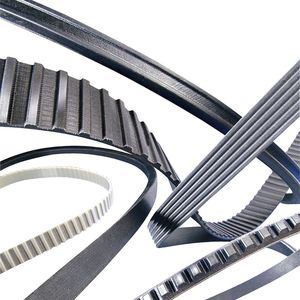

... the long term. We offer a variety of belts, from standard V- belts to high-performance ‘Extra Power’ belts that can transmit up to 40% more power than standard products. However, identifying exactly which ...


Length: 13 in - 170 in
Pitch: 0.38, 0.2, 0.5 in
... Synchro-Cog timing belt has a trapezoidal tooth profile that provides maintenance-free synchronization with equal load capacity from both sides of the belt. It allows greater flexibility and efficiency ...
Timken Belts

...
Technical specifications
- Product family: Timing

... cross section is increased (when compared to the standard belt) and this results in a lower belt elongation and more precise positioning accuracy. • HPFE high resistance and flexibility: this kind of cord combines high ...
Elatech S.r.l.

Length: 60 mm - 100 mm
Width: 1,524 mm - 1,800 mm
Thickness: 3 mm - 10.5 mm
... production line. ELAClean® range includes Positive drive belts [tooth pitch 26mm (EC-P1) and 50mm (EC-P2, Self centering positive drive belt [tooth pitch: 39.7mm (EC-C4 and Flat belts [ belt ...
Elatech S.r.l.

... to choose the pitch of the cleat equal to the pitch of the belt. This fact allows minimization of the effects of tolerance on the total length of the belt. Wrap angle Warp angle of the belt may be ...
Elatech S.r.l.


... Timing belts (metric AT10 pitch) Material white polyurethane and steel ...
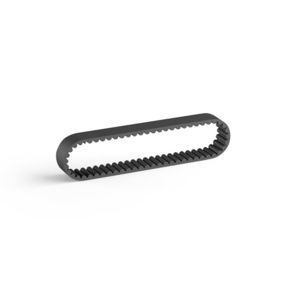
Width: 15 mm
... Toothed drive belt Material neoprene and nylon Function drive belt to be used with 904503 flange ...


... Timing belts and timing drive tapes are designed to function with specialized timing pulleys to guarantee precise, cyclical transport of products. Conveyor belts ...
Belt Technologies Europe Limited

... Timing belts and timing drive tapes are designed to function with specialized timing pulleys to guarantee precise, cyclical transport of products. Conveyor belts ...
Belt Technologies Europe Limited

... Timing belts and timing drive tapes are designed to function with specialized timing pulleys to guarantee precise, cyclical transport of products. Conveyor belts ...
Belt Technologies Europe Limited
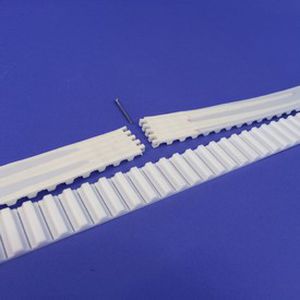

... welded belts. TENSIONING TOOLS FOR ERO JOINT® HP To use for small space area Alternatives Spiral seams The mechanical spiral seams system is also very easy to assemble as ERO Joint® HP but ...


... and preventing internal engine damage. Toothed Design Timing belts have teeth along their length that mesh with corresponding teeth on the pulleys or sprockets. This toothed design ...
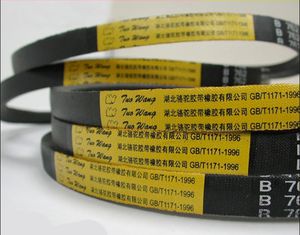
... Toothed V- belt—also known as a notched V- belt or cogged V- belt—is a V- belt that has notches (teeth) cut into its inner side to improve flexibility and heat dissipation. DESCRIPTION ?️ ...
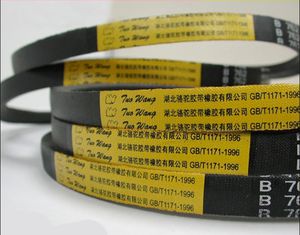
Width: 13, 17, 22, 32 mm
... A/B/C/D V- belts are classical V- belts, categorized by their cross-sectional dimensions. These letters (A, B, C, D) are standard designations used to describe the belt width and height, as defined by standards ...


... Custom transmission belts for the hollow glass industry: We offer a complete range of synchronous belts in rubber and polyurethane, with or without foam coating. Our foam belts are custom designed for ...

... Custom transmission belts for the hollow glass industry: We offer a complete range of synchronous belts in rubber and polyurethane, with or without foam coating. Our foam belts are custom designed for ...
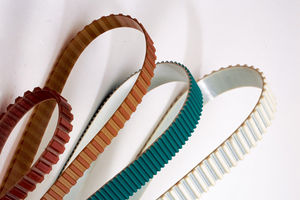

... Available tooth types T2,5 - T5 - T10 - T20 AT5 - AT10 - AT15 - AT20 H - XH - XL - MXL HTD3M - HTD5M - HTD8M - HTD14M Variety in cords: · Steel cords · Reinforced steel cords · Extra flexible steel cords · Stainless steel cords · Kevlar ...
Tempo International

Width: 10 mm - 150 mm
... Widely Used for Almost Any Industrial Synchronous Transmission Purpose High Abrasion Resistant High Effeciency High Precision Transmission Consist of: High Strength Steel Cord or Other Cords High Quality Polyurethane Components ...
Tempo International

... 1.Available With Different Designs for Different Application -Add-on Fabric for Lower Friction -Add-on PVC for Chemical Resistant Purpose -Add-on Rubber For Higher Friction, and Heat Resistant Purpose -Add-on Buffle or Other Parts For Customized Design 2.Any ...
Tempo International

Length: 91.44 mm - 503.93 mm
Thickness: 1.2 mm - 15.7 mm
Pitch: 10 mm - 180 mm
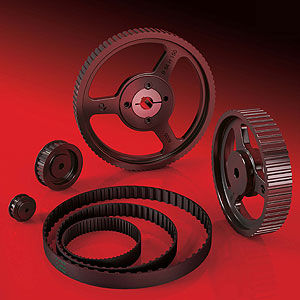
... , aluminium. The main feature of this belt transmission type is its very large versatility of use. Belts are available in several types of materials, each one with its specific performances. Neoprene belts ...
POGGI Trasmissioni Meccan. SpA

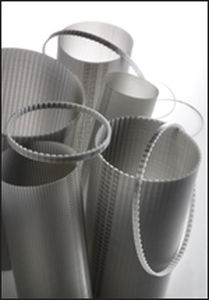

... iSync™ belts are made with special polyurethane compound and high resistance steel tension cords which are processed with a unique and highly sophisticated technology to get a superior polyurethane belt. iSync™ belts ...
SIT S.p.A.
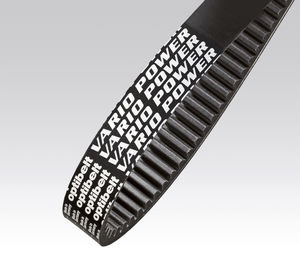

Length: 550 mm - 3,500 mm
Width: 10 mm - 85 mm
Temperature: -30 °C - 90 °C
... of sparks. Better heat dissipation: Reduced belt temperature In the double- toothed optibelt VARIO POWER the double- toothed V- belt ensures better heat dissipation and thus significantly ...
Optibelt


Pitch: 1.3 mm - 1,380 mm
Temperature: -30 °C - 80 °C
... Timing Belts and Pulleys Reliance timing belts and timing pulleys are available in 2.5 mm and 5 mm pitch. High tensile stainless steel reinforced polyurethane belts ...
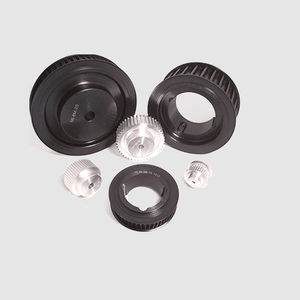

Length: 90 mm - 4,956 mm
... Double-sided belts have teeth equally constructed on each side of the belt, which enables them to mesh with toothed pulleys on both the inside and outside. The construction of the belts ...
Cross & Morse


Width: 10 mm - 25.4 mm
Thickness: 6 mm - 23 mm
Temperature: -25 °C - 100 °C
... transmission capacity than wrapped Belts Special cog design for enhanced flexibility and heat dissipation rate Suitable for drives using smaller diameter pulleys and high RPM Anti-static, oil & heat resistant Maximum Belt ...
PIX Transmissions Limited

A timing belt has teeth to prevent slippage. This allows it to transmit motion as would a chain or gear, without alteration of speed. A flat belt, in contrast, can slip or flex, creating a speed differential between the two shafts it conects.
ApplicationsTiming belts are used in numerous settings, especially those where space and power are limited. However, they also are found on camshafts and secondary motorcycle drives.
How to chooseChoice of timing belt will depend on the same criteria as other belts:
- Power to be transmitted
- Rotational speed of the two shafts
- Distance between shafts
- Space constraints
- Usage parameters (vibrations, shocks, temperature, humidity, cleanliness, etc.).
- Works well at low speed
- Reduced initial tension
- Silent transmission without slippage
- No lubrication required
- Regular replacement to avoid engine damage
the best suppliers