


{{product.productLabel}} {{product.model}}
{{#if product.featureValues}}{{product.productPrice.formattedPrice}} {{#if product.productPrice.priceType === "PRICE_RANGE" }} - {{product.productPrice.formattedPriceMax}} {{/if}}
{{#each product.specData:i}}
{{name}}: {{value}}
{{#i!=(product.specData.length-1)}}
{{/end}}
{{/each}}
{{{product.idpText}}}
{{product.productLabel}} {{product.model}}
{{#if product.featureValues}}{{product.productPrice.formattedPrice}} {{#if product.productPrice.priceType === "PRICE_RANGE" }} - {{product.productPrice.formattedPriceMax}} {{/if}}
{{#each product.specData:i}}
{{name}}: {{value}}
{{#i!=(product.specData.length-1)}}
{{/end}}
{{/each}}
{{{product.idpText}}}


Resolution: 1 µm - 2 µm
The surfaceCONTROL 3500 3D sensor is used for inline inspection of geometry, shape and surface on diffusely reflecting surfaces such as metal, plastic or ceramics. The high-precision surfaceCONTROL 3D ...

Resolution: 1.5 µm - 3 µm
... high-performance surfaceCONTROL 3D 3200 snapshot sensor is ideally suited for use in industrial applications. It performs automated inline 3D measurements for geometry, shape and surface ...
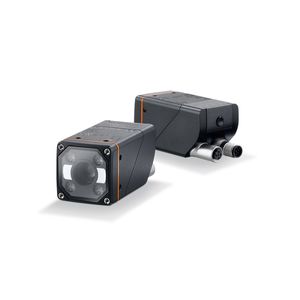

... application within 2 minutes. Robot sensor calibration The Robot sensor calibration wizard enables precise control of an object by a robot arm. By means of marker calibration, the coordinate systems ...

IFM now offers a state-of-the-art technology called the Electronic Eye. This groundbreaking technology allows object recognition for assembly and manufacturing tasks and for quality control. One great thing about this technology is its ...
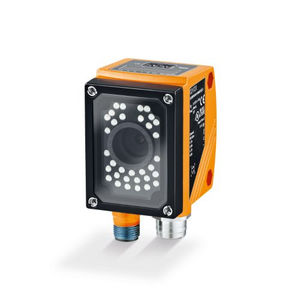
For a variety of inspection tasks in industry Stand-alone device with integrated illumination Compact and robust housing Intuitive, user-friendly handling Powerful Ethernet interface for data transmission


Features Easily install into any application Self-contained models mean no additional amplifer or hardware is required, reducing installation complication and time. Focus and brightness can be adjusted automatically, resulting in ...
Keyence
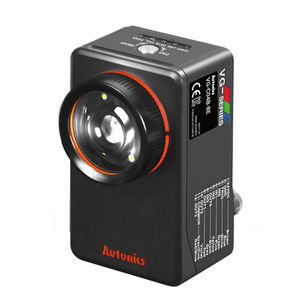

The VG series (color type) vision sensors utilize images captured by the integrated industrial camera lenses to determine the target object's presence, color, size, shape, orientation, patterns and more. ...


Vision sensors include numerous image processing functions for the automation industry. From simple presence checks to color and shape recognition, the counting and sorting of objects, ...
wenglor sensoric GmbH

Resolution: 20 mm - 500 mm
OCR readers detect characters, symbols and texts in all languages, but also logos, character combinations, image fragments or print marks. The characters can be printed, needle-punched, punched or dotted and are recognized against any ...
wenglor sensoric GmbH
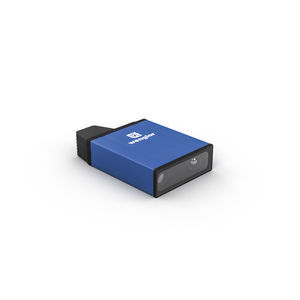
Resolution: 4 µm - 306 µm
... Glance 5 MP resolution Easy integration via SDK or GigE Vision High point cloud quality with up to four 3D point clouds per second Integrated 3D point cloud calculation
wenglor sensoric GmbH


DESCRIPTION The VISOR® Robotic is a versatile vision sensor that meets rising expectations in Industry 4.0. It offers ease of use, various versions for different automation tasks, and easy integration ...
SensoPart Industriesensorik GmbH

... adapting to process and product variations effortlessly. Highlights: ⯀ Easy setup without image processing knowledge ⯀ AI technology in a robust vision sensor, made for industrial ...
SensoPart Industriesensorik GmbH
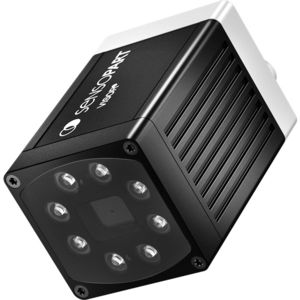
DESCRIPTION SensoPart has expanded its range of vision sensors with the VISOR® Solar in order to combat rising cost pressure in the production of solar cells. The compact sensor detects ...
SensoPart Industriesensorik GmbH
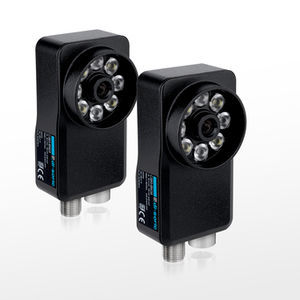

Our Vision sensors can be operated intuitively and are commissioned within minutes without training. They can be used out of the box, and have extensive software tools and standardized interfaces available ...


Resolution: 1.98 mm
SensNode-LR-VAI LoRaWAN® Vision AI Sensor The SensNode-LR-VAI Vision AI Sensor combines TinyML artificial intelligence technology with LoRaWAN long-range communication ...


Resolution: 5 m
Pattern detection, skew correction, pattern repeat control Patcontrol PCS - Pattern control system and weft distortion control Pattern detection, skew correction and pattern repeat control with one system PATTERN AND DISTORTION CONTROL The ...
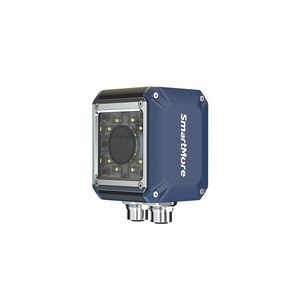

Equipped with advanced vision algorithms, is a compact industrial intelligent vision sensor that can be applied to various inspection scenarios and industries, such as automotive, food, ...
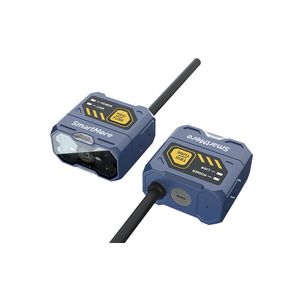
Equipped with advanced vision algorithms, is a compact industrial intelligent vision sensor that can be applied to various inspection scenarios and industries, such as automotive, food, ...


The S wide sensor provides the benefits of a digital microscope integrated into a high-resolution 3D measuring instrument. In only one shot, it acquires 35 x 29 mm of XY area and 40 mm of depth with no Z movement.

Vision Sensors of product families LDCR and PICO offers the right solution for different industrial applications. The sensors are robust, compact and economically priced complete systems ...


Resolution: 50 mm - 2,000 mm
... easy usability • Smart camera and compact model for use anywhere Differing from conventional models, the IV3 Series Vision Sensor with Built-in AI automatically determines imaging conditions and detection ...


Resolution: 6.2, 16 mm
... In-Sight SnAPP vision sensor brings the power of machine vision to everyone. With guided setup and pre-trained AI, In-Sight SnAPP allows manufacturers to quickly and easily automate inspections, ...
Cognex Corporation
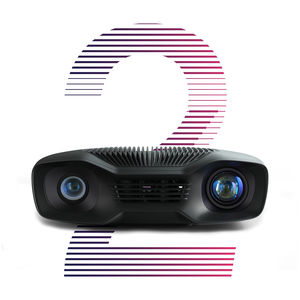

Resolution: 0.39 mm - 700 mm
Zivid Two gives you exceptional 3D image quality lightning fast in an ultra-compact form-factor. Design fast, reliable pick and place robots cells capable of handling a wide variety of challenging objects and scenes.
Zivid
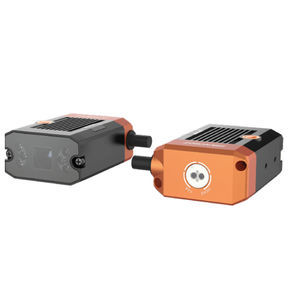

The SC2000E vision sensor integrates full functions of a vision system: lighting, acquisition, processing, and communication in minimal fuselage. Bring new choices for Y/N, P/N verifications ...
Hikrobot


SceneScan is Nerian's latest 3D depth sensing solution, and the successor to our popular SP1 stereo vision sensor. SceneScan relies on stereo vision and hardware-accelerated ...
Nerian Vision GmbH
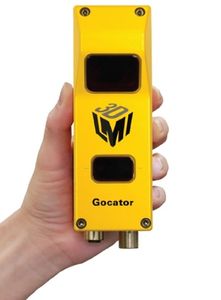

We live in a 3D world with manufacturing processes that demand high speed and highly accurate part inspection. Machine vision solutions designed to support automated production can be complicated to design, ...
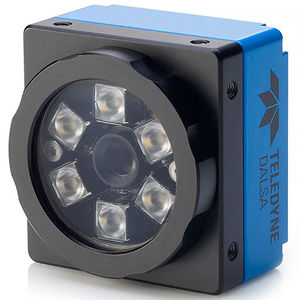

Increase product quality, lower production costs. Vision system performance at vision sensor pricing. Introducing BOA Spot: simple, affordable, and reliable performance for quality ...
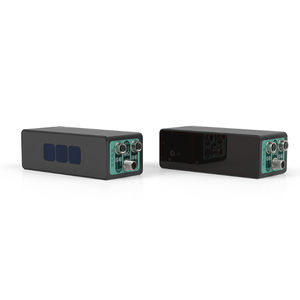
... vehicles (AGV)—as a raw data sensor, the SmartRunner Explorer 3-D is suitable for a wide range of applications that require detailed contour detection. Due to its temperature-regulating aluminum housing, the rugged sensor ...
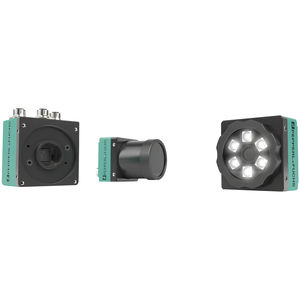

object detection vision sensorVOS
Maximum flexibility with just one sensor—the VOS 2-D universal vision sensors offer the complete package of license-free software and modular hardware for your individual vision ...
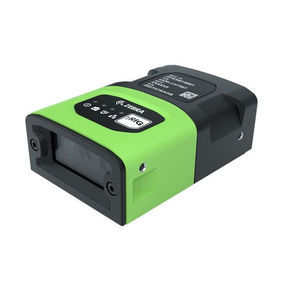

... enabling your primary machine vision applications to feed all the processes that drive your business. With Zebra Aurora’s powerful software platform, you can easily set up, deploy and run the VS20 — and all other Zebra ...
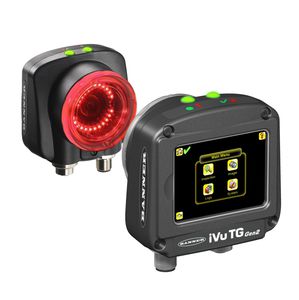

Brings the simplicity of a photoelectric sensor and the intelligence of a vision sensor together to provide inspection solutions that can be applied and supported right on the factory ...

... external PC required to configure or operate sensor - Ethernet and RS232 communications - Multiple stored inspections - Software emulator to configure the iVu Plus offline - Rugged IP67 housing (sensor) - ...


... in SICK AppSpace or HALCON Deep learning available as licensed option The InspectorP62x is an industrial all-in-one vision sensor that is easy to use, compact and versatile. The integrated system ...
SICK


... structure of stacked CMOS image sensor together with Cu-Cu connection makes it possible to realize the industry’s smallest pixel with a large fill factor. This technology has produced a small Event-based Vision ...


EGE infrared detectors are used to detect hot objects and to record and measure temperatures. The sensors detect the infrared radiation of warm and hot objects from 20° C to 800 ° C. EGE infrared detectors are designed ...

A vision sensor is a very simple camera used as a sensor. It replaces a photoelectric sensor in specific applications for which the latter is not suited.
ApplicationsVision sensors are versatile. They are found in parts inspection and sorting, color recognition and for the optical control of bottle filling. They are used for tasks beyond the capabilities of traditional sensors, including production quality control (texture sensing) and detection of label printing errors.
TechnologiesThe performance of these devices depends on the capabilities of their image sensors (speed, image quality, etc.). Speed and low price make CMOS (complementary metal-oxide semiconductor) sensors the most common type. Vision sensors also include lighting (usually powerful LEDs), control elements (microprocessor plus FPGA micro-controller) and a communications interface, usually Ethernet.
How to chooseChoice will depend on specific application, though these devices can be programmed to perform a wide range of tasks. Image treatment speed is another important factor.
- Fast and compact
- Sealed case
- Integrated lighting
- Network-capable
Please specify:
Help us improve:
remaining