


- Company
- Products
- Catalogs
- News & Trends
- Exhibitions
Electromechanical level switch ATS 165tiltfloatfor liquids


Add to favorites
Compare this product
Characteristics
- Technology
- float, electromechanical, tilt
- Medium
- for liquids
- Applications
- for tanks, for pump control, for overflow detection
- Material
- polypropylene
- Mounting
- suspended
- Other characteristics
- ACS certfied, with internal ballast, SPDT
- Process temperature
85 °C
(185 °F)- Process pressure
3.5 bar
(50.76 psi)
Description
Overview
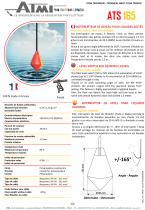
The ATS 165 is a dry-contact float level switch designed to automate pump control and alarm devices in clear or highly agitated liquids. It detects both high and low levels within the same tank (hysteresis ≤ 1.5 m) and is available in an ACS-certified version (ATS 165 EP) for potable water applications. Designed and manufactured in France.
Main applications
Operating principle
The float tilts as the liquid level changes, actuating an internal mechanical switch. The cable has three conductors (COM, NO, NC) allowing selection of the desired wiring mode for filling or emptying operations. Suitable for use in paired configurations for min/max control.
Operating modes
Key features
Technical specifications
Additional information
Switching angle depends on liquid agitation, filling/emptying flow rates and ballast position. Cable lengths can be supplied to order to avoid splices that may affect operation.
The ATS 165 is a dry-contact float level switch designed to automate pump control and alarm devices in clear or highly agitated liquids. It detects both high and low levels within the same tank (hysteresis ≤ 1.5 m) and is available in an ACS-certified version (ATS 165 EP) for potable water applications. Designed and manufactured in France.
Main applications
- Direct pump control (up to 1.5 HP) or unlimited control via external relay.
- Level monitoring in tanks and basins subject to strong turbulence or agitation.
- Paired installations for minimum/maximum level regulation.
Operating principle
The float tilts as the liquid level changes, actuating an internal mechanical switch. The cable has three conductors (COM, NO, NC) allowing selection of the desired wiring mode for filling or emptying operations. Suitable for use in paired configurations for min/max control.
Operating modes
- Drain mode: the switch starts the pump at the high position (overflow protection) and stops it when the tank is emptied to protect the pump.
- Fill mode: the circuit closes (NC) at the low position to start the pump and fill the tank.
Key features
- Omnidirectional detection—operates regardless of orientation in the liquid.
- Biconical shape in copolymer polypropylene to limit deposit build-up; minimal maintenance required.
- Adaptable to density variations and turbulence by adjusting ballast position and cable length.
- Adjustable counterweight on the cable to modify switching angle and level differential (manufacturer guidelines available).
Technical specifications
- Switching angle: ±165°
- Allowed fluid density: 0.70 to 1.10
- Supply: 250 - 400 VAC/VDC, 50/60 Hz
- Switch rating: 20 (8) A (20 A resistive; 8 A inductive)
- Housing material: copolymer polypropylene
- Cable: 3 x 1 mm² neoprene, HR HY
- Weight: 325 g
- Dimensions: Height 152 mm — Diameter 95 mm
- Ballast: 350 g loaded resin
- Available cable lengths: 5, 6, 10, 13, 15, 20, 25 and 30 m
Additional information
Switching angle depends on liquid agitation, filling/emptying flow rates and ballast position. Cable lengths can be supplied to order to avoid splices that may affect operation.
VIDEO


Other ATMI products
---


Related Searches
- ATMI level switch
- ATMI liquid level switch
- ATMI level sensor
- ATMI liquid level sensor
- ATMI float level switch
- Analog level probe
- ATMI stainless steel level switch
- Storage tank level probe
- ATMI tank level switch
- ATMI plastic level switch
- Stainless steel level probe
- Water level probe
- Flange level limit switch
- ATMI vertical level switch
- ATMI solid level switch
- 2-wire level probe
- Compact level limit switch
- ATEX level limit switch
- High-precision level probe
- Compact level sensor
*Prices are pre-tax. They exclude delivery charges and customs duties and do not include additional charges for installation or activation options. Prices are indicative only and may vary by country, with changes to the cost of raw materials and exchange rates.
About DirectIndustry
DirectIndustry is a marketplace that offers B2B players a complete experience, from product sourcing to purchase. DirectIndustry is an entity of VirtualExpo Group.
Are you a buyer?
Are you a supplier?