


Gas chromatograph chromaSGCfor gas analysisfor sulfur compounds

Add to favorites
Compare this product
Characteristics
- Type
- gas, GC
- Applications
- for gas analysis, for sulfur compounds
- Detector type
- FPD, flame photometric detector
- Other characteristics
- on-line, isothermal, continuous
Description
Overview
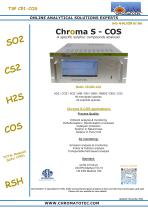
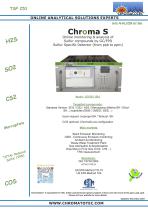
ChromaS is an automated online isothermal gas chromatograph designed for continuous analysis and monitoring of sulfur compounds (H2S, COS, CS2, SO2, RSH). Detection uses a sulfur-specific photometric double flame detector (double FPD) delivering trace ppb-level sensitivity for industrial and ambient air monitoring.
Principle
Features
VISTACHROM ® software
Standards, Approvals & Certifications
Technical Specifications (detailed)
Technical characteristics
ChromaS is an automated online isothermal gas chromatograph designed for continuous analysis and monitoring of sulfur compounds (H2S, COS, CS2, SO2, RSH). Detection uses a sulfur-specific photometric double flame detector (double FPD) delivering trace ppb-level sensitivity for industrial and ambient air monitoring.
Principle
- Continuous, uninterrupted sampling
- Sample injection into a GC column for chromatographic separation
- Controlled oven for optimized isothermal temperature selection per application
- Detection by a sulfur-specific photometric double flame detector
Features
- Double flame detector design to prevent quenching and ensure selective sulfur response
- Automatic linearization and calibration of compounds
- Compound identification based on retention time (elution profile)
- Built-in automatic data validation using an internal permeation tube
VISTACHROM ® software
- Remote monitoring and instrument control
- Full traceability via archiving of chromatograms, results and quality control records
- Configuration and management of threshold alarms
- Data export via MODBUS / MGS1 / 4-20 mA / 0-10 V
Standards, Approvals & Certifications
- Referenced standards: ASTM (listed)
- US EPA Method TO-15 (listed)
- US EPA Method 16 (Total Reduced Sulfur) (listed)
Technical Specifications (detailed)
- Compounds analysed:
- H2S, Me-SH, Et-SH, Isopropyl-SH, N-propyl-SH, 2-butyl-SH, Terbutyl-SH
- DMS, DES, DMDS
- COS, CS2
- SO2, RSH and other sulfur species
- Detection limits:
- 4 ppb for double-sulfur compounds (e.g. DMDS, CS2)
- 7 ppb for single-sulfur compounds (e.g. H2S, DMS)
- Detection range:
- Low Range: 4 ppb to 5 ppm
- High Range: 100 ppb to 100 ppm
- Precision / Repeatability:
- RSD < 5% on concentration over 24 h
- RSD < 1% on retention time over 24 h
- Results & Data Handling:
- Full storage of chromatograms and results
- Individual timestamping of analysed dates and times
- Cycle time:
- Standard cycle time: 10 minutes
- Shorter cycle times possible depending on application
- Gas supply & flows:
- Carrier gas: Air or N2 at 3 bar (approx. 5 mL/min) via 1/8" connection
- Sample inlet: -1 bar or ambient pressure (via sample pump)
- Detector gases: H2 at 2 bar (approx. 70 mL/min) 1/8"; Air at 3 bar (approx. 80 mL/min) 1/8"
- Pneumatic valve commutation: 90 mL/min
- Detector: Sulfur-specific photometric double flame detector (double FPD) to avoid quenching and provide sulfur-selective response
Technical characteristics
- Product name / model: ChromaS
- Analyzer type: Automatic isothermal gas chromatograph with GC-FPD
- Analytes: Individual sulfur compounds (ppb to % level depending on configuration)
- Detection limits: down to 4 ppb (double sulfur compounds) and 7 ppb (single sulfur compounds)
- Typical cycle time: 10 minutes (application dependent)
- Data export: MODBUS, MGS1, analog 4-20 mA / 0-10 V
- Software: VISTACHROM ® for remote monitoring, archiving and alarms
- Standards referenced: ASTM, US EPA TO-15, US EPA Method 16
Catalogs
Exhibitions
Meet this supplier at the following exhibition(s):


Other CHROMATOTEC products
Sulfur Compounds Analyzers


Related Searches
- CHROMATOTEC gas analyzer
- CHROMATOTEC concentration analyzer
- CHROMATOTEC monitoring analyzer
- CHROMATOTEC liquids analyzer
- CHROMATOTEC automatic analyzer
- Calibration system
- Desktop analyzer
- Dust analyzer
- Gas detector
- CHROMATOTEC process analyzer
- Portable analyser
- CHROMATOTEC continuous analyzer
- Water analyser
- Real-time analyser
- Oxygen analyser
- CHROMATOTEC integration analyzer
- Laboratory analyser
- Compact analyser
- Industrial detector
- CHROMATOTEC calibration analyzer
*Prices are pre-tax. They exclude delivery charges and customs duties and do not include additional charges for installation or activation options. Prices are indicative only and may vary by country, with changes to the cost of raw materials and exchange rates.