



- Company
- Products
- Catalogs
- News & Trends
- Exhibitions
Thermal residual current circuit breaker FCLdifferentialovercurrentearth-leakage

Add to favorites
Compare this product
Characteristics
- Type
- differential, thermal
- Electrical characteristics
- residual current, earth-leakage, short-circuit, overcurrent, alternating current, three-phase
- Operating mode
- automatic
- Applications
- distribution, electrical power supply
- Number of poles
- 3-pole
- Other characteristics
- indoor, outdoor
- Primary current
Max.: 4,000 A
Min.: 1,250 A
- VAC
Max.: 40.5 kV
Min.: 4.16 kV
- VDC
110 V, 220 V
Description
• IEC 62271-1, IEC 60282-1, IEEE Std C37.302, NEMA
• ISO 9001, KEMA, CESI, CE, TUV, UL, ASTA
• Seismic design, ETGI-1.020, IEEE Std 693, NCh2369
• Structural design, ASTM A325, ANSI/AISC 360, AWS D1.1
• High altitude correction per IEC 62271 & IEEE C37, ~ 5000m
• Reduction of harmonics, voltage sags and flicker due to the lower total source impedance
• Providing a very high and fast fault-current breaking capability at high operating currents
• Available for medium voltage ratings up to 40.5kV, 6,300A and 200kA rms breaking capability
• Implementation of the project-specific setting values for the instantaneous current and rate of current rise
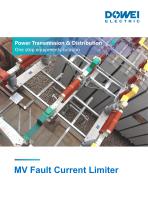
MV Fault Current Limiter
A Medium Voltage Fault Current Limiter (MV Fault Current Limiter / UFCL) is a protection device designed to rapidly reduce excessive short-circuit currents in medium-voltage electrical networks. It limits fault current magnitude within the first few milliseconds after a fault occurs, helping protect switchgear, transformers, cables, generators, and distribution equipment.
UFCL is commonly used when the available fault current exceeds the interrupting capability of existing circuit breakers or when utilities need to increase network capacity without replacing large amounts of equipment.
1. Working Principle
During normal operation:
·UFCL has very low impedance.
·Full load current flows normally.
During a short circuit:
·Fault current rises rapidly.
·UFCL increases its impedance within milliseconds.
·The fault current peak is reduced.
·Existing protection equipment can safely interrupt the fault.
2. Main Components
A.) Current Limiting Element
The main component that creates temporary impedance.
Possible technologies:
·Superconducting element
·Power electronic converter
·Saturable reactor
·Inductive reactor
·Solid-state switching element
B.) Detection and Control System
Functions:
·Detects abnormal current rise
·Triggers limiting action
·Controls switching devices
Components:
·Current sensors
·Digital controller
·Protection relay interface
C.) Bypass / Recovery System
Functions:
·Allows normal operation after fault clearing
·Protects limiting components
·Restores low impedance state
D.) Cooling System (for some technologies)
Required for:
·Superconducting fault current limiters
·High-power electronic systems
Cooling methods:
·Cryogenic cooling
·Forced air cooling
·Liquid cooling
3. Advantages
·Reduces fault current : Protects equipment from high short-circuit levels
·Fast operation: Acts before first current peak
·Extends equipment life: Reduces thermal and mechanical stress
·Avoids switchgear replacement: Allows existing breakers to remain in service
·Improves grid flexibility: Enables network expansion
·Supports renewable integration: Controls increased fault levels
4. Applications
Utility Distribution Networks
Used for:
·MV substations
·Distribution feeders
·Network interconnections
Renewable Energy Plants
Applications:
·Solar PV plants
·Wind farms
·Battery storage systems
Purpose:
·Manage increased fault contribution from distributed generation
Industrial Facilities
Used in:
·Steel plants
·Mining facilities
·Chemical plants
·Large manufacturing sites
Microgrids
Provides:
·Fault current management
·Protection coordination
·Flexible operation
MV Fault Current Limiter (UFCL) summary:
A Medium Voltage Fault Current Limiter (UFCL) is a fast-acting series device that reduces short-circuit current levels within milliseconds, protecting MV networks from excessive fault energy. It enables utilities and industries to increase system capacity, integrate renewable generation, and avoid costly replacement of existing switchgear and transformers.
• ISO 9001, KEMA, CESI, CE, TUV, UL, ASTA
• Seismic design, ETGI-1.020, IEEE Std 693, NCh2369
• Structural design, ASTM A325, ANSI/AISC 360, AWS D1.1
• High altitude correction per IEC 62271 & IEEE C37, ~ 5000m
• Reduction of harmonics, voltage sags and flicker due to the lower total source impedance
• Providing a very high and fast fault-current breaking capability at high operating currents
• Available for medium voltage ratings up to 40.5kV, 6,300A and 200kA rms breaking capability
• Implementation of the project-specific setting values for the instantaneous current and rate of current rise
MV Fault Current Limiter
A Medium Voltage Fault Current Limiter (MV Fault Current Limiter / UFCL) is a protection device designed to rapidly reduce excessive short-circuit currents in medium-voltage electrical networks. It limits fault current magnitude within the first few milliseconds after a fault occurs, helping protect switchgear, transformers, cables, generators, and distribution equipment.
UFCL is commonly used when the available fault current exceeds the interrupting capability of existing circuit breakers or when utilities need to increase network capacity without replacing large amounts of equipment.
1. Working Principle
During normal operation:
·UFCL has very low impedance.
·Full load current flows normally.
During a short circuit:
·Fault current rises rapidly.
·UFCL increases its impedance within milliseconds.
·The fault current peak is reduced.
·Existing protection equipment can safely interrupt the fault.
2. Main Components
A.) Current Limiting Element
The main component that creates temporary impedance.
Possible technologies:
·Superconducting element
·Power electronic converter
·Saturable reactor
·Inductive reactor
·Solid-state switching element
B.) Detection and Control System
Functions:
·Detects abnormal current rise
·Triggers limiting action
·Controls switching devices
Components:
·Current sensors
·Digital controller
·Protection relay interface
C.) Bypass / Recovery System
Functions:
·Allows normal operation after fault clearing
·Protects limiting components
·Restores low impedance state
D.) Cooling System (for some technologies)
Required for:
·Superconducting fault current limiters
·High-power electronic systems
Cooling methods:
·Cryogenic cooling
·Forced air cooling
·Liquid cooling
3. Advantages
·Reduces fault current : Protects equipment from high short-circuit levels
·Fast operation: Acts before first current peak
·Extends equipment life: Reduces thermal and mechanical stress
·Avoids switchgear replacement: Allows existing breakers to remain in service
·Improves grid flexibility: Enables network expansion
·Supports renewable integration: Controls increased fault levels
4. Applications
Utility Distribution Networks
Used for:
·MV substations
·Distribution feeders
·Network interconnections
Renewable Energy Plants
Applications:
·Solar PV plants
·Wind farms
·Battery storage systems
Purpose:
·Manage increased fault contribution from distributed generation
Industrial Facilities
Used in:
·Steel plants
·Mining facilities
·Chemical plants
·Large manufacturing sites
Microgrids
Provides:
·Fault current management
·Protection coordination
·Flexible operation
MV Fault Current Limiter (UFCL) summary:
A Medium Voltage Fault Current Limiter (UFCL) is a fast-acting series device that reduces short-circuit current levels within milliseconds, protecting MV networks from excessive fault energy. It enables utilities and industries to increase system capacity, integrate renewable generation, and avoid costly replacement of existing switchgear and transformers.
Catalogs
Related Searches
- Surge protector
- Circuit breaker
- Isolator switch
- Power supply surge protector
- Class II surge arrester
- Multipole isolator switch
- Varistor surge protector
- 3-pole isolator switch
- Surge protector with fault indication
- Current circuit breaker
- Voltage circuit breaker
- Single-phase surge protector
- Single-pole circuit breaker
- Distribution circuit breaker
- Electrical installation surge protector
- Anti-surge surge protector
- MOV surge protector
- Class I surge protector
- AC isolator switch
- Single-pole surge protector
*Prices are pre-tax. They exclude delivery charges and customs duties and do not include additional charges for installation or activation options. Prices are indicative only and may vary by country, with changes to the cost of raw materials and exchange rates.