
- Metrology - Laboratory
- Analytical Instrumentation
- Laser particle size analyzer
- Malvern Panalytical

- Company
- Products
- Catalogs
- News & Trends
- Exhibitions
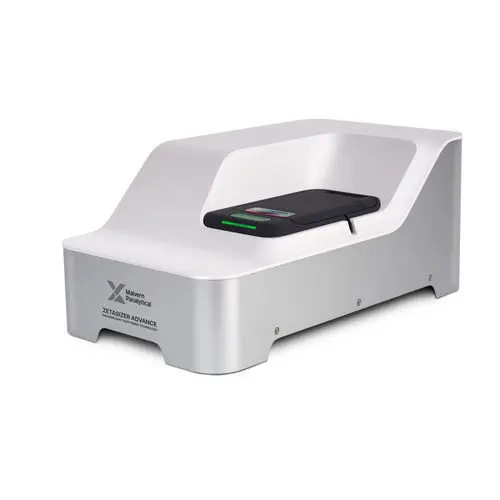
Static light scattering particle size analyzer Zetasizer Ultradynamic light scatteringlaserelectrophoretic light scattering

Add to favorites
Compare this product
Characteristics
- Technology
- static light scattering, dynamic light scattering, laser, electrophoretic light scattering
- Applications
- for the food industry, laboratory, for the pharmaceutical industry, for nanotechnology, for research
- Other characteristics
- benchtop, automatic, multi-parameter, zeta potential, high-performance
Description
Overview
The Zetasizer Ultra is an integrated light-scattering analyzer for particle size, particle concentration, zeta potential and molecular weight measurements. It combines multiple measurement modes and automated workflows to deliver reproducible data for R&D and production environments.
Key features
Key applications
Industry applications
Compliance and software
OmniTrust integration and ZS Xplorer provide features for data integrity, user access controls and audit trails to support regulated environments (including 21 CFR Part 11 workflows). Documentation, software updates and application resources are available for validation and training.
Technical specifications (selected)
The Zetasizer Ultra is an integrated light-scattering analyzer for particle size, particle concentration, zeta potential and molecular weight measurements. It combines multiple measurement modes and automated workflows to deliver reproducible data for R&D and production environments.
Key features
- Single platform for particle size, particle concentration and zeta potential; also supports molecular weight by static light scattering.
- Adaptive Correlation tailors each run to sample behaviour to reduce noise and accelerate accurate results versus conventional DLS.
- Multi-Angle DLS (MADLS) for improved resolution of multimodal size distributions and concentration measurement.
- ZS Xplorer software with guided workflows and machine learning-assisted quality checks to flag issues and recommend actions.
- Compatible with Zetasizer Sample Assistant for automated high-throughput operation and a low-volume sizing cell for measurements from as little as 1 µL (with appropriate cells/accessories).
- Supports a wide range of samples from biological materials (proteins, viruses, lipid nanoparticles) to ceramics, nanomaterials and coatings.
Key applications
- Lipid nanoparticles: characterization of size, concentration, polydispersity and zeta potential to monitor formulation stability and manufacturing yield.
- Viruses: rapid size and concentration measurements for titer assessment and distribution using MADLS.
- Ceramics and inorganic powders: resolve multimodal size populations not distinguishable by single-angle DLS.
Industry applications
- Academia: particle and molecular sizing and surface charge analysis for research studies.
- Bioscience & pharmaceuticals: stability and aggregation monitoring for biologics and formulations.
- Food & beverage: control of texture and emulsion stability via particle sizing and zeta potential.
- Nanomaterials, paints & coatings: dispersion quality, color and durability assessment.
Compliance and software
OmniTrust integration and ZS Xplorer provide features for data integrity, user access controls and audit trails to support regulated environments (including 21 CFR Part 11 workflows). Documentation, software updates and application resources are available for validation and training.
Technical specifications (selected)
- Measurement principles: NIBS Dynamic Light Scattering; DLS (90° and 13°); Multi-Angle DLS (MADLS); M3‑PALS for zeta; Static Light Scattering (Debye plot) for molecular weight.
- Measurement angles: 173°, 13°, 90°.
- Size measurement range: 0.3 nm – 15 µm.
- Minimum sample volume (size): 3 µL (low-volume cells indicative from 1 µL with accessories).
- Minimum sample volume (zeta): 20 µL (using diffusion barrier/low-volume techniques).
- Concentration range (size/MADLS examples): indicative minima ~0.1–0.2 mg/mL for 15 kDa protein; MADLS particle concentration ~1×10^8 to 1×10^12 particles/mL (mode dependent).
- Molecular weight (SLS): 300 Da – 20 MDa; accuracy ±10% (Debye plot).
- Detector: Avalanche photodiode. Laser: He‑Ne 633 nm (variants with max 4 mW or 10 mW).
- Temperature control: 0 °C – 120 °C (dry nitrogen purge required below dewpoint).
- Dimensions (W×D×H): 322 × 565 × 245 mm. Weight: 19 kg.
- Power: AC 100–240 V, 50–60 Hz. Typical 45 W, Max 100 W. Interface: USB 2.0+.
- Standards: ISO 22412, ISO 13099-2, relevant USP chapters and ASTM methods (selected).
Catalogs

Zetasizer Pro and Ultra
20 Pages
Zetasizer Advance
5 Pages
Other Malvern Panalytical products
Zetasizer range - Particle Size, Zeta Potential & Concentration Analyzers


Related Searches
- Malvern Panalytical gas analyzer
- Concentration analyser
- Monitoring analyser
- Liquids analyser
- Malvern Panalytical automatic analyzer
- Desktop analyzer
- Malvern Panalytical solids analyzer
- Malvern Panalytical spectrometer
- Process analyser
- Portable analyser
- Continuous analyser
- Water analyser
- Real-time analyser
- Oxygen analyser
- Malvern Panalytical laboratory analyzer
- Compact analyser
- NDIR analyzer
- Calibration analyser
- Temperature analyser
- Lab spectrometer
*Prices are pre-tax. They exclude delivery charges and customs duties and do not include additional charges for installation or activation options. Prices are indicative only and may vary by country, with changes to the cost of raw materials and exchange rates.
About DirectIndustry
DirectIndustry is a marketplace that offers B2B players a complete experience, from product sourcing to purchase. DirectIndustry is an entity of VirtualExpo Group.
Are you a buyer?
Are you a supplier?