


- Company
- Products
- Catalogs
- News & Trends
- Exhibitions
Linear displacement sensor eddyNCDT 3001non-contactinductiveeddy current


Add to favorites
Compare this product
Characteristics
- Type
- linear
- Contact / non-contact
- non-contact
- Technology
- inductive, eddy current
- Output signal
- analog output
- Measurement object
- metal
- Protection class
- IP67
- Applications
- industrial, OEM applications, for process automation, rugged
- Other characteristics
- compact, rugged, high-precision, cylindrical, high-speed, with integrated electronics
- Measuring range
Min.: 2 mm
(0.08 in)Max.: 8 mm
(0.31 in)2 mm, 4 mm, 8 mm
(0.08 in, 0.16 in, 0.31 in)- Linearity
Min.: 0.25 %
Max.: 1.4 %
- Measuring rate
5 kHz
- Supply voltage
Min.: 12 V
Max.: 32 V
- Ambient temperature
Min.: 0 °C
(32 °F)Max.: 70 °C
(158 °F)
Description
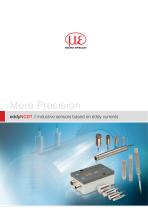
The new eddyNCDT 3001 is a cost-effective eddy current sensor with housing that has to date only been reserved for inductive sensors and proximity sensors. This compact sensor comes with integrated elec-tronics including temperature compensation, offering an excellent price/performance ratio, as well as easy operation. The high meas-urement accuracy and linearity as well as the high frequency response rate of 5 kHz are outstanding characteristics compared to other sensors in the same price class. The sensors are factory-calibrated for ferromagnetic and non-ferromagnetic metals in the measuring range of 4 mm. The sensors are protected to IP67. As the sensors are easy to use and cost-effective, they are particularly suitable for standard production in OEM applications. The new DT3001series opens up new application fields for the Micro-Epsilon product range based on the eddy current principle.
Eddy current sensors from Micro-Epsilon measure displacement, distance, position, oscillations, vibrations, etc. Non-contact eddy current sensors offer extremely precise measurements where sub-micron ac-curacy is required. Modifications to the standard eddy current sensors are often required, particularly for mid-size and large series. What can be modified? Sensors can be adapted in many different ways to suit customer-specific applications. e.g. changes to the cable, sensor material and design, and to the controller. Customized sensors can be produced efficiently, which results in considerable cost reductions.
VIDEO
Catalogs

Exhibitions
Meet this supplier at the following exhibition(s):


Other MICRO-EPSILON products
Eddy current sensors for displacement, distance & position


Related Searches
- Measuring machine
- MICRO-EPSILON displacement sensor
- MICRO-EPSILON linear displacement sensor
- Automatic measuring machine
- Optical measuring machine
- Distance sensor
- High-precision measuring machine
- Measuring system for industrial applications
- MICRO-EPSILON analog displacement sensor
- Parts measuring machine
- MICRO-EPSILON non-contact displacement sensor
- MICRO-EPSILON industrial displacement sensor
- Non-contact measuring machine
- Control measuring machine
- Diameter measuring machine
- Laser measurement system
- MICRO-EPSILON precision displacement sensor
- MICRO-EPSILON metal displacement sensor
- Magnetic speed sensor
- Rotational speed sensor
*Prices are pre-tax. They exclude delivery charges and customs duties and do not include additional charges for installation or activation options. Prices are indicative only and may vary by country, with changes to the cost of raw materials and exchange rates.
About DirectIndustry
DirectIndustry is a marketplace that offers B2B players a complete experience, from product sourcing to purchase. DirectIndustry is an entity of VirtualExpo Group.
Are you a buyer?
Are you a supplier?