


Gas nitriding ZeroFlowautomotivefor gearsfor metal fabrication

Add to favorites
Compare this product
Characteristics
- Type
- gas
- Applications
- automotive, for gears, for metal fabrication, for shaft, industrial
- Production method
- large series
Description
Overview
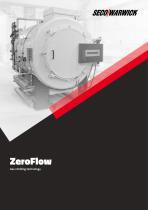
ZeroFlow is a modern, energy‑saving gas nitriding technology for VR (horizontal) and PVR (pit/vertical) retort furnaces. It enables precise control of the nitrided layer composition while minimizing ammonia and process gas consumption, reducing cycle time, energy use and emissions. The system is built for mass production and integration into automated process lines.
Key concept
ZeroFlow operates with a tightly closed retort and forces internal atmosphere circulation. During phases when the load does not absorb nitrogen (e.g. KN reduction or diffusion phases) ammonia flow is stopped (zero flow). Forced circulation and controlled atmosphere maintain process uniformity and repeatability.
Advantages
Benefits compared to traditional nitriding
Processes and versatility
ZeroFlow furnaces support gas nitriding, nitrocarburizing (FNC), post‑oxidation, tempering, annealing and other heat‑treatment processes. Available in horizontal (VR) and pit/vertical (PVR) retort layouts with options for nitrocarburizing and post‑oxidation equipment.
Typical industries / applications
Process description / Technology
Nitriding is executed in a tightly closed retort with forced atmosphere circulation. Temperature and nitrogen potential (KN) are controlled by measuring hydrogen content in the retort; ammonia dosing is managed by a mass flow valve under PID control from the PLC to maintain set KN. Exhaust atmosphere is treated via neutralizing equipment (e.g. thermal oxidizer) to meet local emission requirements. Units include internal atmosphere mixer and cooling gas blower to accelerate load cooling. Systems support full automation and integration for mass production.
Technical specifications
ZeroFlow is a modern, energy‑saving gas nitriding technology for VR (horizontal) and PVR (pit/vertical) retort furnaces. It enables precise control of the nitrided layer composition while minimizing ammonia and process gas consumption, reducing cycle time, energy use and emissions. The system is built for mass production and integration into automated process lines.
Key concept
ZeroFlow operates with a tightly closed retort and forces internal atmosphere circulation. During phases when the load does not absorb nitrogen (e.g. KN reduction or diffusion phases) ammonia flow is stopped (zero flow). Forced circulation and controlled atmosphere maintain process uniformity and repeatability.
Advantages
- Precise shaping of nitrided layer composition
- High process efficiency and throughput
- Consistent quality and repeatability
- Reduced environmental impact and minimal emissions
- Reliable automatic operation and straightforward recipe setup
- Direct atmosphere control inside the retort
- Accurate temperature control and uniformity (≈±3°C)
- PLC + IPC (Siemens) control, full automation and visualization
- Data archiving, reporting, preventive maintenance and remote diagnostics
- Compact design for integration into automated lines
Benefits compared to traditional nitriding
- Minimal ammonia consumption (ammonia introduced only to supply required nitrogen to parts)
- Possible use of pure ammonia without dilution
- Vacuum purging replaces continuous gas purging, reducing inert/process gas use
- Direct measurement and control of atmosphere composition inside the retort for dynamic process control
- Optional internal dissociator (IAD) for precision without energy losses
- Operational cost and process gas usage significantly reduced (ammonia up to ~10× lower vs traditional)
- Process simulator: ZeroFlow Feedback Control
Processes and versatility
ZeroFlow furnaces support gas nitriding, nitrocarburizing (FNC), post‑oxidation, tempering, annealing and other heat‑treatment processes. Available in horizontal (VR) and pit/vertical (PVR) retort layouts with options for nitrocarburizing and post‑oxidation equipment.
Typical industries / applications
- Automotive: brake discs, gears, pinions, shafts, hydraulic pump parts, crankshafts, camshafts, valve springs, piston rings/pins
- General machinery: bushings, pins, shafts, rings, cylinders
- Tooling: cutting tools, forging dies, extrusion dies, die inserts, screws for injection molding, mold parts, press tools
Process description / Technology
Nitriding is executed in a tightly closed retort with forced atmosphere circulation. Temperature and nitrogen potential (KN) are controlled by measuring hydrogen content in the retort; ammonia dosing is managed by a mass flow valve under PID control from the PLC to maintain set KN. Exhaust atmosphere is treated via neutralizing equipment (e.g. thermal oxidizer) to meet local emission requirements. Units include internal atmosphere mixer and cooling gas blower to accelerate load cooling. Systems support full automation and integration for mass production.
Technical specifications
- Commercial name / model: ZeroFlow
- Furnace types: Retort nitriding furnaces — horizontal (VR) and pit/vertical (PVR)
- Retort operation: tightly closed retort with forced atmosphere circulation
- Purging method: vacuum purging (reduces inert/process gas use)
- Atmosphere control: direct hydrogen measurement in retort, KN control via PLC with PID ammonia dosing
- Internal components: atmosphere mixer, cooling gas blower, optional internal dissociator (IAD)
- Control system: PLC + IPC (Siemens), full automation and visualization
- Temperature uniformity: approx. ±3°C
- Process range (nitriding): typically 450–600°C
- Standards compliance: AMS‑2750, AMS‑2759, CQI‑9
- Operational benefits: up to ~10× reduction in ammonia consumption vs traditional processes, lower energy use, lower emissions
- Supported processes: gas nitriding, nitrocarburizing (FNC), post‑oxidation, tempering, annealing
- Options: nitrocarburizing and post‑oxidation installations, automation line compatibility
- Environmental: exhaust atmosphere treated through neutralizing equipment (e.g. thermal oxidizer)
Exhibitions
Meet this supplier at the following exhibition(s):
ICI 2026 TECHNICAL CONFERENCE AND EXPO
25-28 Oct 2026 Grand Rapids (USA - Michigan) Stand 315
More information
Other SECO/WARWICK products
Vacuum heat treatment


*Prices are pre-tax. They exclude delivery charges and customs duties and do not include additional charges for installation or activation options. Prices are indicative only and may vary by country, with changes to the cost of raw materials and exchange rates.
About DirectIndustry
DirectIndustry is a marketplace that offers B2B players a complete experience, from product sourcing to purchase. DirectIndustry is an entity of VirtualExpo Group.
Are you a buyer?
Are you a supplier?