


Automatic hardening machine 4D QUENCH

Add to favorites
Compare this product
Characteristics
- Options
- automatic
Description
Overview
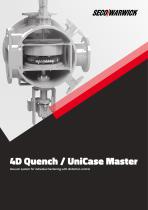
4D QUENCH is a vacuum heat-treatment system for individual quenching of components (gears, shafts, bearing races, rings, sleeves, etc.) made from carburizing or through-hardening steels. The system combines vacuum heating with high-pressure nitrogen quenching to limit oxidation and metallurgical alteration while providing precise distortion control, repeatable results and full part-level traceability. It is suitable for integration into in-line production and automated manufacturing cells.
Features
Advantages
Parts (typical applications)
Technologies
Industries
Materials
Technical specifications
4D QUENCH is a vacuum heat-treatment system for individual quenching of components (gears, shafts, bearing races, rings, sleeves, etc.) made from carburizing or through-hardening steels. The system combines vacuum heating with high-pressure nitrogen quenching to limit oxidation and metallurgical alteration while providing precise distortion control, repeatable results and full part-level traceability. It is suitable for integration into in-line production and automated manufacturing cells.
Features
- Individual part hardening by vacuum heating and high-pressure nitrogen quench
- Integration with CNC cells and in-line production
- Capacity scalable up to ~1,000,000 pieces/year depending on configuration
- Adaptable working zone dimensions
- Customizable system configuration
- Compact footprint with low utility consumption
- 4D quenching using adjustable quench nozzles and rotating table
- High-pressure nitrogen as quench medium (oil- and helium-free)
Advantages
- Control and reduction of quench-induced distortion
- High precision and repeatability of heat-treatment results
- Elimination of intergranular oxidation/attack (IGO/IGA)
- No surface oxidation during heating due to vacuum environment
- Improved surface quality compared with conventional oil quench
- Designed for high-volume and continuous production
- Operational flexibility with on-demand start/stop
- Fully automated process with part-level monitoring and 100% traceability
- Removes need for oil, helium, copper masking or stop-off paints
- Reduces fixtures, material logistics and manual handling
- Eliminates oil vapor, washer chemicals and fire/radiation risks
Parts (typical applications)
- Mechanical transmission components: gears, rings, shafts, sleeves, bearing races
Technologies
- Bright hardening by high-pressure gas quench (4D quench)
Industries
- Automotive
- Transmission
- Bearing manufacturing
- General machinery
- Aerospace
Materials
- Carburizing grades and standard through-hardening steels traditionally quenched in oil
- Higher-alloy and special steels suitable for gas quenching
Technical specifications
- System composed of a vacuum heating chamber and a high-pressure nitrogen quench chamber with part transfer mechanisms
- Vacuum heating protects part surfaces from oxidation and unwanted metallurgical changes
- Proprietary arrangement of cooling nozzles provides uniform cooling from all sides (3D cooling)
- Rotating table adds the fourth dimension to enhance quench uniformity (4D quench)
- Adjustable nozzle pattern to match part size and geometry
- Nitrogen quench delivers cooling comparable to oil with improved uniformity and repeatability
- No need for oil or helium quench media
- Single-piece flow enables integration with CNC and in-line manufacturing
- Eliminates many heat-treatment fixtures and reduces material logistics and cycle time
- Reduces hard machining time and associated costs
- Full automation with part-level monitoring and 100% traceability
- Compact design with low utility consumption and footprint
- Customizable configuration and adaptable working zone
- Configured for high-volume production (up to ~1,000,000 pieces/year depending on setup)
Exhibitions
Meet this supplier at the following exhibition(s):
Other SECO/WARWICK products
Vacuum heat treatment


Related Searches
- SECO WARWICK oven
- SECO WARWICK chamber oven
- SECO WARWICK electric oven
- SECO WARWICK heat treatment oven
- Drying furnace
- SECO WARWICK laboratory oven
- SECO WARWICK combustion oven
- SECO WARWICK gas oven
- SECO WARWICK tunnel oven
- SECO WARWICK industrial oven
- Baking oven
- SECO WARWICK controlled atmosphere oven
- SECO WARWICK vacuum oven
- SECO WARWICK high-temperature oven
- SECO WARWICK automatic oven
- Digital furnace
- SECO WARWICK programmable oven
- SECO WARWICK forced convection oven
- SECO WARWICK annealing oven
- SECO WARWICK continuous oven
*Prices are pre-tax. They exclude delivery charges and customs duties and do not include additional charges for installation or activation options. Prices are indicative only and may vary by country, with changes to the cost of raw materials and exchange rates.
About DirectIndustry
DirectIndustry is a marketplace that offers B2B players a complete experience, from product sourcing to purchase. DirectIndustry is an entity of VirtualExpo Group.
Are you a buyer?
Are you a supplier?