

- Detection - Measurement
- Optical and Acoustic Measurements
- Micromechanical vibration sensor
- Shenzhen Ruicom Technology Co., Ltd.


- Company
- Products
- Catalogs
- News & Trends
- Exhibitions
Digital vibration sensor GKM3MEMScapacitivemicromechanical


Add to favorites
Compare this product
Characteristics
- Technology
- MEMS, capacitive, micromechanical
- Applications
- for machine monitoring, for railway applications, for automotive applications, for wind turbine
- Other characteristics
- robust, high-precision, 3-axis, waterproof, with temperature sensor, digital
- Frequency
Max.: 1,000 Hz
Min.: 0 Hz
Description
Product introduction
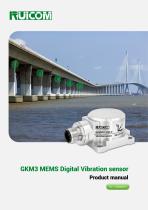
The GKM3 is a triaxial MEMS digital vibration (accelerometer) sensor designed for vibration and shock testing, multi‑point synchronous measurement and centralized data acquisition. It provides selectable digital outputs (RS232 / RS485 / TTL) and supports long‑distance daisy‑chain connection of multiple sensors via address coding. Core elements include a single‑crystal silicon capacitive sensing chip, a low‑power ASIC signal conditioner, a microprocessor storing compensation data and an integrated temperature sensor. The unit is factory calibrated for long‑term scale factor stability and includes solid‑state power reset and overcurrent protection for reliable operation.
Performance parameters (summary)
Applications & installation notes
The GKM3 is a triaxial MEMS digital vibration (accelerometer) sensor designed for vibration and shock testing, multi‑point synchronous measurement and centralized data acquisition. It provides selectable digital outputs (RS232 / RS485 / TTL) and supports long‑distance daisy‑chain connection of multiple sensors via address coding. Core elements include a single‑crystal silicon capacitive sensing chip, a low‑power ASIC signal conditioner, a microprocessor storing compensation data and an integrated temperature sensor. The unit is factory calibrated for long‑term scale factor stability and includes solid‑state power reset and overcurrent protection for reliable operation.
Performance parameters (summary)
- Model: GKM3
- Measurement axes: X, Y, Z (triaxial)
- Bias calibration:
- Upward / power‑off repeatability:
- Bias temperature coefficient: 0.01 %/°C (typical)
- Resolution / threshold (@1 Hz):
- Nonlinearity:
- Bandwidth (3 dB): 500 Hz (typical)
- Noise density: down to 21 μg/√Hz (lower ranges) — up to 86.6 μg/√Hz (higher ranges)
- Resonant frequency: ≈2.4 kHz (low ranges) / ≈5.5 kHz (high ranges)
- Automatic serial output rates: 5 / 10 / 25 / 50 / 100 / 200 / 500 / 1000 Hz; MODBUS: 10 / 25 / 50 Hz
- Protection class: IP67
- Materials & dimensions: aluminum alloy enclosure; magnetic base carbon steel + magnet; sensor L36 × W32 × H24 mm; magnetic base L36 × W32 × H8.1 mm
- Weight: sensor net ≤ 68 g; magnetic base ≤ 50 g
- Connector / cable: MI2*1.0 or 5‑pin aviation plug; 2 m shielded PVC cable
- Operating note: avoid continuous operation beyond specified measurement ranges
Applications & installation notes
- Recommended for vibration testing, shock tests, structural monitoring, modal analysis and rotating‑machine diagnostics
- Mounting options: magnetic base for temporary attachment or mechanical fastening for permanent installation
- Verify selected measurement range and output rate to match test requirements; configure address codes for multi‑sensor setups
- Observe supply voltage range (9–36 VDC) and connector mating instructions; consult manufacturer for calibration or extended environmental qualification
VIDEO
Other Shenzhen Ruicom Technology Co., Ltd. products
Vibration Sensor


Related Searches
- Vibration sensor
- Machine monitoring vibration sensor
- Robust vibration sensor
- High-precision vibration sensor
- MEMS vibration sensor
- Preventive maintenance vibration sensor
- 3-axis vibration sensor
- Waterproof vibration sensor
- Vibration sensor with temperature measurement
- Vibration sensor for railway applications
- Motor vibration sensor
- Process monitoring vibration sensor
- Pump vibration sensor
- Vibration sensor for automotive applications
- Wind turbine vibration sensor
- Vibration meter vibration sensor
- Vibration sensor with temperature sensor
- Digital vibration sensor
- Mechanical vibration sensor
- Capacitive vibration sensor
*Prices are pre-tax. They exclude delivery charges and customs duties and do not include additional charges for installation or activation options. Prices are indicative only and may vary by country, with changes to the cost of raw materials and exchange rates.
About DirectIndustry
DirectIndustry is a marketplace that offers B2B players a complete experience, from product sourcing to purchase. DirectIndustry is an entity of VirtualExpo Group.
Are you a buyer?
Are you a supplier?
© 2026 All rights reserved - Terms - Privacy policy - General Terms - Manage cookies - 鄂ICP备2026053537号-2 -  鄂公网安备42018502009509号 -