



- Metrology - Laboratory
- Metrology and Test Equipment
- Electrodynamic shaker
- STEP Engineering S.r.l.
Electrodynamic shaker HUD


Add to favorites
Compare this product
Description
Overview
STEP Lab electrodynamic Hardware-in-the-Loop (HIL) test systems (HUD series) provide real-time integration between virtual vehicle models and physical controllers/ECUs. Designed for automotive validation, these high-dynamic test rigs support both full-vehicle 4-poster applications and component-level HIL testing to reproduce real road profiles and driving conditions.
Key capabilities
Features
Strategic collaboration
STEP Lab maintains a strategic partnership with VI-grade to deliver pre-integrated HIL solutions for shock absorbers and suspension systems, including support for active and semi-active control strategies. The collaboration simplifies integration with AutoHawk and related tools.
Typical applications
Technical specifications (extract)
STEP Lab electrodynamic Hardware-in-the-Loop (HIL) test systems (HUD series) provide real-time integration between virtual vehicle models and physical controllers/ECUs. Designed for automotive validation, these high-dynamic test rigs support both full-vehicle 4-poster applications and component-level HIL testing to reproduce real road profiles and driving conditions.
Key capabilities
- Real-time linkage of virtual vehicle models with physical controllers, ECUs and software.
- Support for a wide variety of dynamic loads, frequencies and speed ranges.
- Low-latency communication and multi-protocol interface options (CAN, FlexRay, Ethernet, others).
- Connection to real-time target computers (STEP Lab or third-party solutions).
- Compatibility with third-party HIL platforms and hardware.
- Ability to test complete vehicles on 4-poster rigs using virtual tyres, wheels and body with real shock absorbers.
- Test Manager controller adaptable to different test sequences and automation needs.
Features
- Electrodynamic actuators and servomechanisms optimized for HIL dynamics.
- Deterministic real-time data exchange and logging.
- Multi-protocol support to interface with widespread automotive tools and ECUs.
- Modular architecture for integration with STEP Lab machines and third-party benches.
- Configurable measurement channels and online monitoring for test validation.
Strategic collaboration
STEP Lab maintains a strategic partnership with VI-grade to deliver pre-integrated HIL solutions for shock absorbers and suspension systems, including support for active and semi-active control strategies. The collaboration simplifies integration with AutoHawk and related tools.
Typical applications
- HIL testing of shock absorbers and suspension subsystems.
- Validation of active and semi-active suspension control strategies.
- Full-vehicle HIL validation using 4-poster rigs with virtualized subsystems.
- Integration testing between vehicle models, real ECUs and test-bench hardware.
Technical specifications (extract)
- Support for tests across a broad range of loads and dynamic conditions.
- Real-time interaction between virtual models and physical controllers/software.
- Support for multiple communication protocols and low-latency data paths.
- Connection to real-time target computers (STEP Lab or third-party).
- Compatibility with hardware such as AutoHawk (VI-Grade), dSPACE, Speedgoat (MathWorks), National Instruments.
- Capability for complete vehicle testing on 4-poster rigs (virtual tyres/wheels/body; real shock absorbers).
- Test Manager controller configurable for rapid, repeatable and traceable test execution.
VIDEO
Catalogs

Other STEP Engineering S.r.l. products
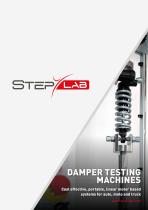
Damper Test Systems


Related Searches
- Test machine
- Test cabinet
- Test stand
- Temperature test cabinet
- Material testing machine
- Automatic test machine
- Climatic test chamber
- PC-controllable testing machine
- Humidity test cabinet
- Environmental test cabinet
- Compression test machine
- Industrial test machine
- Automatic test stand
- Tensile test machine
- Laboratory test machine
- Flexure testing machine
- Test chamber with window
- Research and development test machine
- Low-temperature test chamber
- Electromechanical test machine
*Prices are pre-tax. They exclude delivery charges and customs duties and do not include additional charges for installation or activation options. Prices are indicative only and may vary by country, with changes to the cost of raw materials and exchange rates.